
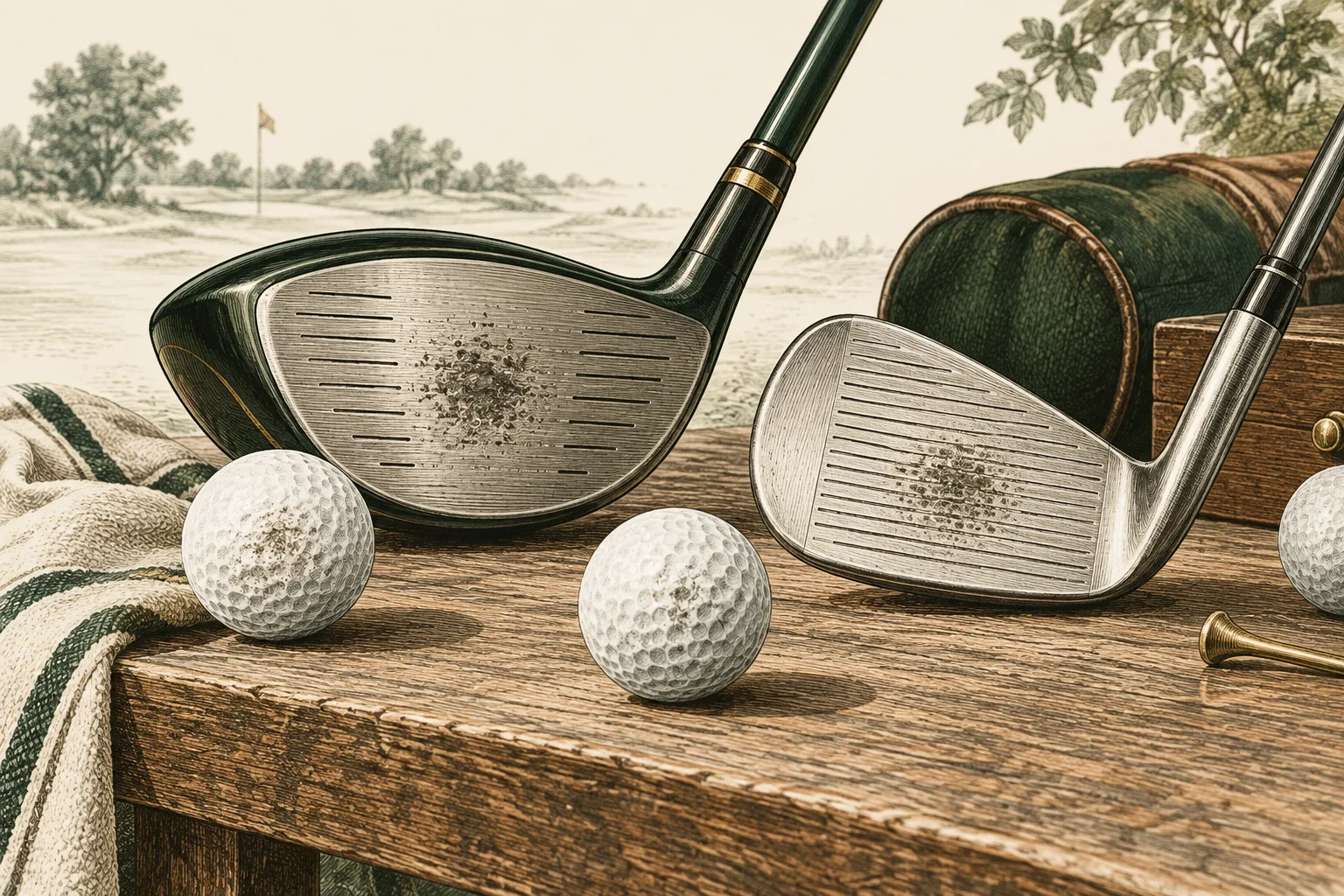
Open the Records tab and scroll to Purest Strike. Your driver row says 1.49×. Your pitching wedge row says 1.22×. The instinct — everybody's instinct — is to read that as one good club and one bad one. It isn't. Those two numbers are the same achievement: each is the best strike that club is physically capable of producing. The wedge isn't losing to the driver. It was never in the race.
If you've never met smash factor, start with Ball Speed, Club Speed, and Smash Factor — it covers what the ratio is and where you should land with a driver. This piece is the part that essay only touches: every club has a different ceiling, and that changes how the number should be read, what you practice, and how this app keeps the record.
Loft doesn't waste your speed. It spends it.
Smash factor is ball speed divided by club speed — it looks like a pure efficiency score, how much of your swing made it into the ball. Within one club, that's exactly what it is. Across clubs it's something else, because loft changes what "into the ball" means.
The energy of the collision has three places to go: forward speed, backspin, and vertical launch. Loft is the dial that sets the split. A driver at 10.5° sends nearly everything forward. A 56° wedge routes a huge share of it into rotation — our working envelopes put a full 7-iron around 6,000–7,500 rpm and a 56° wedge at 8,000–11,000. That spin isn't waste. It's the whole reason a wedge stops on a green instead of skidding into the back bunker. But it is paid for out of the same swing, and it comes off the top of your ball speed.
So every club has its own ceiling, and the ceilings sit far apart. The bands this app recognizes: a driver tops out around 1.48–1.52, mid irons around 1.35–1.40, wedges around 1.10–1.25. A wedge at 1.22 is at the top of its class. A wedge at 1.45 isn't a triumph — it means you delivered that wedge with a big chunk of its loft taken off, and you'll find out about it when the ball won't hold a green.
The driver's ceiling is written into the Rules of Golf
Here's the part most golfers don't know: the driver's ceiling isn't only physics. It's legislation.
Under Appendix II, 4c of the Rules of Golf, a clubface may not be too springy. The test is characteristic time: a pendulum strikes the face and the governing bodies measure how long the contact lasts. The limit is 239 microseconds, plus an 18-microsecond test tolerance. It replaced an older test that measured coefficient of restitution directly — the 0.830 figure you may have heard. Every conforming driver on every shelf is built right up to that line and not past it.
That's why the driver band tops out where it does. It's a legal ceiling, not a talent ceiling, and there is no equipment left to buy your way past it.
It's also why this app refuses certain numbers outright. The record builder throws out any shot reading above 1.52 smash, or any shot whose ball speed exceeds club speed × 1.53. That isn't the app doubting you — it's the app refusing to print a number a launch monitor could not physically have produced. A venue-branded record built on a bad sensor read is worse than no record at all.
Why there's no "purest strike in the bag" trophy
There used to be. One tile, every qualifying shot, sorted by smash factor, no club in the key. It looked fine — right until you had a second club in the bag.
Then it broke, permanently. A driver's rules-capped ceiling near 1.50 outranks a flawless wedge at 1.24 forever. You could strike a lob wedge better than you have struck anything in your life and the board would file it below a mediocre drive. Worse, the artifact guard is calibrated on the driver, so a physically impossible 1.45 wedge would sail through the gate and sit on top of your own leaderboard.
So the record was rekeyed per club — one Purest Strike for the driver, one for the 7-iron, one for the pitching wedge — listed in bag order and never sorted by value, because sorting by value is exactly how the old bug got in. The house rule underneath is blunt: never rank or compare smash across clubs. Only within one.
Reading your own row
Each row is judged against its own band and nothing else. Driver at 1.49, inside 1.48–1.52 — that's a flush one, sitting at the ceiling. Seven-iron at 1.36, inside 1.35–1.40 — same. Pitching wedge at 1.22, inside 1.10–1.25 — same again. Three perfect strikes, three completely different numbers, and no way to rank them against each other that means anything.
Now the honest part. For a lot of clubs we draw no band at all. Woods, hybrids, long irons and short irons have no ruled band in this system, so those rows say so instead of inventing one. A made-up band is worse than a blank, because you would practice against it. Your 3-wood at 1.45 is a real record on a real shot — there just isn't a line drawn for it yet, and we would rather tell you that than guess.
One more gate: a club needs at least 5 smash reads before it gets a Purest Strike row at all. One lucky flush isn't a record. It's a coincidence with good timing.
No markers, no smash — and the honest fallback
Smash needs club speed, and club speed is the one number a launch monitor can't read off the ball. It has to see the club itself, which means the free Foresight markers. Without them there is no club speed, so there is no smash — not a low one, none at all. In our own capture the FSX files come back missing club speed about 94% of the time, and GSPro-proxy shots carry no club data whatsoever.
When smash is missing, the app falls back to ranking your shots on that club by ball speed alone: same club, faster ball, probably a better strike. It's an honest second-best and it's labeled as one, because it quietly conflates "swung harder" with "struck better." If you want the real number, the stickers are free at the front desk and take about a minute per club.
The bay drill: the ladder, not the ten
The other essay hands you the ten-driver median, and you should do that one. This is the other drill — the one that finds the club actually costing you shots.
Three clubs, one session: driver, mid-iron, wedge. Five swings each, rotating — driver, iron, wedge, driver, iron, wedge — never five in a row, because five in a row builds a rhythm you will not have on the eighth tee. Write down the best smash on each club.
Then don't compare them to each other. Compare each one to its own band. Driver short of 1.48, mid-iron short of 1.35, wedge under 1.10 — whichever club sits furthest below its own band is the club to spend the next hour on. Most people expect that to be the driver. It usually isn't. It's the mid-iron at 1.28, quietly costing close to a full club of distance and every green it can't hold. That's a diagnosis worth an hour with Pat, and it's the kind of thing a monitor shows you in five swings that a grass range will hide for a season.
Two rows on one board, 1.49 and 1.22. Both perfect. Now you know why.
Related reading: Ball Speed, Club Speed, and Smash Factor · Club Speed: the ceiling on distance, and why most of your swings don't show one

The Most Forgiving Drivers of the 2010s, Ranked by the Data
From roughly 2014 to 2019, every major manufacturer spent its entire driver budget chasing one number: MOI — how much the head resists twisting when you miss the middle. Carbon crowns, tungsten back weights, faces engineered to fight your specific mishit. Those flagships were the most forgiving drivers ever built to that point, and forgiveness does not expire. Your heel strike in 2026 is the same heel strike it was in 2018, and a head that held ball speed on it then holds ball speed on it now.