
There is exactly one number on your bay screen you could check with your own eyes. Ball speed, smash and spin are invisible physics you have to trust the launch monitor about. Apex is just how high the ball got, and you have been watching that since the first time you squinted into the sun off a tee box and said either "ooh" or "oh no."
And almost nobody looks at it. Ball speed gets the applause, carry gets the argument, and apex sits quietly in the corner holding the answer to the question that actually decides golf shots: when this ball lands, is it going to stop, or is it going to keep going?
Let's give it its due. If you have never looked at the launch and spin numbers that produce it, read Launch and Spin: the Flight Recipe first — this piece is what those two numbers add up to.
What a number like 118 feet actually looks like
Height is the one flight number this app prints in feet instead of yards, on every screen, without exception. Yards are for how far it went. Feet are for how high. Mixing the two is how a perfectly enormous shot ends up sounding modest, and how two screens end up disagreeing about the same ball.
So calibrate yourself once and you will never need to again. Count a storey as 10 feet — that is the conversion this app uses everywhere, and it is close enough for real buildings. A flagstick runs about seven feet, which makes a handy second yardstick.
An apex of 118 feet is therefore about a 12-storey building. It is roughly seventeen flagsticks stacked end to end. That is a ball that spent real time up where the wind lives.
Hold that picture, because the next number tends to knock people over.
Tour players hit everything to about the same height
Here is TrackMan's PGA Tour average set, converted to feet. Driver peaks around 105. Seven-iron, about 102. Eight-iron, about 99. Pitching wedge, about 96. Three-iron, about 90.
That is the entire bag inside roughly 15 feet, and TrackMan states the headline plainly: a tour driver and a tour pitching wedge peak within about nine feet of each other.
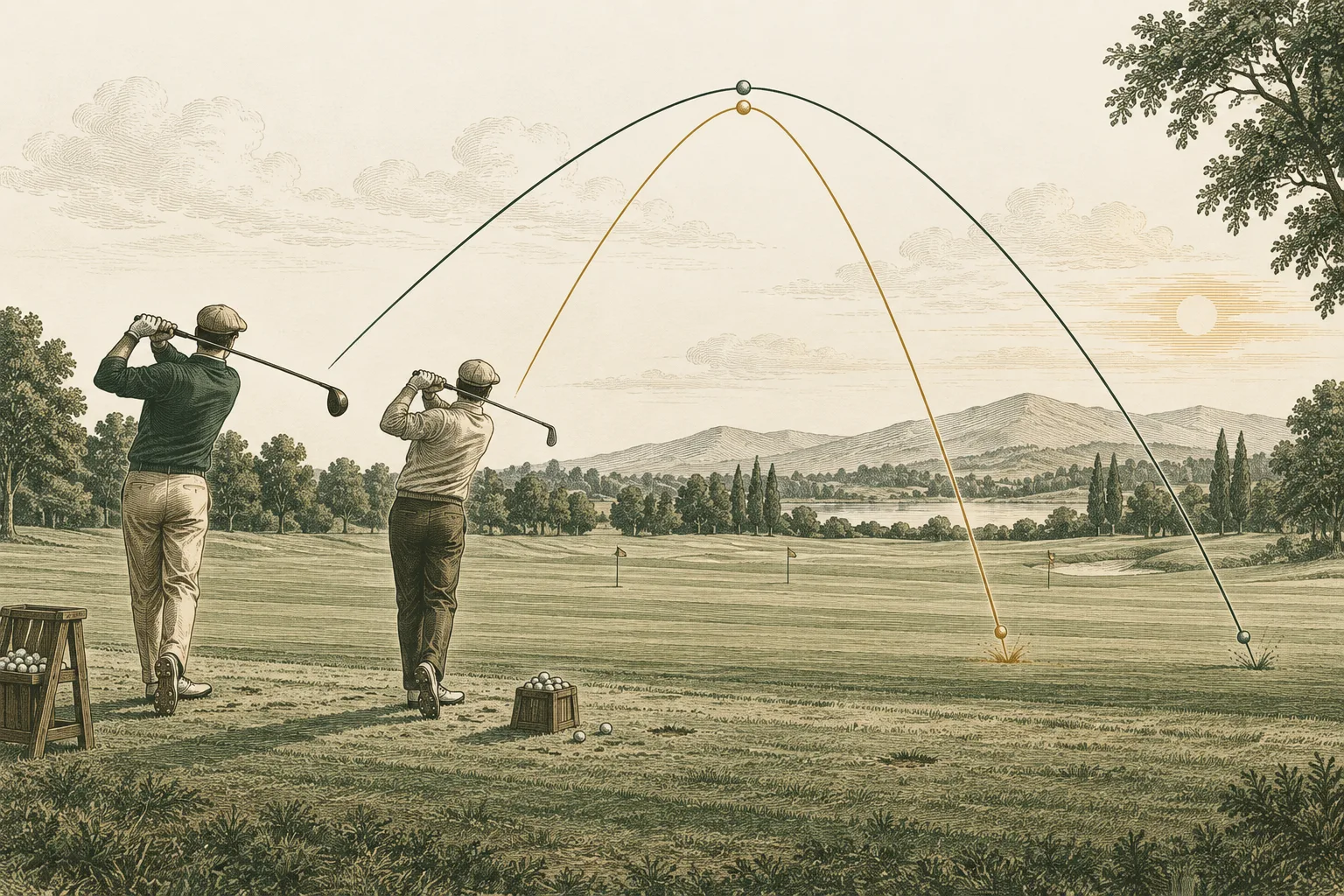
This offends every instinct you have. A wedge feels like it goes straight up; a driver feels like it stays down. But they arrive at nearly the same ceiling by completely opposite routes. The driver carries enormous ball speed and very little spin — roughly 1,800 to 3,200 rpm — so it climbs gently for a long time and peaks late and far away. The wedge has modest ball speed and enormous spin — 8,000 to 11,000 rpm on a 56-degree — so it leaps, tops out early, and is already falling while the driver is still going up.
Same height. Completely different flights. Which brings us to the part most golf writing gets wrong.
Height is not the same thing as stopping power
Read that same tour chart one column to the right, at the landing angle.
The driver peaks around 105 feet and lands at 39 degrees. The eight-iron peaks around 99 feet and lands at 51 degrees. Nearly identical apex. Twelve degrees apart on the way down. One of them bounces and runs; the other takes a hop and sits.
What stops a golf ball is descent angle, not height. Steeper than about 45 degrees into a green and the ball generally holds; shallower and it releases through the back. Height is one ingredient in a steep descent — the other is how much forward speed is left at the top, and that is precisely where the driver and the wedge part company.
So here is the honest part, because we would rather say it than let a good-looking number imply something it has not earned. Your Apex record tells you how high your best ball flew. It does not tell you that ball would have held a green. A launch monitor can read descent angle, and there is a column for it — but it is not carried onto your records today, so when your plate says 118 feet, read that as a height record and nothing more. Height is a strong hint. It is not the receipt.
When more height costs you distance
Now the bad news about going high.
A driver that peaks too high is nearly always a driver spinning too much. It leaves fine, then climbs like it caught an escalator, stalls out, and drops almost vertically well short of what your ball speed promised. That is ballooning, and it is not a power problem — it is a recipe problem. Into a headwind it gets worse, because wind multiplies whatever spin you gave it.
The tell is easy. If your driver is peaking as high as your eight-iron and carrying less than your ball speed says it should, spin is the thief, and swinging harder will only buy more of it.
Irons have their own version of the same trade, and your own board will show it to you. Say the best eight-iron carry on your board is 162 yards — peaking at 104 feet, launched at 19.8 degrees with 6,900 rpm. Then look at the highest eight-iron you ever hit: 118 feet, off 22.4 degrees of launch and 7,260 rpm, carrying 152 yards.
Two and a half degrees more launch. A few hundred more rpm. Fourteen feet higher — and ten yards shorter. That is the entire trade in one pair of shots. Height you did not ask for is distance you already paid for.
Why the Apex record is an any-club record
Your Apex Height record is the highest ball you have ever hit with anything in the bag, and it is very often won by a short iron or a wedge rather than the driver. Those clubs deliver the most loft and the most spin, and one slightly high, slightly spinny strike will out-climb a genuinely good drive.
In a typical board, every driver shot sits somewhere between 84 and 108 feet, and a single eight-iron at 118 feet beats the lot. That is not a flaw in the record. That is the record being honest about what "highest" means.
Which is why it deserves a little skepticism about yourself. A tour eight-iron averages about 99 feet. If yours peaked at 118, you did not out-flight a tour player — you hit one unusually high eight-iron, and unusually high with an iron usually means slightly short.
What to do about it in a bay
Book an hour and run this. Hit ten shots with one iron and watch the apex column instead of the distance column. A tight apex spread means you are finding the middle of the face. A shot fifteen feet below the pack is a thin one. A shot well above it is usually high on the face with the spin falling off — which is a strike story the distance number alone will never tell you.
Then hit ten drivers. If apex runs high and carry runs short, tee it higher and hit up on it; attack angle is the cheapest spin reduction in golf. If apex stays high after that, the fix is not in your swing — it is in the loft, the shaft, or the ball, and that is a fitting conversation. Come see Pat, put the numbers on the screen, and change one variable at a time.
Height is not a score. It is a diagnosis. Learn to read it and your bag will start telling you the truth about itself.
From the glossary
Related reading: Launch and Spin: the Flight Recipe · Your Longest Drive: where the ball finished, and why

The Most Forgiving Drivers of the 2010s, Ranked by the Data
From roughly 2014 to 2019, every major manufacturer spent its entire driver budget chasing one number: MOI — how much the head resists twisting when you miss the middle. Carbon crowns, tungsten back weights, faces engineered to fight your specific mishit. Those flagships were the most forgiving drivers ever built to that point, and forgiveness does not expire. Your heel strike in 2026 is the same heel strike it was in 2018, and a head that held ball speed on it then holds ball speed on it now.