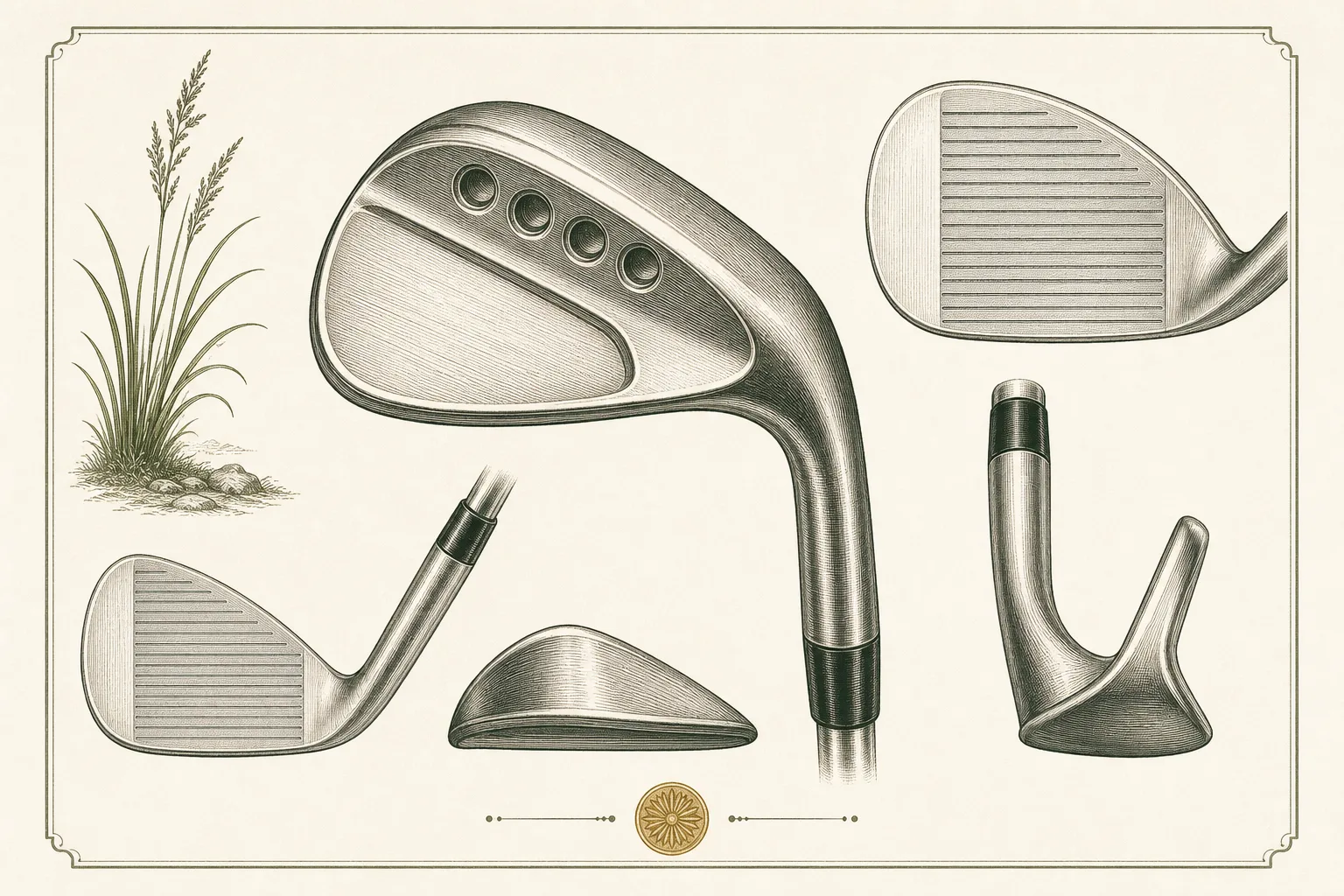
“Soft carbon-steel forging with mack-daddy-era grooves. Steel-dominant players' wedge; a feel keep.”
Released in 2010, the Callaway Forged Wedge was Roger Cleveland's first wedge built entirely to the USGA's new groove-condition rule, which banned the sharp square grooves that had dominated the prior decade. Callaway's answer was Triple Net Forging, a process precise enough to pack 21 grooves tightly across the face — right at the new sharpness limit — to claw back as much spin as the rules allowed. Soft-forged from carbon steel with a clean, minimalist tour shape (no sole graphics, no cavity gimmicks), it read as Cleveland stripping the design back to fundamentals after the flashier X-Tour and X-Forged lines. It served as Callaway's mainstream forged wedge until the Mack Daddy line took over the name in 2011–2012.
It carries no cult pricing or forum-hunt status, but period reviewers (Today's Golfer, The Sand Trap, MyGolfSpy's 'Ultimate Review' format) singled it out as an unusually clean, well-executed players' wedge — the kind of well-reviewed model that got quietly overshadowed within a year or two once Callaway's more heavily marketed Mack Daddy line took the spotlight.
Better players and low-to-mid handicaps who want soft forged feel, workability around the green, and conforming spin under the post-2010 groove rules. Not a fit for a high-handicapper who chunks or blades wedges regularly — a wide-sole, cavity-back game-improvement wedge will forgive far more.
Launched into a wedge market reset by the USGA's 2010 groove-condition-of-competition rule, which every manufacturer had to redesign around; Callaway, TaylorMade, Titleist (Vokey SM4), and Cleveland all released 'first legal groove' wedges within the same window. Callaway replaced it in the lineup with the Mack Daddy (2011) and Mack Daddy 2 (2012), which pushed groove volume back toward the rule's limit using a different 5V design.
A traditional forged, tour-shaped wedge with a compact head, minimal offset, and no perimeter-weighting or bounce-sole gimmick to bail out a mis-hit — it is built for feel and spin control, not for saving thin or heavy strikes. Firmly at the low end of the forgiveness scale, in line with other players'-shape forged wedges of its generation.
Calibrated across the whole catalog — a tour blade scores low here on purpose; it means control, not ease.
A single forged wedge with no collector interest; realistic 2026 private-party price is roughly $25–$45 depending on condition and grind, similar to other same-era Cleveland/Callaway forged wedges once their groove-rule novelty wears off.
Reading is one thing — hitting is another. Book a bay and see the numbers for yourself before you buy anywhere.
“Soft carbon-steel forging with mack-daddy-era grooves. Steel-dominant players' wedge; a feel keep.”
Released in 2010, the Callaway Forged Wedge was Roger Cleveland's first wedge built entirely to the USGA's new groove-condition rule, which banned the sharp square grooves that had dominated the prior decade. Callaway's answer was Triple Net Forging, a process precise enough to pack 21 grooves tightly across the face — right at the new sharpness limit — to claw back as much spin as the rules allowed. Soft-forged from carbon steel with a clean, minimalist tour shape (no sole graphics, no cavity gimmicks), it read as Cleveland stripping the design back to fundamentals after the flashier X-Tour and X-Forged lines. It served as Callaway's mainstream forged wedge until the Mack Daddy line took over the name in 2011–2012.
It carries no cult pricing or forum-hunt status, but period reviewers (Today's Golfer, The Sand Trap, MyGolfSpy's 'Ultimate Review' format) singled it out as an unusually clean, well-executed players' wedge — the kind of well-reviewed model that got quietly overshadowed within a year or two once Callaway's more heavily marketed Mack Daddy line took the spotlight.
Better players and low-to-mid handicaps who want soft forged feel, workability around the green, and conforming spin under the post-2010 groove rules. Not a fit for a high-handicapper who chunks or blades wedges regularly — a wide-sole, cavity-back game-improvement wedge will forgive far more.
Launched into a wedge market reset by the USGA's 2010 groove-condition-of-competition rule, which every manufacturer had to redesign around; Callaway, TaylorMade, Titleist (Vokey SM4), and Cleveland all released 'first legal groove' wedges within the same window. Callaway replaced it in the lineup with the Mack Daddy (2011) and Mack Daddy 2 (2012), which pushed groove volume back toward the rule's limit using a different 5V design.
A traditional forged, tour-shaped wedge with a compact head, minimal offset, and no perimeter-weighting or bounce-sole gimmick to bail out a mis-hit — it is built for feel and spin control, not for saving thin or heavy strikes. Firmly at the low end of the forgiveness scale, in line with other players'-shape forged wedges of its generation.
Calibrated across the whole catalog — a tour blade scores low here on purpose; it means control, not ease.
A single forged wedge with no collector interest; realistic 2026 private-party price is roughly $25–$45 depending on condition and grind, similar to other same-era Cleveland/Callaway forged wedges once their groove-rule novelty wears off.
Reading is one thing — hitting is another. Book a bay and see the numbers for yourself before you buy anywhere.