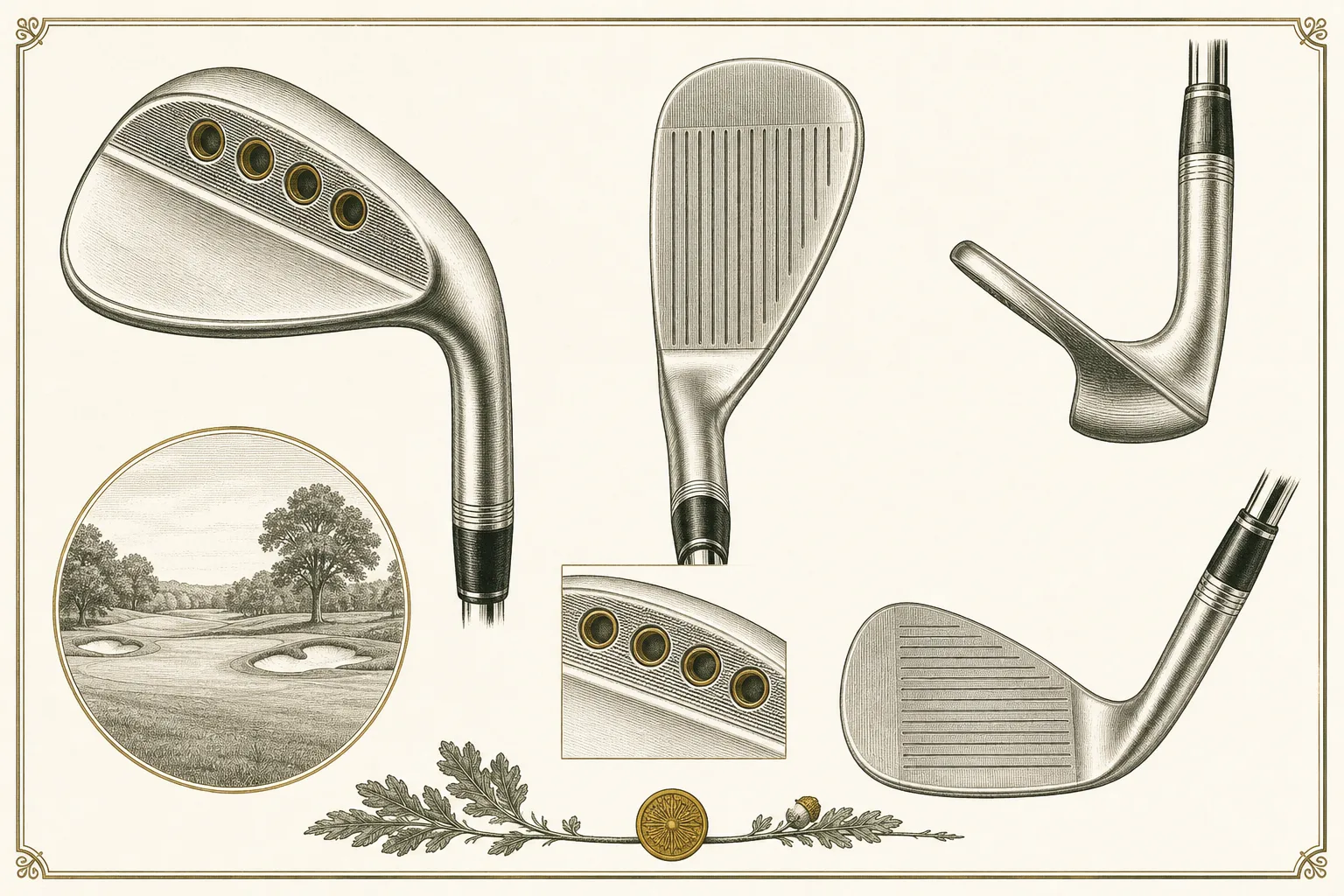
Launched at US retail in mid-July 2013, the Mack Daddy 2 was Callaway's first major Mack Daddy step-up: grooves 39% larger with sharper side walls than the 2011 original, plus a laser-etched Micro Groove face texture Callaway said added 25% more surface roughness that would fade predictably with wear. It offered three interchangeable sole grinds — a versatile C-Grind for heel/toe playability, a tight-radius U-Grind favored by and inspired by Phil Mickelson for steep, aggressive players, and a Standard grind splitting the difference — putting real grind choice in front of ordinary buyers rather than reserving it for Tour staff.
Widely and consistently reviewed well (GolfWRX, Golfalot, Today's Golfer, MyGolfSpy, The Sand Trap all covered it positively) and Tour-validated by staff including Phil Mickelson and Marc Warren at launch, but it functions as a strong mainstream generation in an ongoing product cycle rather than a club that developed its own independent mystique — it was itself superseded within about two years by the Mack Daddy 3.
Good for mid-to-low handicap players who want genuine grind choice (C/U/Standard) to match their attack angle and course conditions, and who value spin and feel over a forgiving shape. High-handicappers or those wanting a bail-out cavity-back wedge should look at Cleveland's contemporary CG/RTX cavity-back models instead.
Went head-to-head with Titleist's Vokey SM5 and Cleveland's CG15/RTX in the early-2010s players'-wedge market. It replaced the original 2011 Mack Daddy and was itself replaced by the Mack Daddy 3 (2015), continuing Callaway's roughly two-year wedge refresh cadence that carried through MD4 and into the JAWS branding.
A compact forged players' wedge; forgiveness here means groove/spin consistency rather than mis-hit distance retention. Reviewers found it 'undeniably softer at impact' with 'the most bite out of the rough' versus competitors of its generation, but off-center strikes on the thin topline, low-offset head still lose more distance/control than a cavity-back design would.
Calibrated across the whole catalog — a tour blade scores low here on purpose; it means control, not ease.
Realistic 2026 private-party pricing is low, roughly $45-$70 on eBay/2nd Swing (observed listings around $45.64-$54.84 for standard configurations), reflecting its age and the several newer Mack Daddy/JAWS generations that have since superseded it.
Reading is one thing — hitting is another. Book a bay and see the numbers for yourself before you buy anywhere.
Launched at US retail in mid-July 2013, the Mack Daddy 2 was Callaway's first major Mack Daddy step-up: grooves 39% larger with sharper side walls than the 2011 original, plus a laser-etched Micro Groove face texture Callaway said added 25% more surface roughness that would fade predictably with wear. It offered three interchangeable sole grinds — a versatile C-Grind for heel/toe playability, a tight-radius U-Grind favored by and inspired by Phil Mickelson for steep, aggressive players, and a Standard grind splitting the difference — putting real grind choice in front of ordinary buyers rather than reserving it for Tour staff.
Widely and consistently reviewed well (GolfWRX, Golfalot, Today's Golfer, MyGolfSpy, The Sand Trap all covered it positively) and Tour-validated by staff including Phil Mickelson and Marc Warren at launch, but it functions as a strong mainstream generation in an ongoing product cycle rather than a club that developed its own independent mystique — it was itself superseded within about two years by the Mack Daddy 3.
Good for mid-to-low handicap players who want genuine grind choice (C/U/Standard) to match their attack angle and course conditions, and who value spin and feel over a forgiving shape. High-handicappers or those wanting a bail-out cavity-back wedge should look at Cleveland's contemporary CG/RTX cavity-back models instead.
Went head-to-head with Titleist's Vokey SM5 and Cleveland's CG15/RTX in the early-2010s players'-wedge market. It replaced the original 2011 Mack Daddy and was itself replaced by the Mack Daddy 3 (2015), continuing Callaway's roughly two-year wedge refresh cadence that carried through MD4 and into the JAWS branding.
A compact forged players' wedge; forgiveness here means groove/spin consistency rather than mis-hit distance retention. Reviewers found it 'undeniably softer at impact' with 'the most bite out of the rough' versus competitors of its generation, but off-center strikes on the thin topline, low-offset head still lose more distance/control than a cavity-back design would.
Calibrated across the whole catalog — a tour blade scores low here on purpose; it means control, not ease.
Realistic 2026 private-party pricing is low, roughly $45-$70 on eBay/2nd Swing (observed listings around $45.64-$54.84 for standard configurations), reflecting its age and the several newer Mack Daddy/JAWS generations that have since superseded it.
Reading is one thing — hitting is another. Book a bay and see the numbers for yourself before you buy anywhere.