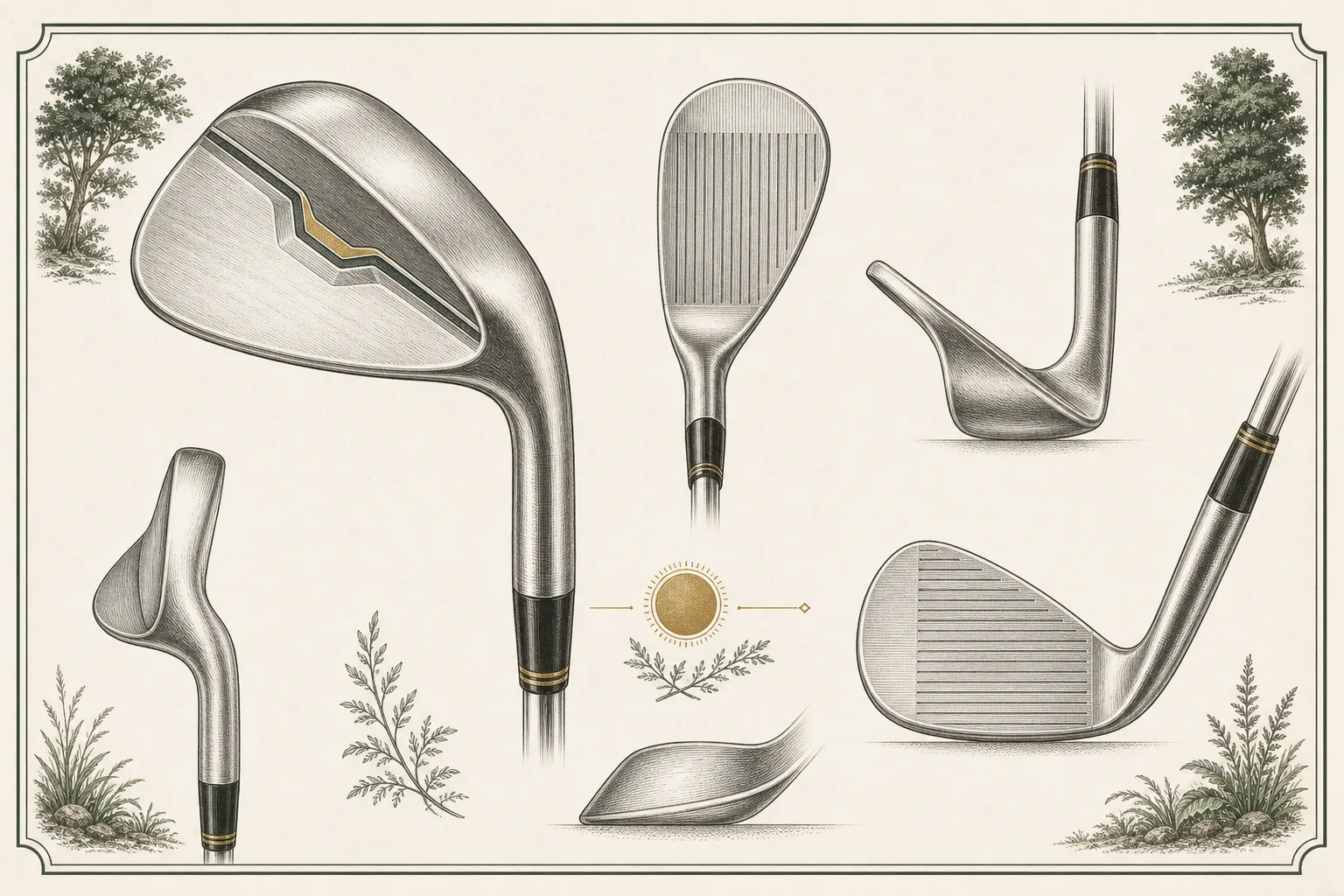
“Grain Flow Forged Mizuno wedge with white-satin or blue-ion finishes. Steel-dominant players' wedge; a feel-player identity club.”
The MP-T11 landed in 2011 as Mizuno's forged tour wedge built around a 360-degree sole grind for versatility, offered in white-satin and blue-ion finishes and Grain Flow Forged from 1025E mild carbon steel for the brand's signature soft feel. It arrived just as the USGA's 2010 groove-rule change forced every wedge maker to soften spin claims, and Mizuno's response was to use wider, shallower grooves on the 56-64 degree heads (where the ball compresses less) and narrower, deeper grooves on the lower lofts built for fuller, squarer strikes. MyGolfSpy's contemporary test called it flatly the best wedge of 2011, with amateur testers averaging just 5.9 yards from the pin - an unusually strong, specific result for a wedge review of that era.
MyGolfSpy's 2011 test called it 'hands-down...best wedge we have tested in 2011' and said it 'absolutely belongs on page one of any list supposedly discussing the best wedges for 2011' - a specific, sourced, superlative claim, not vague praise. It never built the sustained forum-hunting cult of an MP-32-type club and has largely faded from conversation behind Mizuno's later T-series and S-series wedges, which is exactly the sleeper pattern: a genuinely excellent, well-reviewed product now mostly forgotten.
For committed, accurate ball-strikers who value feel, sound and precise distance control around the green over forgiveness on a chunked or bladed shot. A high-handicapper who struggles with contact will get more out of a wider-sole, higher-bounce game-improvement wedge than this compact tour design.
Released in 2011 as part of the first full generation of wedges built to the USGA's new 2010 groove-conformance rules, alongside similarly-adapted wedges from Titleist (Vokey SM4) and Cleveland (CG15/RTX). Mizuno replaced it with the MP-T4 in 2013 and the wider MP-T5/S5 pairing in 2015.
A compact forged tour wedge aimed at skilled players, not a forgiveness-first design - its strength is precision (testers averaged 5.9 yards from the pin) rather than bailout on mis-hits. The 360-degree sole grind adds versatility across lies and shot types, which helps skilled players more than it helps a poor strike; this is 'forgiving for a blade-style tour wedge,' not forgiving in absolute terms.
Calibrated across the whole catalog — a tour blade scores low here on purpose; it means control, not ease.
Original retail was about $120 per wedge. Realistic 2026 private-party value for a clean 15-year-old wedge is roughly $25-45, with grooves worn past the point of real spin (common at this age) pulling toward the bottom of that range - it is a fine playable wedge today but carries no collector premium despite the strong original reviews.
Reading is one thing — hitting is another. Book a bay and see the numbers for yourself before you buy anywhere.
“Grain Flow Forged Mizuno wedge with white-satin or blue-ion finishes. Steel-dominant players' wedge; a feel-player identity club.”
The MP-T11 landed in 2011 as Mizuno's forged tour wedge built around a 360-degree sole grind for versatility, offered in white-satin and blue-ion finishes and Grain Flow Forged from 1025E mild carbon steel for the brand's signature soft feel. It arrived just as the USGA's 2010 groove-rule change forced every wedge maker to soften spin claims, and Mizuno's response was to use wider, shallower grooves on the 56-64 degree heads (where the ball compresses less) and narrower, deeper grooves on the lower lofts built for fuller, squarer strikes. MyGolfSpy's contemporary test called it flatly the best wedge of 2011, with amateur testers averaging just 5.9 yards from the pin - an unusually strong, specific result for a wedge review of that era.
MyGolfSpy's 2011 test called it 'hands-down...best wedge we have tested in 2011' and said it 'absolutely belongs on page one of any list supposedly discussing the best wedges for 2011' - a specific, sourced, superlative claim, not vague praise. It never built the sustained forum-hunting cult of an MP-32-type club and has largely faded from conversation behind Mizuno's later T-series and S-series wedges, which is exactly the sleeper pattern: a genuinely excellent, well-reviewed product now mostly forgotten.
For committed, accurate ball-strikers who value feel, sound and precise distance control around the green over forgiveness on a chunked or bladed shot. A high-handicapper who struggles with contact will get more out of a wider-sole, higher-bounce game-improvement wedge than this compact tour design.
Released in 2011 as part of the first full generation of wedges built to the USGA's new 2010 groove-conformance rules, alongside similarly-adapted wedges from Titleist (Vokey SM4) and Cleveland (CG15/RTX). Mizuno replaced it with the MP-T4 in 2013 and the wider MP-T5/S5 pairing in 2015.
A compact forged tour wedge aimed at skilled players, not a forgiveness-first design - its strength is precision (testers averaged 5.9 yards from the pin) rather than bailout on mis-hits. The 360-degree sole grind adds versatility across lies and shot types, which helps skilled players more than it helps a poor strike; this is 'forgiving for a blade-style tour wedge,' not forgiving in absolute terms.
Calibrated across the whole catalog — a tour blade scores low here on purpose; it means control, not ease.
Original retail was about $120 per wedge. Realistic 2026 private-party value for a clean 15-year-old wedge is roughly $25-45, with grooves worn past the point of real spin (common at this age) pulling toward the bottom of that range - it is a fine playable wedge today but carries no collector premium despite the strong original reviews.
Reading is one thing — hitting is another. Book a bay and see the numbers for yourself before you buy anywhere.