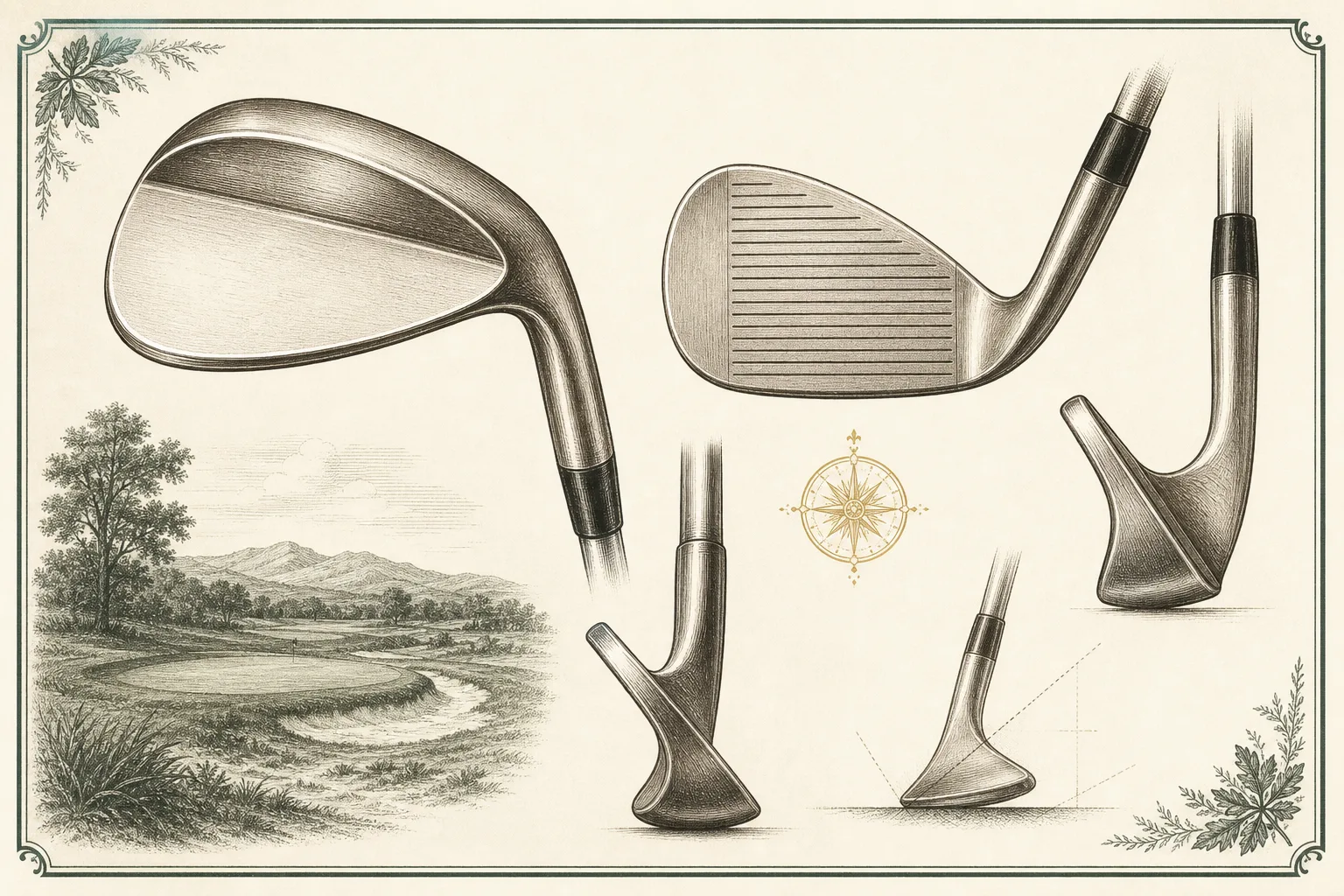
Released in May 1988 (the source of its '588' name), the Tour Action was Roger Cleveland's answer to a Tour then still gaming decades-old Wilson Dynapower wedges from the late 1950s. Forged from 8620 soft carbon steel with U-shaped grooves and a high-toe, large-face profile, it was built directly around feedback from the world's best players and instantly reset the standard for wedge shaping and turf interaction. It went on to win hundreds of professional events and dozens of major championships, and at its peak roughly 95% of players at an NCAA championship were reportedly gaming 588 wedges — a level of category dominance essentially unmatched before or since.
Independently documented as the wedge against which the entire modern category is judged: Golf.com, MyGolfSpy and GolfWRX all covered Cleveland's decision to reissue a limited-edition 588 Tour Action decades later specifically because of its legendary standing, citing hundreds of Tour wins, dozens of majors, and the ~95% NCAA-championship gaming rate as evidence of a wedge that defined, rather than merely competed in, its category.
Historically and today, a fit for accomplished ball-strikers who want classic forged feel and Tour-proven shaping and are willing to trade forgiveness for workability — the modern limited-edition reissue is explicitly a nostalgia/collector's piece for enthusiasts as much as a working tool. A high-handicapper wanting mis-hit forgiveness should look at a modern cavity-back wedge like the 588 RTX 2.0 CB instead.
At launch it replaced an era of Tour players still gaming worn-out late-1950s Wilson Dynapower wedges, and it directly set up every subsequent Cleveland 588 generation (RTG, RTX, RTX 2.0, RTX ZipCore) as well as the wider modern wedge category pioneered by Vokey and others. Cleveland released a limited-edition modern reissue of the 588 Tour Action decades after the original, explicitly trading on its legendary status.
A traditional forged blade-style wedge built for Tour-level shaping and feel, not forgiveness — its high toe and large face area were revolutionary for turf interaction and versatility from varied lies in 1988, but the thin topline and minimal offset punish mis-hits the way any pre-cavity-back wedge does. Its legend rests on shot control and feel, not on bailing out off-center strikes.
Calibrated across the whole catalog — a tour blade scores low here on purpose; it means control, not ease.
Original-era 1988-90s Tour Action wedges are uncommon in clean condition; 2nd Swing and Golf Avenue list later 588 Tour Action variants (satin/chrome finishes carried into the 2000s-2010s) typically in the roughly $25-$60 used range, with genuine late-1980s originals commanding more from collectors than functional players due to scarcity rather than playability.
Reading is one thing — hitting is another. Book a bay and see the numbers for yourself before you buy anywhere.
Released in May 1988 (the source of its '588' name), the Tour Action was Roger Cleveland's answer to a Tour then still gaming decades-old Wilson Dynapower wedges from the late 1950s. Forged from 8620 soft carbon steel with U-shaped grooves and a high-toe, large-face profile, it was built directly around feedback from the world's best players and instantly reset the standard for wedge shaping and turf interaction. It went on to win hundreds of professional events and dozens of major championships, and at its peak roughly 95% of players at an NCAA championship were reportedly gaming 588 wedges — a level of category dominance essentially unmatched before or since.
Independently documented as the wedge against which the entire modern category is judged: Golf.com, MyGolfSpy and GolfWRX all covered Cleveland's decision to reissue a limited-edition 588 Tour Action decades later specifically because of its legendary standing, citing hundreds of Tour wins, dozens of majors, and the ~95% NCAA-championship gaming rate as evidence of a wedge that defined, rather than merely competed in, its category.
Historically and today, a fit for accomplished ball-strikers who want classic forged feel and Tour-proven shaping and are willing to trade forgiveness for workability — the modern limited-edition reissue is explicitly a nostalgia/collector's piece for enthusiasts as much as a working tool. A high-handicapper wanting mis-hit forgiveness should look at a modern cavity-back wedge like the 588 RTX 2.0 CB instead.
At launch it replaced an era of Tour players still gaming worn-out late-1950s Wilson Dynapower wedges, and it directly set up every subsequent Cleveland 588 generation (RTG, RTX, RTX 2.0, RTX ZipCore) as well as the wider modern wedge category pioneered by Vokey and others. Cleveland released a limited-edition modern reissue of the 588 Tour Action decades after the original, explicitly trading on its legendary status.
A traditional forged blade-style wedge built for Tour-level shaping and feel, not forgiveness — its high toe and large face area were revolutionary for turf interaction and versatility from varied lies in 1988, but the thin topline and minimal offset punish mis-hits the way any pre-cavity-back wedge does. Its legend rests on shot control and feel, not on bailing out off-center strikes.
Calibrated across the whole catalog — a tour blade scores low here on purpose; it means control, not ease.
Original-era 1988-90s Tour Action wedges are uncommon in clean condition; 2nd Swing and Golf Avenue list later 588 Tour Action variants (satin/chrome finishes carried into the 2000s-2010s) typically in the roughly $25-$60 used range, with genuine late-1980s originals commanding more from collectors than functional players due to scarcity rather than playability.
Reading is one thing — hitting is another. Book a bay and see the numbers for yourself before you buy anywhere.