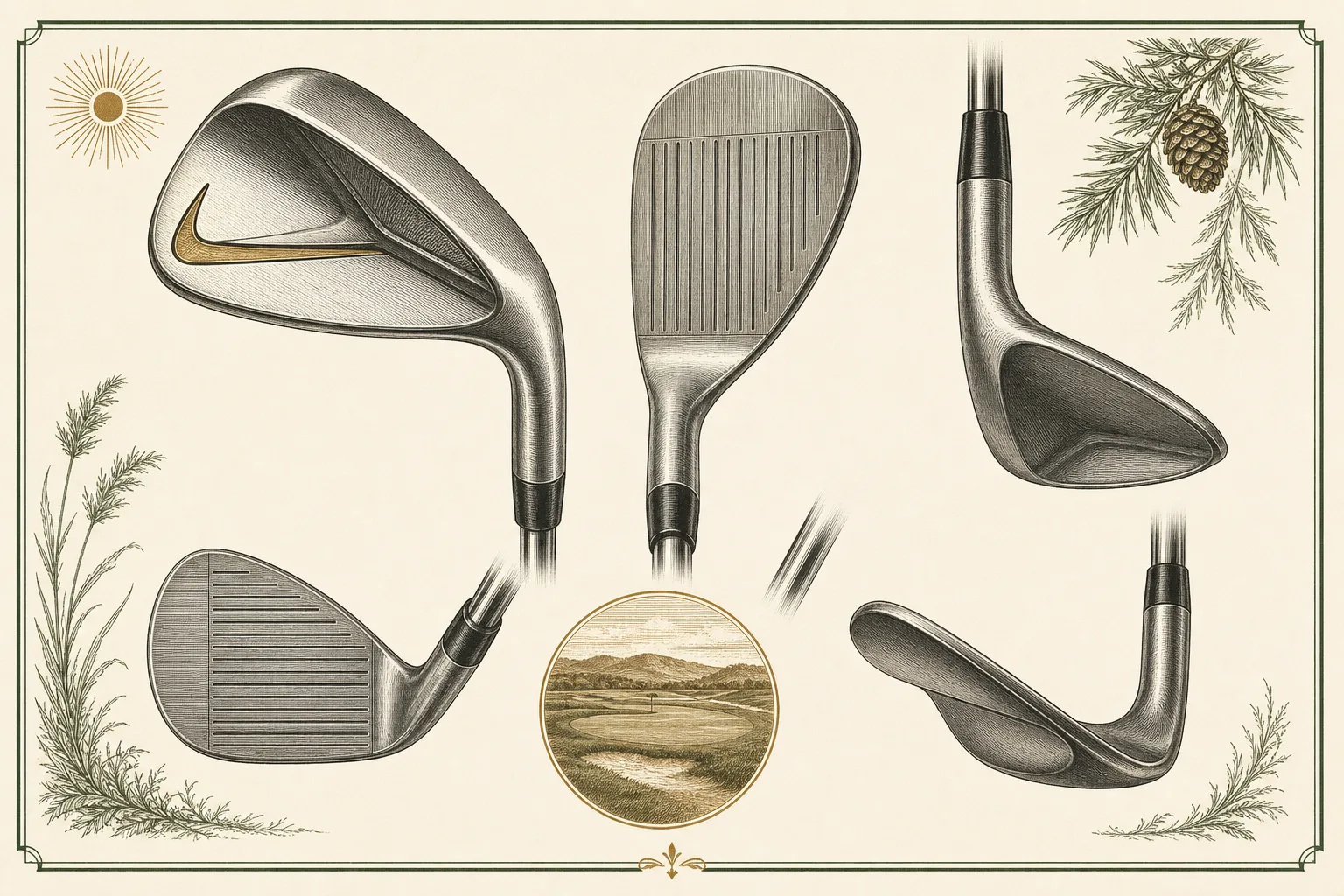
“The VR Forged wedge is a tour-milled players' scoring club - soft forged carbon steel with precision grooves for spin and feel. Built for players who work the ball around the green.”
Nike's flagship scoring wedge across its Victory Red tour push, forged from 1025 mild carbon steel with a laser-cut crosshatch face pattern layered under Nike's X3X grooves for extra spin friction. Tiger Woods, then Nike's marquee tour endorser, had direct input on the grind package, and Nike offered multiple sole grinds across a 48-60 degree range so players could match wedge to turf and attack angle rather than one grind fits all. Sold in satin chrome or a black-oxide finish designed to patina with wear. A straightforward, well-reviewed players' wedge from Nike's most credible equipment period, not a design landmark.
Reviewed positively on release (MyGolfSpy, Today's Golfer, Golf Monthly, National Club Golfer) and tied to Tiger Woods's direct grind-design input during Nike's peak tour-credibility window, but there is no evidence of a collector market, forum hunt threads, or price premium -- it circulates today as a decent, affordable used forged wedge from a defunct equipment brand.
Better players and low-to-mid handicaps who take a divot and want grind/bounce options to match their strike; the crosshatch face and X3X grooves reward crisp, descending contact with extra spin. High-handicappers who chunk or skull wedges regularly will not find forgiveness here -- a cavity-back or wide-sole GI wedge serves them better.
Released alongside Nike's 2010 VR driver/iron push during the height of Tiger Woods's on-course endorsement, competing directly with Titleist Vokey SM4/SM5, Cleveland CG15/RTX, and TaylorMade's ATV wedges. Superseded within Nike's own line by the VR-S Forged and later VR Pro/Method wedges before Nike exited golf equipment entirely in August 2016.
A traditional forged blade-style wedge shaped for feel and spin control, not mis-hit protection; thin/toe strikes lose spin and distance the way any tour-style wedge does. The multiple sole grinds let a fitted player match bounce to attack angle and turf, improving contact consistency for the right swing type, but that is a fitting benefit, not raw forgiveness -- it does nothing for a decelerating or steep angle-of-attack player.
Calibrated across the whole catalog — a tour blade scores low here on purpose; it means control, not ease.
$25-45 for a single wedge in decent condition as of 2026 -- Nike wedges never carried strong resale value even when the brand was active, and demand has only softened further since Nike stopped making clubs in 2016. Black-oxide examples with heavy sole wear or rust sell at the bottom of the range; clean chrome heads with premium steel shafts (Dynamic Gold) sit at the top.
Reading is one thing — hitting is another. Book a bay and see the numbers for yourself before you buy anywhere.
“The VR Forged wedge is a tour-milled players' scoring club - soft forged carbon steel with precision grooves for spin and feel. Built for players who work the ball around the green.”
Nike's flagship scoring wedge across its Victory Red tour push, forged from 1025 mild carbon steel with a laser-cut crosshatch face pattern layered under Nike's X3X grooves for extra spin friction. Tiger Woods, then Nike's marquee tour endorser, had direct input on the grind package, and Nike offered multiple sole grinds across a 48-60 degree range so players could match wedge to turf and attack angle rather than one grind fits all. Sold in satin chrome or a black-oxide finish designed to patina with wear. A straightforward, well-reviewed players' wedge from Nike's most credible equipment period, not a design landmark.
Reviewed positively on release (MyGolfSpy, Today's Golfer, Golf Monthly, National Club Golfer) and tied to Tiger Woods's direct grind-design input during Nike's peak tour-credibility window, but there is no evidence of a collector market, forum hunt threads, or price premium -- it circulates today as a decent, affordable used forged wedge from a defunct equipment brand.
Better players and low-to-mid handicaps who take a divot and want grind/bounce options to match their strike; the crosshatch face and X3X grooves reward crisp, descending contact with extra spin. High-handicappers who chunk or skull wedges regularly will not find forgiveness here -- a cavity-back or wide-sole GI wedge serves them better.
Released alongside Nike's 2010 VR driver/iron push during the height of Tiger Woods's on-course endorsement, competing directly with Titleist Vokey SM4/SM5, Cleveland CG15/RTX, and TaylorMade's ATV wedges. Superseded within Nike's own line by the VR-S Forged and later VR Pro/Method wedges before Nike exited golf equipment entirely in August 2016.
A traditional forged blade-style wedge shaped for feel and spin control, not mis-hit protection; thin/toe strikes lose spin and distance the way any tour-style wedge does. The multiple sole grinds let a fitted player match bounce to attack angle and turf, improving contact consistency for the right swing type, but that is a fitting benefit, not raw forgiveness -- it does nothing for a decelerating or steep angle-of-attack player.
Calibrated across the whole catalog — a tour blade scores low here on purpose; it means control, not ease.
$25-45 for a single wedge in decent condition as of 2026 -- Nike wedges never carried strong resale value even when the brand was active, and demand has only softened further since Nike stopped making clubs in 2016. Black-oxide examples with heavy sole wear or rust sell at the bottom of the range; clean chrome heads with premium steel shafts (Dynamic Gold) sit at the top.
Reading is one thing — hitting is another. Book a bay and see the numbers for yourself before you buy anywhere.