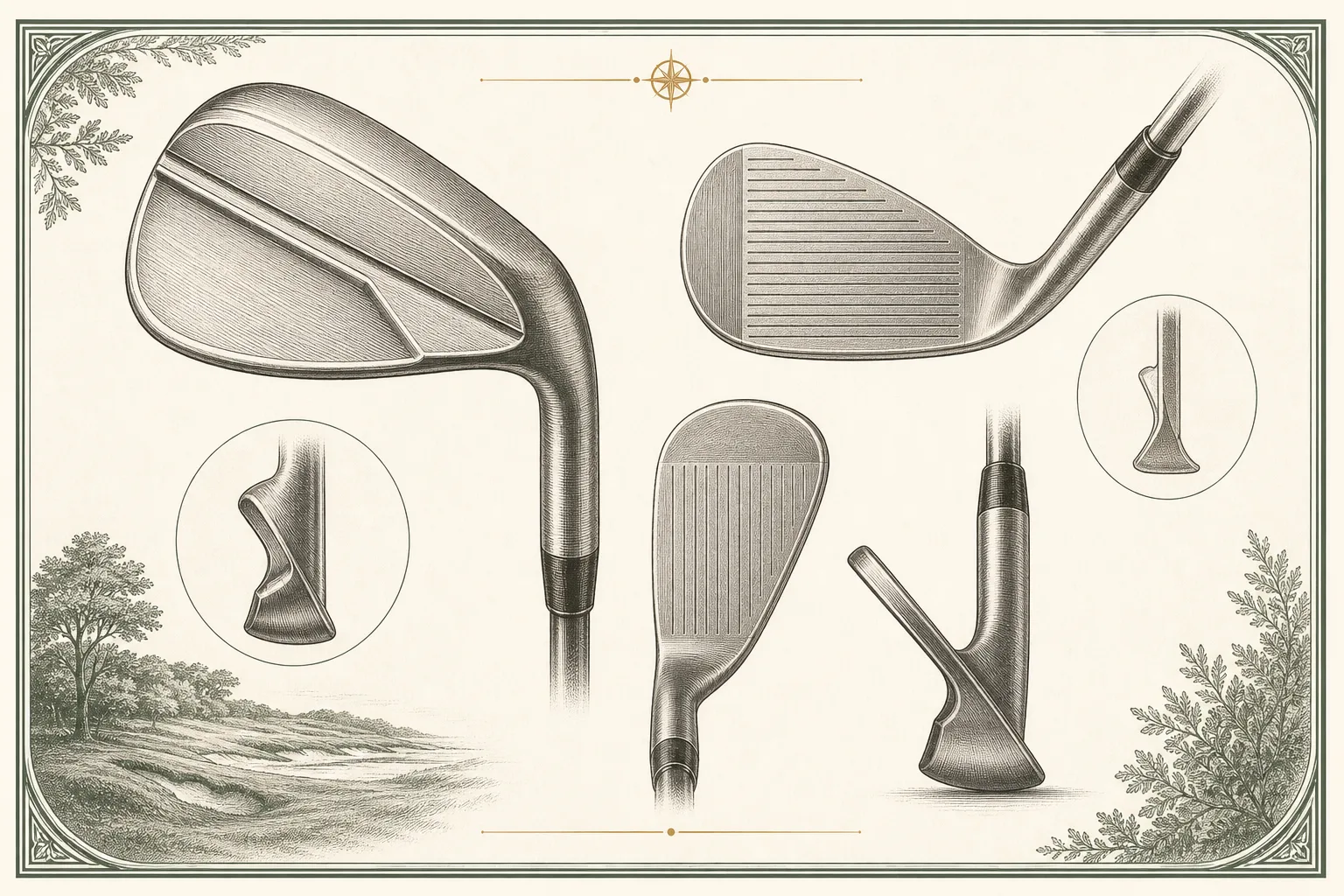
“Ginrei is Itobori's alternate hand-ground shape for players who want a touch more toe height and versatility around the green. Same hand-finishing pedigree, same long lead time.”
Ginrei is the second head shape from Japan's MT Grind Studio (master craftsman Mayuki Takai, Nagoya), sold alongside the standard Itobori wedge as the higher-toe, more versatile-around-the-green option. Like every Itobori head it starts life cold-forged, then is hand-reshaped and ground on a sanding belt rather than a barrel machine -- the 'Itobori' (one-cut) technique that leaves deliberately rough, non-uniform tooling marks as a signature rather than a flaw. Buyers pick from eight finishes (including Vintage Copper and Burning Copper) built to order in Japan, so no two heads are identical and each is effectively limited-edition by process, not marketing.
No mainstream tour or retail footprint -- Itobori sells almost entirely direct-to-boutique (itoboriusa.com, Dragon Golf in Germany/UK, greenrabbit.ch in Switzerland, torquegolf) with no big-box distribution -- yet it has a real, documented following among wedge collectors: GolfWRX and Golf To Impress/tourspecgolf forum threads specifically discuss the Ginrei by name, and Golfmagic's hands-on video review of Itobori's forged clubs called them 'amazing.' That is a niche cult of wedge geeks and Japanese-club importers, not a broad market, which is exactly what keeps it a sleeper rather than an icon.
Low-handicap players and wedge enthusiasts who value feel, workability and a hand-finished object over off-the-rack consistency -- someone who already controls strike location and wants a soft, forged carbon-steel response around the green. Not for a high-handicapper who needs bounce and sole width to bail out mis-hits; a Kasco Dolphin-style wide-sole wedge (see this same catalog) would serve that golfer far better and for a fraction of the cost and 8-12 week wait.
Released in 2022 into the same 2020s boutique-wedge micro-market as Bettinardi's hand-ground wedges, Artisan Golf, and other small-batch forged makers competing against mass-produced Vokey/Cleveland/Titleist tour wedges on craft and exclusivity rather than price or marketing reach. Itobori's angle -- coarse, sword-and-knife-style grinding techniques applied to golf, sold direct-to-order from Nagoya -- is distinctive even within that small field.
This is a traditional players' wedge shape, not a game-improvement design: a hand-ground, mid-sole profile aimed at shot-shaping and feel rather than mishit insurance. The higher-toe Ginrei geometry adds a bit more versatility for opening the face than a classic low-toe grind, but there is no wide anti-dig sole or heavy perimeter weighting here -- center-face precision is the point, so a 3 reflects a real players'-wedge, low-forgiveness tool, calibrated well below a GI iron or a Dolphin-style wide-sole wedge.
Calibrated across the whole catalog — a tour blade scores low here on purpose; it means control, not ease.
There is effectively no conventional secondary market -- these are made-to-order, low-volume heads, not a mass-produced SKU that trades in bulk on eBay/SidelineSwap. Occasional resales (Reddit r/GolfClubs, specialty forums) tend to land close to or even above the roughly $400-410 new price for clean, popular finishes, since Itobori doesn't keep stock and buyers face the same 8-12 week wait to order new. A well-worn or unpopular finish would sell for meaningfully less to the small pool of interested wedge collectors.
Reading is one thing — hitting is another. Book a bay and see the numbers for yourself before you buy anywhere.
“Ginrei is Itobori's alternate hand-ground shape for players who want a touch more toe height and versatility around the green. Same hand-finishing pedigree, same long lead time.”
Ginrei is the second head shape from Japan's MT Grind Studio (master craftsman Mayuki Takai, Nagoya), sold alongside the standard Itobori wedge as the higher-toe, more versatile-around-the-green option. Like every Itobori head it starts life cold-forged, then is hand-reshaped and ground on a sanding belt rather than a barrel machine -- the 'Itobori' (one-cut) technique that leaves deliberately rough, non-uniform tooling marks as a signature rather than a flaw. Buyers pick from eight finishes (including Vintage Copper and Burning Copper) built to order in Japan, so no two heads are identical and each is effectively limited-edition by process, not marketing.
No mainstream tour or retail footprint -- Itobori sells almost entirely direct-to-boutique (itoboriusa.com, Dragon Golf in Germany/UK, greenrabbit.ch in Switzerland, torquegolf) with no big-box distribution -- yet it has a real, documented following among wedge collectors: GolfWRX and Golf To Impress/tourspecgolf forum threads specifically discuss the Ginrei by name, and Golfmagic's hands-on video review of Itobori's forged clubs called them 'amazing.' That is a niche cult of wedge geeks and Japanese-club importers, not a broad market, which is exactly what keeps it a sleeper rather than an icon.
Low-handicap players and wedge enthusiasts who value feel, workability and a hand-finished object over off-the-rack consistency -- someone who already controls strike location and wants a soft, forged carbon-steel response around the green. Not for a high-handicapper who needs bounce and sole width to bail out mis-hits; a Kasco Dolphin-style wide-sole wedge (see this same catalog) would serve that golfer far better and for a fraction of the cost and 8-12 week wait.
Released in 2022 into the same 2020s boutique-wedge micro-market as Bettinardi's hand-ground wedges, Artisan Golf, and other small-batch forged makers competing against mass-produced Vokey/Cleveland/Titleist tour wedges on craft and exclusivity rather than price or marketing reach. Itobori's angle -- coarse, sword-and-knife-style grinding techniques applied to golf, sold direct-to-order from Nagoya -- is distinctive even within that small field.
This is a traditional players' wedge shape, not a game-improvement design: a hand-ground, mid-sole profile aimed at shot-shaping and feel rather than mishit insurance. The higher-toe Ginrei geometry adds a bit more versatility for opening the face than a classic low-toe grind, but there is no wide anti-dig sole or heavy perimeter weighting here -- center-face precision is the point, so a 3 reflects a real players'-wedge, low-forgiveness tool, calibrated well below a GI iron or a Dolphin-style wide-sole wedge.
Calibrated across the whole catalog — a tour blade scores low here on purpose; it means control, not ease.
There is effectively no conventional secondary market -- these are made-to-order, low-volume heads, not a mass-produced SKU that trades in bulk on eBay/SidelineSwap. Occasional resales (Reddit r/GolfClubs, specialty forums) tend to land close to or even above the roughly $400-410 new price for clean, popular finishes, since Itobori doesn't keep stock and buyers face the same 8-12 week wait to order new. A well-worn or unpopular finish would sell for meaningfully less to the small pool of interested wedge collectors.
Reading is one thing — hitting is another. Book a bay and see the numbers for yourself before you buy anywhere.