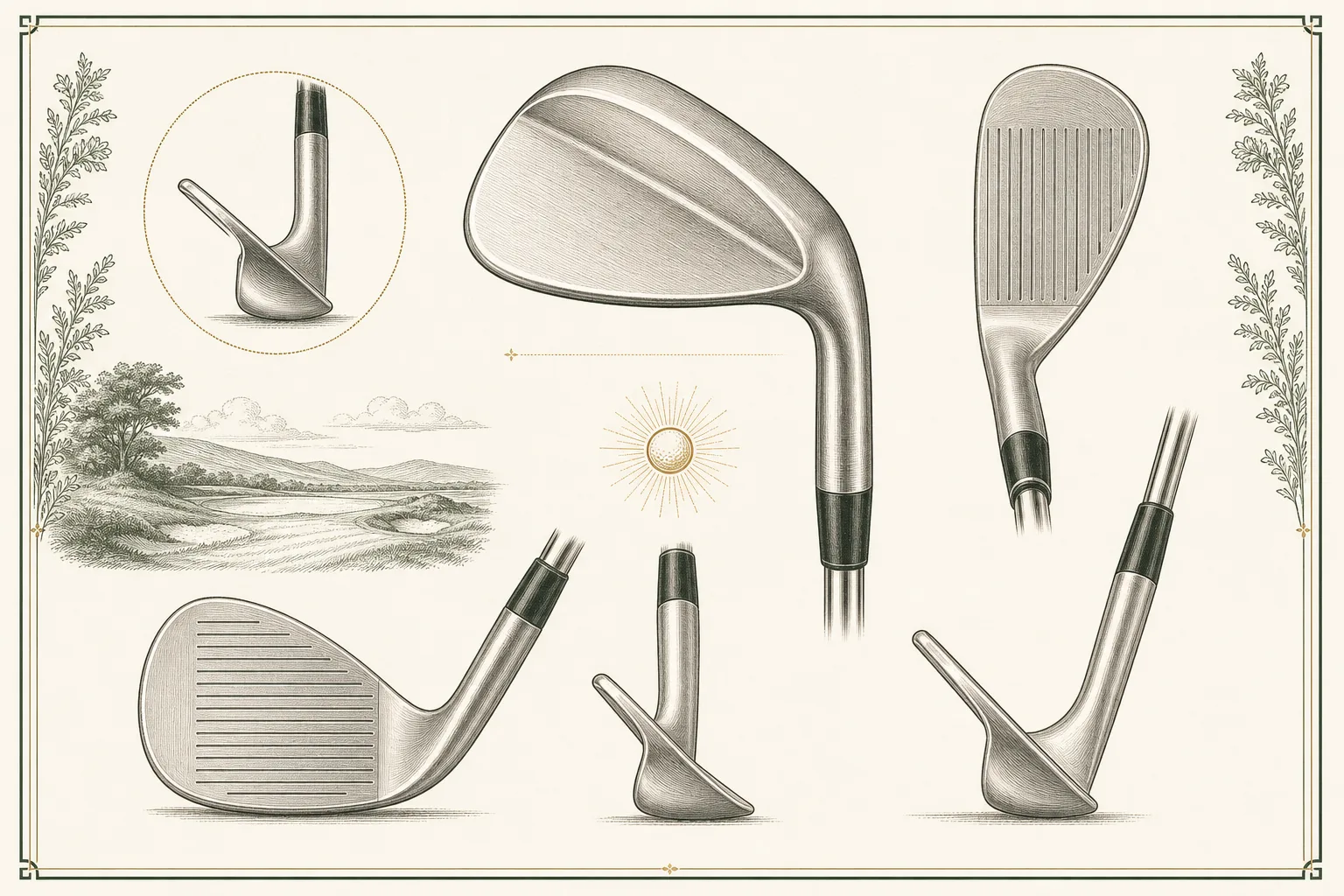
“The signature 'Knuckles' fluted sole stabilizes the head through every turf condition, with 7/12/13 degrees of bounce in the 52/56/60. For the shotmaker who opens the face and needs the sole to behave in sand and rough alike.”
The K-Grind is Miura's signature wedge, built around a sole innovation nobody else was doing at the time: a set of scalloped, finger-like flutes cut into the trailing/leading edge (nicknamed 'Knuckles') that reduce turf and sand resistance when the face is opened. It debuted inside Miura's limited-run 'Series 1957' as a 56-degree-only release, and demand pushed Miura to add 52 and 60-degree versions. Milled from soft carbon steel by the same craftsmen who hand-grind Miura's irons, it carried 7/12/13 degrees of bounce across the 52/56/60 lofts. The design proved durable enough that Miura kept the Knuckles concept alive through a 2019 refresh (K-Grind 2.0) rather than retiring it, which is unusual for a niche wedge grind in a category that turns over fast.
The Knuckles sole is repeatedly singled out across independent outlets (GolfWRX, Golf Aficionado, Into the Grain, Golf.com ClubTest) as one of the most visually and functionally distinctive wedge grinds on the market, not just a Miura fan favorite. Its lineage into a second generation (K-Grind 2.0, still sold in 2026) rather than a quiet discontinuation is the clearest evidence of sustained demand for the exact silhouette, not just the brand halo.
Wedges are typically sold as singles rather than sets. A clean private-party K-Grind commonly runs $90-150 depending on grind wear and shaft; grooves wear faster on a forged soft-carbon wedge than on a harder cast head, so grind/face condition matters more here than on an iron set. Reconditioned-retail listings (2nd Swing, Golf Avenue) can run higher for a graded, warrantied copy — treat those as a ceiling, not the private-sale expectation.
For golfers who already shape wedge shots (open the face, hit flop and low spinners) and want the sole to cooperate in sand, rough, and tight lies. A high-handicapper who just needs a wedge to get the ball airborne reliably gets little extra benefit from the flutes and pays a premium for hand-ground styling they won't use.
Launched into a wedge market dominated by Titleist Vokey and Cleveland at the time; the K-Grind's flutes were a genuinely novel sole geometry rather than a loft/bounce reshuffle. Miura carried the concept forward into the K-Grind 2.0 (2019) with tweaked grinds, and by 2026 Miura's wedge line has expanded further (K-Grind, C-Grind, IC-601 wedges) — the original K-Grind's flutes remain the visual signature people associate with Miura wedges specifically.
A wedge is judged on turf/sand interaction rather than mis-hit tolerance, and here the fluted sole genuinely helps: it lets the face open through bunker sand and thick rough with less digging than a flat-soled wedge. But it is still a compact, blade-shaped, players'-grade head with a small margin for a thin or heavy strike on full shots — the forgiveness on offer is 'behaves well through bad lies,' not 'saves a bad strike.'
Calibrated across the whole catalog — a tour blade scores low here on purpose; it means control, not ease.
Reading is one thing — hitting is another. Book a bay and see the numbers for yourself before you buy anywhere.