
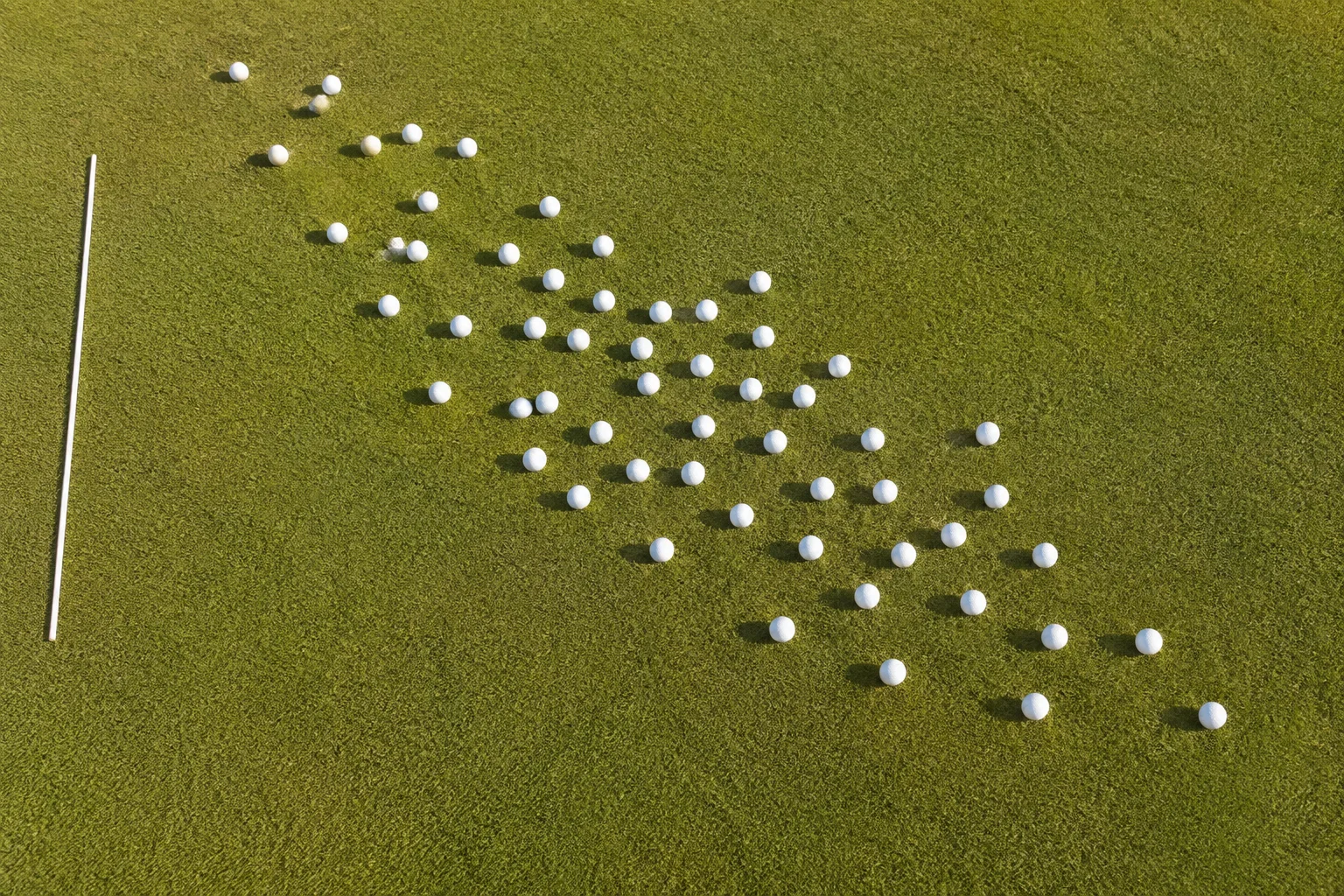
Two members walk out of the bay with the same number. Each one's 7-iron finishes about fifteen yards either side of the line. One of them is a good iron player having a good week. The other is in real trouble. The number cannot tell you which is which.
That is dispersion in one paragraph. Everybody asks how big it is. Almost nobody asks what shape it is — and the shape is where the golf is.
What we actually draw
Your dispersion is not a rating and not a guess. It is built out of where your shots landed: two numbers per shot, how far left or right of the target line the ball finished and how far it flew. Every pair is a dot. Then one ring gets fitted around the dots.
The ring is real arithmetic and it is worth knowing what it is. We take the middle of the cloud, measure how the dots scatter around that middle in both directions at once, and draw the oval that scatter describes, sized at two standard deviations. If your shots behave like one ordinary cloud, roughly six of every seven land inside it.
Hold on to that if. It does a lot of work later.
Three things fall out of that math, and only one of them is the number most people look at:
- a centre — where your pattern actually sits, which is not always where you aimed;
- two radii — how far it reaches the long way and the short way;
- a tilt — which direction the long way points.
The ± figure beside each club is the sideways half-width of that oval, tilt included. It is deliberately never called a standard deviation, because it is not one; it is the honest left-and-right reach of your own pattern. Under twelve shots with a club there is no ring at all, and the page says so in plain words — not enough shots · 7 of 12. We do not draw a ring off a handful of swings, and we never draw a fake fat one to fill the space.
Shape one: which way the oval points
An oval that runs long and thin up and down the target line is a distance problem. Your start lines are fine. What is moving is how far the ball goes — strike, effort, a club that is inconsistent for you. You are not spraying it. You just do not know which yardage you are going to get.
An oval that is wide and flat across the line is the opposite. Your distance repeats and your direction does not. That is a face-and-path problem, and it does not get better by swinging softer.
Same size of ring. Two completely different practice sessions. Read only the ± number and both of those golfers get told the same thing, and one of them spends a month working on the wrong half of his game.
Shape two: where the middle sits
Now look at the centre instead of the edges.
A pattern can be tight and still be wrong, because tight and aimed are two different achievements. Left-and-right here is measured against the target line, so a cloud whose centre sits eight yards right of that line is telling you something specific and cheap: the ball is going where you are actually aimed, which is not where you think you are aimed. Alignment. Ball position. An eye that has been lying to you for years.
That is the best news dispersion ever gives you. A bias is a setup fix. Spread is a swing fix. Setup fixes are faster.
Shape three: one way, or two ways
Here is where a single number can lie to you outright.
Curve is stored as one figure on every shot — the tilt of the ball's spin, which is the thing that makes it bend. Tilted right, it curves right. Tilted left, it curves left. Simple enough.
Now take a golfer who hits half his shots with a big slice and half with a big hook. Average his curve numbers and you get roughly zero. Zero reads as flies straight. It is confidently, completely wrong, and it hides the single most punishing pattern in golf: the two-way miss. You cannot aim around a two-way miss. There is no safe side.
That failure was live in this product once. The rule written to kill it is blunt: an average curve number may never grade a shot. Every shot is graded on its own, and what comes back is the mix — how many straight, how many gentle, how many big, and which way each one went. Never an average of the thing.
The bar for naming a side is 60% of your curving shots. Not a majority — sixty percent. Eleven right and nine left is a coin, and telling that man he has a slice sends him aiming left into nine of his own hooks. Below the bar you get the truth instead: a two-way miss — 12 of 20 shots curve, and they split both ways. That sentence is worth more than any yardage on the page.
The same 60% bar is applied a second, independent way — not to how the ball curved, but to where it finished. Shots that ended more than half a metre off the line get their side counted, and if neither side holds sixty percent of them, your miss reads mixed rather than picking a favourite. Two different measurements, one honest bar, and neither of them will hand you a direction it does not have.
It also explains the if from earlier. The ring assumes one cloud. A two-way miss is two clouds. Fit one oval around both and you get something fat, centred on a spot you almost never actually hit. The middle of a two-humped pattern is a shot you do not own.
When this rule was being written we sat with an eight-shot 3-iron sheet off another launch monitor. Four struck, three duffed, one miss. The carries averaged 174 yards — and not one of the eight shots landed within twelve yards of that average. The average described a shot the man never hit all day.
Why the driver ring is bigger, and why that is fine
Curve in yards is not the same thing as curve in degrees. The ball keeps bending for as long as it is in the air, so one degree of spin tilt is worth something like twenty yards on a 250-yard driver and about two yards on a 105-yard wedge.
So a driver ring will be wider than a wedge ring for every golfer alive, and standing them side by side in yards tells you nothing. That is why shape here is graded on a club-scaled ladder: a driver has to bend fewer degrees before we call it a curve, a wedge has to bend more. Compare a club to itself over time. Never to the club next to it.
What the picture cannot tell you yet
Dispersion tells you what your pattern is. The number that would tell you why — the gap between where the face pointed and where the club was travelling, which is the actual engine of curve — needs Foresight markers on the club.
Across all the shots hit in this building, that block of numbers is missing far more often than it is present: face-to-target is absent on something like 95 of every 100 shots our range files capture. That is not your bay misbehaving and it is not a broken sensor. It is that almost nobody has put the stickers on. They are free at the front desk, they take a minute, and they turn "you curve it right" into "here is the gap doing it".
The one line to keep
Tour players are not straight. They are tight, and they miss in one direction.
Size tells you how much room your golf needs. Shape tells you what to go and work on. Read the shape first.
Related reading: Reading Your Shot Data Like a Fitter · What Your Miss Says About Your Next Club · What counts as a record here · The World Isn't Clean, and Neither Is the App
What the Bay Measures, and What It Does Not
A launch monitor looks omniscient. Ball leaves the club, and a second later the screen has a dozen numbers on it. It is easy to assume everything you'd want to know was measured, and that a blank field means something broke.