

You hit one on Tuesday night that said 280. Saturday morning you stand on a real tee with the same driver and the same swing, and 280 is nowhere in sight.
Nobody lied to you. But that number was not one number — it was three different kinds of number stacked on top of each other, and only some of them were ever going to leave the building. Here is which is which.
The three kinds of number on your screen
Measured. The cameras watch the ball come off the face. Ball speed, launch angle, which way it started, how much it is spinning. That is a photograph of your ball at the moment it leaves. It is as true in this bay as it would be anywhere on earth.
Computed from measured things. Carry — how far the ball flies. We do not watch it land; it hits a screen a few feet in front of you. Carry is worked out from the launch we measured, run through flight physics. Our own rule for it calls that high confidence and repeatable, because real numbers went in the front.
Modeled. Total — carry plus roll. This is where the room stops measuring and starts making an educated guess about the ground.
Our own data dictionary says it about as plainly as it can be said. Carry is "the only distance you can trust on the course, because carry doesn't care what the fairway is made of." Total is "carry plus simulated bounce and roll — a nice headline, but the sim is guessing at the turf."
That is most of the answer. It is worth one more layer, though, because "the sim is guessing" is an odd thing to hear from the people who run the sim.
Roll is the soft part, and roll is most of the argument
Roll is not a rounding error. At the long end of the bag it is enormous.
A driver arrives shallow and with low spin, so on firm simulator settings it commonly runs another 15 to 40-plus yards after it lands. A sand wedge arrives steep and spinning hard, so it rolls a couple of feet or hops backwards. Same golfer, same session — the ground is doing almost nothing to one club and a huge amount to the other.
Which means the ground decides most of the gap between carry and total on exactly the clubs people brag about.
And the room cannot check what the ground is doing, because the ground is a setting somebody typed in. When we run tournaments here, turf, firmness and wind are written down as a human statement, and our own code says why in as many words: the simulator "exposes no supported settings readback," so that record "MUST NOT be treated as automatic configuration proof." The rule behind our leaderboards is blunter — the turf side of a pin is "DECLARED ONLY."
That is not a defect we are confessing. It is a real limit of the equipment, and we write it down rather than paper over it.
Then why does the app show total first?
Because for long clubs it is the more useful number, and that was a deliberate call.
Driver, woods, hybrids and your long and mid irons lead with total, because out on a course you pick a long club by where the ball finishes. A 3-wood that carries the same as your 7-iron but runs forty yards further is a trap if carry is the only thing we ever show you.
Wedges and short irons flip the other way and lead with carry, because they barely roll and carry is the number you fly at a flag.
Either way both numbers are on the screen, and both are labelled. The rule in this app is that every distance says out loud which one it is — there is no bare "Distance" that quietly means one thing on one page and the other thing on the next. When you want the number that travels with you, read carry. When you want the number that gaps your bag, read total.
So where did the 280 go?
Split it. The carry half of it is genuinely yours, and it is portable: same launch, same air, same flight. What changes outdoors is everything that happens after the ball lands, and it does not all move in one direction.
Some of it goes against you out there. Soft spring turf gives back almost no roll. Wind exists, and in here it mostly does not — a bay round plays in still air unless somebody sets wind on purpose, which flatters everybody. And the mat hands you a clean, flat lie on every single swing, which the eleventh fairway will not.
Some of it was quietly on your side in here. Simulator courses can sit at altitude, and thin air genuinely does fly a golf ball further. The guard that throws impossible readings off your records is built deliberately generous about exactly this, in its own words: wide enough for altitude-boosted sim courses, because those long numbers are real. It rejects the impossible, not the improbable. And the ground was firm, because somebody set it firm.
None of that means you were fooled. It means one swing was measured under conditions that a person chose, and Saturday's conditions are chosen by the weather.
The rest of that story — wind, ground, lies, putting, and the nerve you cannot practise indoors — has its own piece: From the Bay to the First Tee. This one is only about the instrument.
Playing a course here is a different data source again
Hitting balls on the range and playing eighteen on a simulated course are not the same feed.
Shots that reach us only through the course game arrive with no club data at all — no club speed, no face numbers — and often without a launch-monitor distance either. On top of that, the game applies its own physics, its own altitude and its own wind. A distance the game worked out and a distance our launch monitor measured would look identical sitting in the same column, and they are not the same claim, so we keep them apart.
That is a large part of why your records here are set on range and assessment swings only, and never on the drive you smashed on the eighteenth in a sim round. On the range you are measuring. In a round you are playing.
The label was already telling you
Look at the bottom of your records board. It does not say verified. It says Sim-verified · The Clubhouse.
That word is carrying real weight. It means: this happened, here, on this equipment, under these conditions, and we will stand behind it. It has never meant that the same swing produces the same number at eight in the morning on your home course, and we have never said it did.
What to take outside with you
Take your carry ladder. How far each club flies is the honest, portable part, and it is the single most useful thing this room will ever give you. Take your start lines and your shape. Take the swing you built.
Leave the totals in the bay. They were computed over ground nobody measured, and the course brings its own ground.
Your 280 was real. It was just real in here.
From the glossary
Related reading: From the Bay to the First Tee: What Changes When You Play Outdoors · What counts as a record here · Your Longest Drive: where the ball finished, and why · Clean Data In, Clean Numbers Out
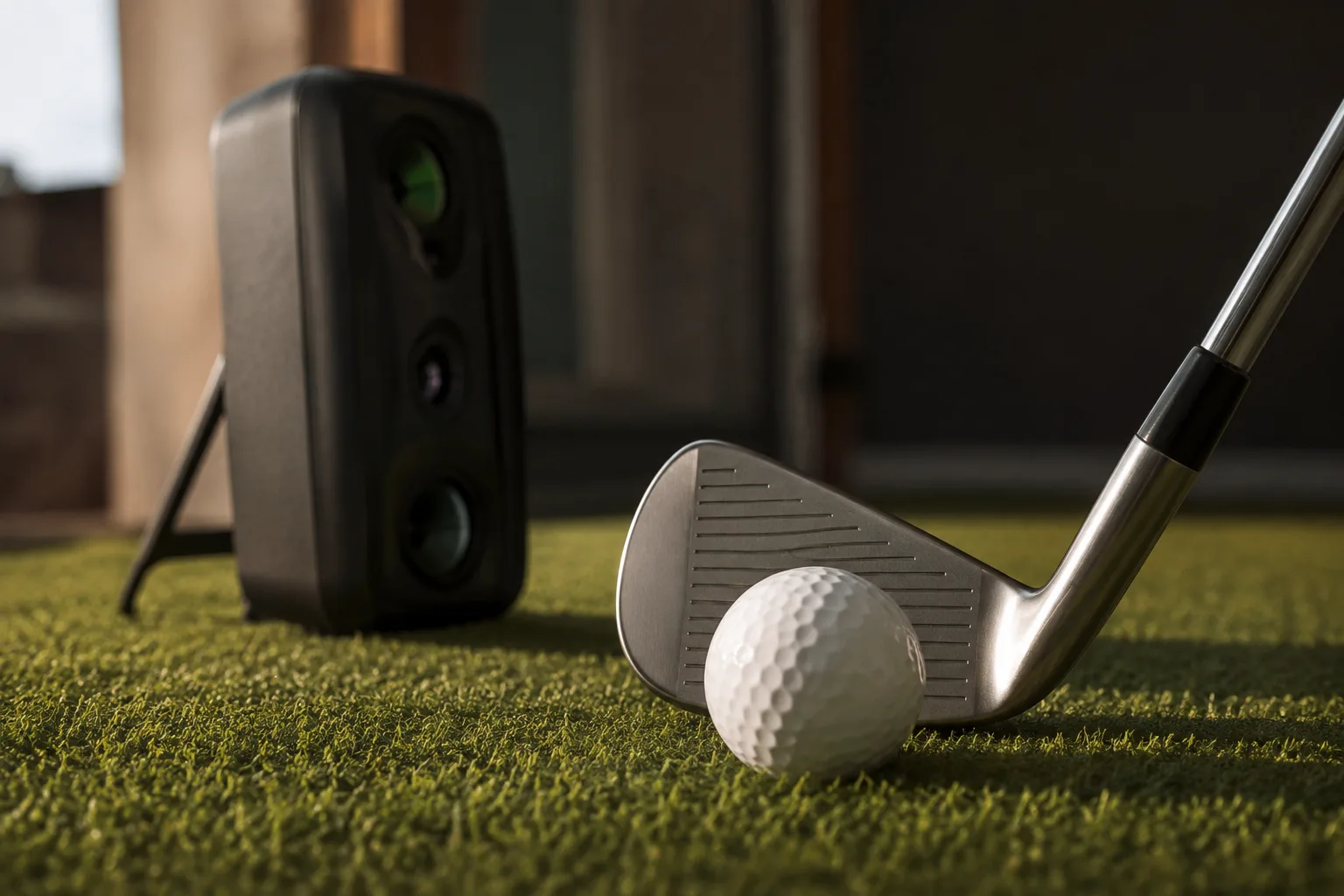
What the Bay Measures, and What It Does Not
A launch monitor looks omniscient. Ball leaves the club, and a second later the screen has a dozen numbers on it. It is easy to assume everything you'd want to know was measured, and that a blank field means something broke.