
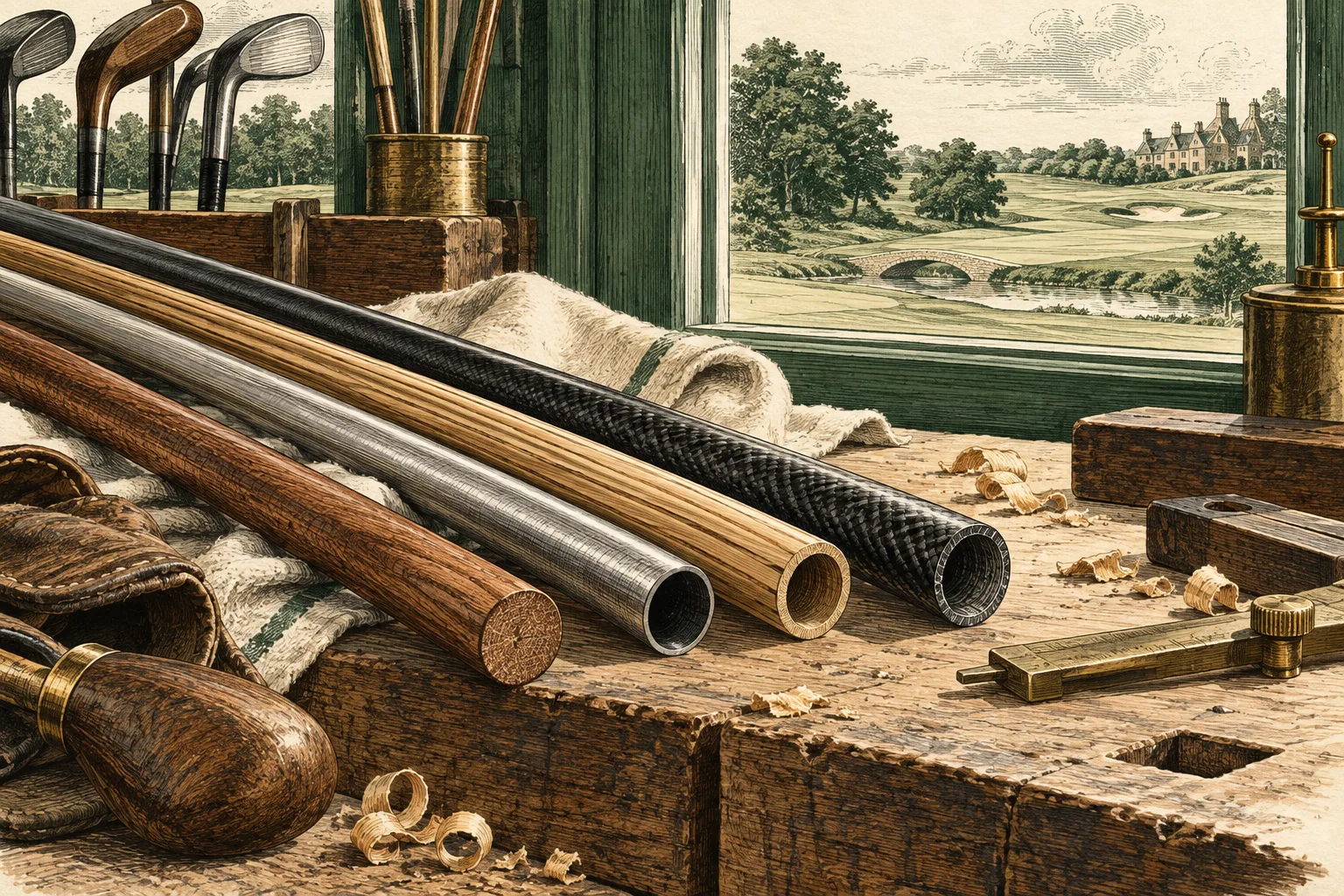
Golfers love to believe the shaft in their hands right now is the smart one — the version that finally got it right after all those primitive attempts before it. Hazel was for people who didn't know better. Hickory was folk magic. Steel was a fad the traditionalists fought off before it, too, got outdated. Whatever you're swinging today is, obviously, the mature, settled answer.
It never is. Golf shaft history isn't a straight line of progress — it's the same three-act play performed over and over with a different material each time. Act one: a new material shows up promising to fix everything wrong with the old one, and the marketing runs hot. Act two: a real, physical flaw surfaces once enough golfers have played it. Act three: the industry quietly engineers around the flaw, and the hype either matures into something genuinely better or gets replaced by the next material's hype.
Three hundred years of this. Hazel to hickory. Hickory to steel. Steel to aluminum. Aluminum to fiberglass. Fiberglass to graphite — twice. And if you squint at the marketing language circulating right now, the same script is running again in 2026. Understanding the pattern isn't just a good story — it's the best tool a golfer has for reading through whatever the current cycle is trying to sell.
The hazel years: whatever wood was on hand
The earliest documented reference to what golfers actually swung comes from 1687, when a diarist named Thomas Kincaid wrote about golf clubs shafted in hazel. It's an accidental piece of history — nobody in the 1680s was trying to leave a record for future equipment nerds — but it tells us something real: shaft material wasn't yet a decision so much as an accident of geography. You built a shaft out of whatever springy wood grew locally.
That changed as golf commercialized and clubmakers started comparing notes across regions. Exotic imported hardwoods entered the conversation — lancewood and lemonwood, purpleheart and greenheart, danga, alongside more familiar ash — and every wood had its partisans, each supposedly holding some edge in "spring" or durability that nobody had actually measured. By the early 1800s the market had settled on lemonwood, lancewood, and ash, not because anyone had tested them, but because generations of clubmakers had converged on what worked by feel and failure.
That's worth noting, because it's the first appearance of a theme that never leaves this story: in the absence of measurement, folklore fills the gap. Every material era that follows has its own version of these wood-grain myths — confident claims nobody tested, repeated until they hardened into conventional wisdom.
Hickory and the black magic of "matching"
Hickory shows up in print for the first time in August 1828, in The Sporting Magazine, and by the 1890s it was the dominant shaft wood everywhere golf was played seriously. It earned that dominance honestly — hickory is tough, springy, and abundant enough to support a real industry. But it brought its own mythology: Tennessee hickory versus other regional stock, brown versus white, the supposedly superior "ring hickory" — distinctions long on conviction and short on anything resembling a controlled test.
The deeper problem wasn't the wood itself. It was that no two pieces of it behaved the same way. Wood is a natural material, full of grain irregularities, and every blank cut from a hickory log had its own personality — its own stiffness, its own way of loading and releasing. There was no way to manufacture consistency, only to hunt for it after the fact.
Nothing illustrates that hunt better than a story involving the golf world's biggest star of the era. In the 1920s, equipment man J. Victor East set out to duplicate the exact feel of Bobby Jones's favorite driver — a club built around a shaft from clubmaker Jack White that Jones considered nearly irreplaceable. No machine existed yet that could measure what made the shaft special, so East did the only thing available to him: he hand-tested roughly 5,000 hickory blanks in search of a match. Only two came close enough to satisfy him. That's a treasure hunt, not a fitting process by any modern definition — and it's the clearest illustration of what "shaft fitting" meant in an era with no instruments to fit with. Feel was the only sensor anyone had, and feel doesn't scale.
That's the flaw hiding inside hickory's golden age: the wood performed beautifully when you happened to find a good blank, but there was no way to guarantee you'd found one or reproduce it at volume. An industry built on unrepeatable discoveries is an industry waiting for a material that can be engineered on purpose.
Steel's thirty-year fight for legitimacy
Steel should have been an easy win — consistent, moldable, immune to the grain lottery that made hickory such a gamble. Instead, it took roughly three decades of failed attempts and governing-body resistance before it actually won.
The first attempt landed badly: engineer Horsburgh patented a solid steel shaft in 1894, and it failed, because a solid rod is heavy and dead-feeling, nothing like the springy wood golfers knew. The real breakthrough waited until 1910, when A.F. Knight patented a tubular steel shaft. Making it hollow was the key — a tube could be engineered for controllable resistance to twisting and tuned to bend at deliberately chosen points, exactly the design control hickory could never offer. Knight's patent was licensed to Horton Manufacturing, which sold the shafts as "Bristol"; a seamless-tube design followed out of the UK, and by the mid-1920s American makers were refining tapering processes that let steel flex progressively along its length.
Then golf's governing bodies got involved, and the story turned political. The R&A banned steel shafts outright in the early 1920s; the USGA approved them in 1926, a gap during which the same equipment was legal on one side of the Atlantic and illegal on the other. The R&A caved in 1929. Meanwhile, the hickory industry fought back the only way a losing industry knows how: with a standards committee, organizing a trade association in 1928 and pushing through an official commercial standard for hickory shafts in 1930 — a genuinely interesting idea, imposing the consistency measurement hickory had always lacked, and years too late. The market had already moved to steel, which didn't need a committee to prove its consistency; you could just measure it and get the same answer, shaft after shaft.
By the mid-1930s steel had won completely, and kept improving — new heat-treatment processes and precision dies let makers dial in flex with a control hickory never offered, and by 1950 one major catalog listed more than a dozen distinct shaft types. Steel's hype cycle, unusually, ended vindicated: the flaw was in the first two engineering attempts, not the material, and once those got fixed, steel simply was better.
Aluminum's rocket and crash
Steel's long reign made the industry hungry for the next leap, and aluminum looked like it might be it. The first production aluminum shafts appeared in 1965; two years later, Arnold Palmer won twice using them — tour validation is rocket fuel for any equipment trend — and sales boomed almost overnight.
The boom didn't survive contact with wider use. Aluminum's problem wasn't strength or consistency — it was feel. Golfers found it soft and dead through impact, and once that verdict spread past the early adopters, the category collapsed. By 1973, just six years after Palmer's wins, aluminum was finished as a mainstream shaft material — the cleanest, fastest hype cycle in this whole story: overpromise, boom, real flaw, bust, inside a single decade.
Fiberglass: the false start nobody remembers
Fiberglass tried twice to be golf's next material, and failed twice for the same reason. Golfcraft introduced a fiberglass shaft in 1954, and Shakespeare followed with its own version later in the decade, both promising the lightness that would eventually make graphite a real success — but that era's fiberglass couldn't control torsional stiffness, so the shafts twisted excessively and broke outright. Fiberglass never got a second act. It's easy to forget it belongs in this story at all, but it's a useful reminder that not every hype cycle resolves with the material getting fixed. Sometimes the flaw just wins, and the industry moves on.
Graphite's two acts
Graphite's story is the richest hype cycle here, mostly because it happened twice.
Frank Thomas developed the filament-winding techniques behind graphite shafts at Shakespeare in the late 1960s, using carbon fiber sourced from Union Carbide, and the first commercial graphite shafts reached golfers around 1971. Thomas's work was never patented exclusively, so other manufacturers moved in fast — Aldila, under James Flood, became the company that actually turned graphite into a cultural moment. 1973 was the breakout year: a new pre-preg sheet-wrap manufacturing method, celebrity endorsements, and marketing that promised recreational golfers something like 30 extra yards off the tee. Graphite's promise felt like the real thing.
It wasn't, at least not yet. By 1974 the flaws were impossible to hide: wildly inconsistent quality control, and — critically — far higher torque than golfers' steel shafts, often six to ten degrees of twist versus roughly two-and-a-half to three-and-a-half for steel. A shaft that twists that much under load doesn't deliver the clubface squarely at impact, and average golfers felt it. Aldila's sales collapsed to roughly 30% of their 1974 level almost overnight — a bust every bit as sharp as aluminum's had been.
Graphite's second act is the part that matters for how the material is used today, because this time the industry fixed the underlying problem instead of abandoning it. By 1984, Aldila had brought torque down to roughly four degrees with its Low Torque line; a 1986 follow-up pushed it near two degrees, genuinely competitive with steel. Tour players adopted it quickly. But the cycle wasn't quite finished: in 1987-88, recreational golfers who bought the marketing without being properly fit ran into a new backlash, because low-torque, high-frequency shafts built for tour-level swings don't suit an average golfer's motion. The material had been fixed. The fitting hadn't caught up — a gap that recurs once you start looking for it.
The 1990s: hype without a new material to hang it on
By the 1990s the industry had run out of genuinely new base materials, so marketing energy shifted to secondary features: "geometric" shaft profiles, vibration-dampening inserts like SensiCore, and a steady drumbeat of new ultra-light weight milestones. Some delivered real, incremental value; a lot was packaging dressed up as innovation — proof a hype cycle doesn't need a brand-new material. Sometimes it just needs a new number to chase.
2026: same script, new material
The pattern hasn't stopped — it's just wearing 2026's marketing language.
Take the ultra-soft, exaggerated-whip shaft category epitomized by the Korean import Autoflex, built around unusually low frequencies that let the shaft load and release far more dramatically than a conventional design. The marketing promises big distance gains, with figures in the 5-to-10-yard range thrown around freely. Independent testers who've actually put these shafts on a launch monitor tend to find something more modest — often in the neighborhood of 1 to 1.5 mph of ball speed gain for the golfers it genuinely suits: real, but a fraction of the headline claim, and dependent on whether a golfer's swing matches that ultra-soft profile. That's the overpromise phase, playing out live.
Putters are having their own hype moment. Zero-torque designs exploded in popularity after J.J. Spaun won the 2025 U.S. Open using an L.A.B. Golf DF3, and TaylorMade, Scotty Cameron, Odyssey, and PING all rushed competing designs to market within months. Whether the category delivers the consistency gains its marketing implies for the average recreational putter — versus a tour pro under tournament pressure — is an open question, and exactly the kind of claim history says deserves scrutiny before you believe it.
Then there's a marketing frontier unthinkable in Bobby Jones's era: shafts sold on "AI-optimized" design and "smart" sensor-driven fitting. Some of it is genuinely useful — sensor tools that read a golfer's tempo, transition, and release in a handful of swings, the way Mizuno's Shaft Optimizer does, are a real improvement over a static chart. But "AI" stamped on a shaft's marketing copy, by itself, tells you as much as "ring hickory" told a golfer in 1895: nothing you can verify without independent measurement.
The lesson that hasn't changed once in 300 years
Read this whole story back to back and one lesson repeats every time. The golfers who got burned in each cycle weren't unusually gullible; they were working with the only information available to them: a story, a celebrity endorsement, a confident label. The golfers who got it right verified the claim against their own hands, their own swing, their own results — whether that meant hand-testing 5,000 hickory blanks or, today, getting on a launch monitor.
Measurement beats marketing. Fitting beats fashion. That's not a modern insight — it's the one thread running through this story since 1687. Start with the specs that actually matter in The Clubhouse Guide to Golf Shafts, and if you're wondering whether it's worth paying someone to measure your swing against your own shaft instead of trusting the next label, read Is a Shaft Fitting Worth It?. Three hundred years of hype cycles say it usually is.
From the glossary
Related reading: The Clubhouse Guide to Golf Shafts · Is a Shaft Fitting Worth It? The Honest Version · Steel vs. Graphite: The Stereotype Is a Decade Out of Date · The Smart Used-Shaft Market

Sleeper Classics: Great Clubs the Market Forgot
The used-club market has a memory problem. Prices track two things — marketing budgets and recency — and neither has much to do with how a club actually performs. A driver that led forgiveness testing in its day gets lapped by nine model cycles and lands in the $100 bin next to genuine junk. A forged iron a Champions Tour pro carried in his own bag sells for less than a single new wedge because the brand never bought enough American ad pages. That inefficiency is your opening.