
Flex is a letter, and the letter is not a specification. That is the problem the first four chapters of this series keep running into. Frequency is what the trade reaches for next: an actual number, in cycles per minute, produced by an actual instrument. It is a real measurement, and it is genuinely useful. It is also misunderstood more often than any other number on a shaft, because almost nobody says out loud what the machine is actually measuring.
What the machine does
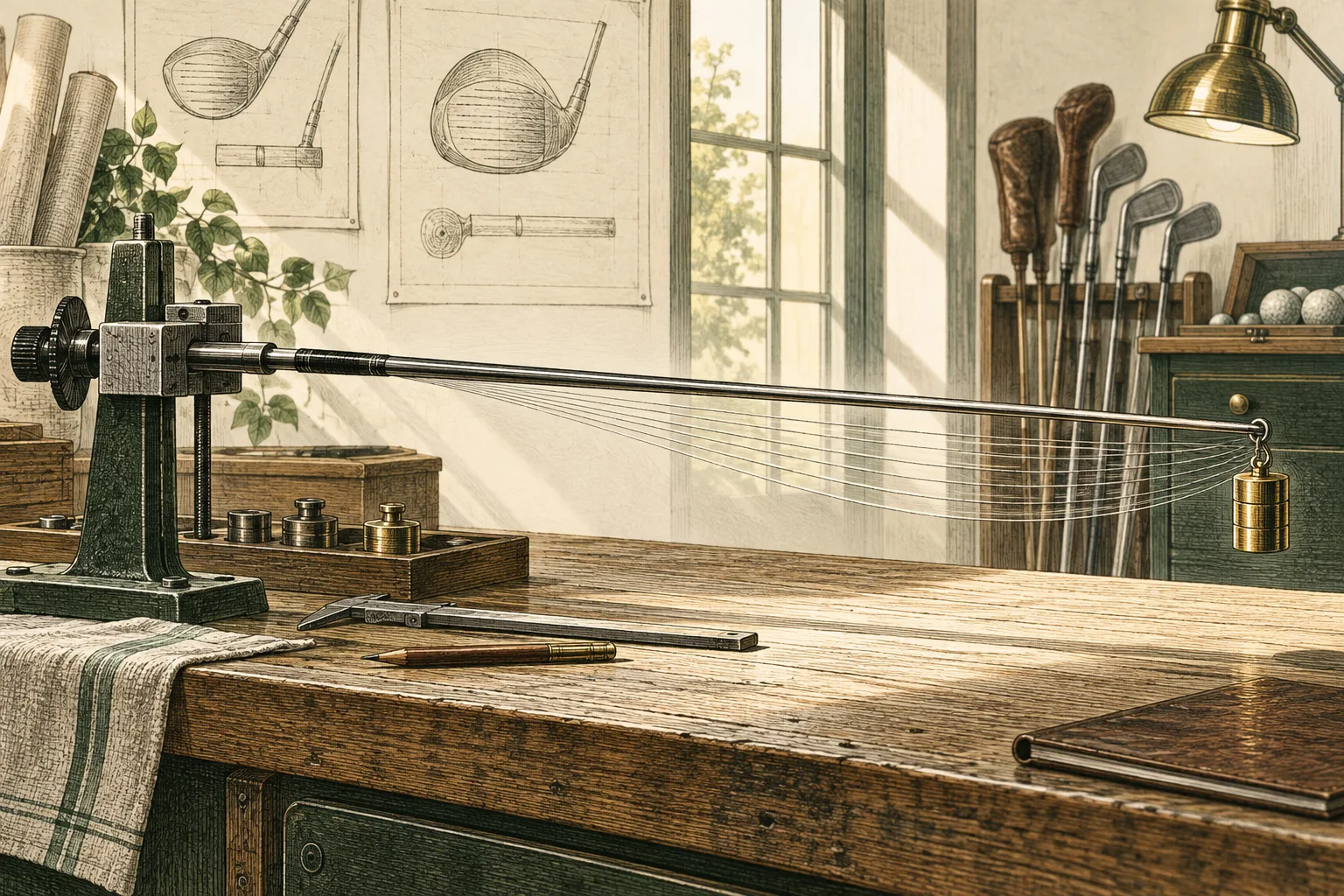
Clamp the butt end of a shaft in a fixture. Hang a standard weight on the tip if the shaft is raw, or leave the head on if the club is built. Pull the tip down, let go, and count how many times it oscillates in a minute. That count is the frequency, in CPM.
The GolfWorks laser frequency machine is a fair picture of the standard bench tool: a five-inch clamp that will hold raw or gripped shafts, an ASTM standard 205-gram tip weight for measuring raw shafts, and a laser rather than reflected light so the reading is not thrown off by shaft color or material. Mitchell's DigiFlex reads from half a cycle per minute to thirty thousand and will also tell you whether a shaft is symmetric — Mitchell's own threshold is that a shaft varying three cycles or less as you rotate it counts as symmetrical.
So far, so tidy. Here is where it stops being tidy.
The number belongs to the fixture, not the shaft
Frequency is not a property of a shaft the way weight is. It is a property of a beam — and the beam is whatever sticks out of the clamp. Change the clamp and you change the beam and you change the number.
KZG's head builder Matthew Mora published a full set of KBS reference charts measured both ways, and the gap is not subtle. A KBS Tour Regular built to KBS's 4.0 trim, seven-iron, reads 284 CPM in a 2.5-inch clamp and 302 CPM in a five-inch clamp. Same club, same day, same machine, eighteen cycles apart. Mora notes on the same page that KBS's own numbers are meant to be taken with the 2.5-inch clamp. Russ Ryden, who profiles shafts for a living, uses a pneumatic clamp seven inches from the butt.
Three respected sources, three different beams, three different truths. A CPM figure quoted without its clamp length is not a measurement; it is a rumor.
Everything else in the build moves it too
Head weight moves it — Mora states it plainly: varying head weights will change the expected CPM readings. Length moves it: the standard iron-set convention is roughly four CPM per half inch, so a seven-iron at 304 wants an eight-iron near 308. Grip weight and even tape build-up move it a little. When somebody tells you their driver "is 250," ask which head, at what length, in what clamp.
What one flex is worth, in cycles
Mitchell gives the working conversion: a shaft at 250 CPM and a shaft at 270 CPM are two flexes apart. Call it ten cycles to a flex and you will not be far wrong on the bench.
Which makes the next number genuinely startling.
One part number, four flexes
Steel iron shafts are usually sold parallel-tip and trimmed to flex by the builder. The KBS charts show exactly what that means. One shaft — KBS Tour, Regular, about 118 grams — built to KBS's 4.0, 4.5, 5.0 and 5.5 trims produces a seven-iron reading 284, 291, 294 and 297 CPM. Same box. Same label. Thirteen cycles of spread, and the chart's own trajectory notes move from "High" to "Low" across that range.
Now put the two charts side by side. A KBS Tour Regular trimmed to 5.5 gives a seven-iron at 297 CPM. A KBS Tour Stiff — a genuinely different shaft, ten grams heavier — trimmed to 5.0 gives a seven-iron at 297 CPM. Identical frequency. Different letter on the label. Different weight in your hands.
If you ever wondered why fitters get impatient with flex letters, that is the sentence.
Where frequency stops telling the truth
Frequency measures one thing: how the whole beam behaves at the butt end. A shaft is not one number long. Ryden's demonstration is the one to remember — three six-iron shafts, every one of them reading 354 CPM on his instrument, and their EI profiles are visibly different objects once you plot local stiffness along the length. His Project X numbers make the same point from the other direction: a 5.0 at 350, a 6.0 at 363, and a 6.0 LZ at 349 — the LZ, wearing the stiffer number, reading softer than the 5.0.
Tim Briand of True Spec Golf has the cleanest summary of frequency's real job: it "will put you in the right area of the stadium, but not the right seat."
The bands this article deliberately does not print
You will find charts online giving you a CPM range per club and per flex. We are not printing one, because every honest version of that chart needs four footnotes — clamp length, head weight, club length, tip trim — and the versions circulating without those footnotes are how people end up convinced their fitter is wrong.
What can be said honestly: GOLF.com's working range for shafts generally is about 200 at the soft end to 300-plus at the stiff end, and the published KBS iron charts land between roughly 250 and the high 330s once trim and clamp are specified. That is a wide field, and the width is the finding.
How to actually use CPM
Two jobs, both real.
Matching a set. Measure every club, plot the numbers, and look for the one that is fifteen cycles out of line with its neighbours. That club is why your eight-iron feels like a stranger. This is what frequency was adopted for and it is still the best thing it does.
Comparing a candidate to your gamer. Put your current club and the shaft you are considering on the same machine, same clamp, same afternoon. The difference between two readings taken on one fixture is trustworthy in a way the absolute number never is.
Everything beyond that — how it launches, how it feels in transition, where it is soft — lives in the bend profile, not the frequency. That is the next chapter.
Bring it to a bay
Numbers on a bench are a hypothesis. Book a bay, put the two builds behind the launch monitor and hit twenty balls with each. If the frequency difference is real for your swing, it shows up as a tighter cluster and a repeatable window, not as a bigger number on one shot.
From the glossary
Related reading: The Clubhouse Guide to Golf Shafts · Shaft Flex Explained: Why the Letter on the Label Lies · Bend Profile and the EI Curve: Under the Kick Point · Raw vs. Cut: The Shaft You Buy Is Not the Shaft You Play

Sleeper Classics: Great Clubs the Market Forgot
The used-club market has a memory problem. Prices track two things — marketing budgets and recency — and neither has much to do with how a club actually performs. A driver that led forgiveness testing in its day gets lapped by nine model cycles and lands in the $100 bin next to genuine junk. A forged iron a Champions Tour pro carried in his own bag sells for less than a single new wedge because the brand never bought enough American ad pages. That inefficiency is your opening.