
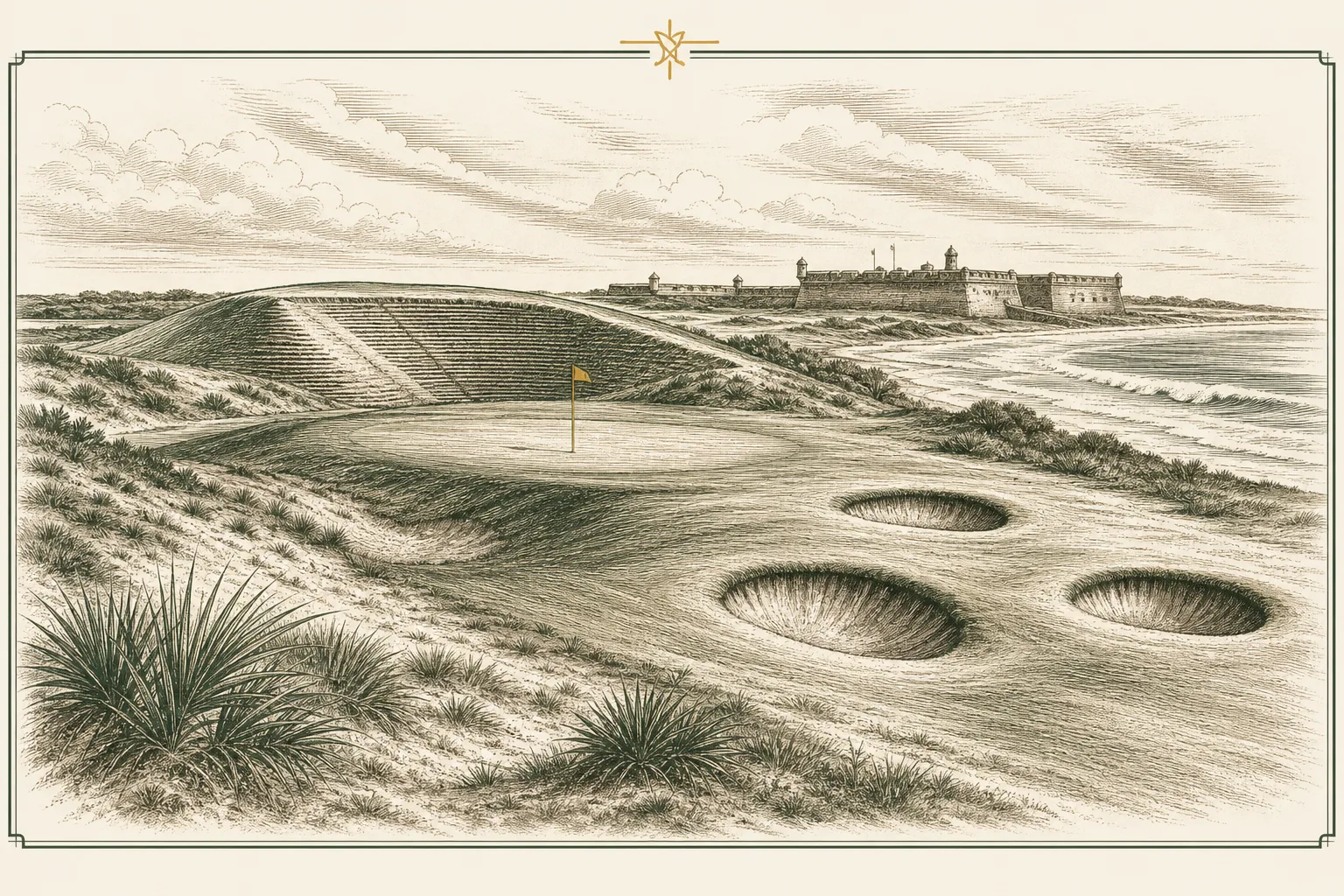
Drive from the Clubhouse: 2.5–3.5 hours.
The First Coast is the longest haul in this guide — figure 2.5 hours to Palatka and a solid 3 to 3.5 up I-75 and I-10 (or US-301 through Starke) to Ponte Vedra and Amelia Island — which makes it a weekend trip, not a dawn-patrol day round. What you get for the drive is the densest concentration of consequential golf in Florida: THE PLAYERS' Stadium Course and its island 17th, the original 1928 island green at Ponte Vedra Inn & Club, the only Palmer–Nicklaus co-design at World Golf Village, and a 1925 Donald Ross original in Palatka that still costs less than a dozen ProV1s. The resort tier on Amelia Island (Omni, Ritz-Carlton) requires a stay to play, so plan lodging around your tee times, not the other way around. Best windows are October–November and March–May; summer brings brutal heat and afternoon storms but also knocks the Stadium Course down to its lowest rate of the year. Play the 17th in our sim first — the real one plays shorter than your nerves will tell you.
TPC Sawgrass (Players Stadium Course) — Ponte Vedra Beach
public · $550–750+ (peak season)
Pete Dye's 1980 Stadium Course is the most famous public-access round in Florida: home of THE PLAYERS, the island-green 17th, and the do-or-die 18th along the lake. Every hole is a Dye set piece, and the PGA TOUR keeps conditioning at tournament grade year-round. Green fee includes a forecaddie and range balls; book 14 days out direct, or further ahead with a Sawgrass Marriott stay.
For newer players: A genuine beating for a beginner — even from the forward tees the water and Dye angles are relentless, so treat it as a bucket-list splurge, not a learning round.
In the encyclopedia: TPC Sawgrass (Players Stadium Course) — read the full write-up, and play it in the sim if it's in the catalog.
TPC Sawgrass (Dye's Valley Course) — Ponte Vedra Beach
public · $200–350
The Stadium's sibling gets the same TOUR-standard agronomy at a third of the price, and it has hosted Korn Ferry Tour and PGA TOUR qualifying events in its own right. It's a Dye/Weed design with water on most holes but wider corridors, so you get the full Sawgrass clubhouse-and-caddie experience without the $700 invoice.
For newer players: Far friendlier than the Stadium and playable for a mid-to-high handicapper from the right tees, though water still lurks on the closing stretch.
In the encyclopedia: TPC Sawgrass (Dye's Valley Course) — read the full write-up, and play it in the sim if it's in the catalog.
World Golf Village (King & Bear Course) — St. Augustine
public · $100–200 (seasonal)
The only course ever co-designed by Arnold Palmer and Jack Nicklaus, and it reads like a conversation between them — open, Palmer-style driving holes giving way to Nicklaus water carries through 200-year-old live oaks and loblolly pines. Conditioning has stayed strong since the Hall of Fame's departure, and it remains the flagship public round in St. Augustine proper.
For newer players: Big fairways and five tee sets make it manageable for newer players who pick the right box; the water holes will still collect a sleeve or two.
In the encyclopedia: World Golf Village (King & Bear Course) — read the full write-up, and play it in the sim if it's in the catalog.
World Golf Village (Slammer & Squire Course) — St. Augustine
public · $80–160 (seasonal)
Bobby Weed built this one with Sam Snead and Gene Sarazen consulting, and it's the gentler, more walkable half of World Golf Village — clean routing through wetlands and pine, sharp greens complexes, and usually a meaningfully cheaper tee sheet than the King & Bear. Pair the two for a genuine 36-hole day trip.
For newer players: The friendlier of the two WGV courses and a fair place for a developing player to post an honest score.
In the encyclopedia: World Golf Village (Slammer & Squire Course) — read the full write-up, and play it in the sim if it's in the catalog.
Ponte Vedra Inn & Club (Ocean Course) — Ponte Vedra Beach
resort · $250–400 (resort guests)
Herbert Strong laid this out in 1928, and its par-3 9th is the original island green — the hole that inspired Dye's 17th a few miles down A1A. It was slated to host the 1939 Ryder Cup before the war intervened. You must stay at the Inn & Club to play, but you're buying nearly a century of Florida golf history on genuine seaside land.
For newer players: Short by modern standards (6,574 yards) and reasonable for a bogey golfer, though ocean wind and the island 9th show no mercy.
Omni Amelia Island Resort (Oak Marsh Course) — Amelia Island
resort · $150–275 (resort guests)
An early Pete Dye design (1972) threaded along serpentine salt-marsh creeks and under moss-draped oaks, freshly renovated by Beau Welling's team in 2025 so it's in the best shape of its life. Tight fairways, small greens, and marsh carries give it real teeth at only 6,471 yards. Tee times are reserved for Omni guests and club members, so build it into an Amelia weekend.
For newer players: Playable yardage but punishing misses — the marsh eats anything offline, so beginners should bring extra balls and patience.
The Golf Club of Amelia Island — Amelia Island
resort · $180–230 (Ritz-Carlton guests)
The Mark McCumber/Gene Littler design that serves as the Ritz-Carlton, Amelia Island's home course — polished parkland golf through oaks, lagoons, and dune ridges a few hundred yards off the Atlantic. Access runs through a Ritz stay-and-play, and the pairing of five-star lodging with an uncrowded, well-kept course makes it the plushest overnight golf trip in northeast Florida.
For newer players: A resort course at heart: generous enough for higher handicaps, with the Ritz service softening any blow to the scorecard.
St. Johns Golf Club — Elkton (St. Augustine)
public · $50–95
St. Johns County poured $8 million into a ground-up rebuild here, and the result is one of Florida's best county-owned courses — fifteen holes dramatically reworked, a new social-hub clubhouse, and a huge short-game area. It routinely draws praise for conditioning that embarrasses courses charging twice the rate, ten minutes off I-95 south of St. Augustine.
For newer players: One of the friendliest quality tracks in the region — multiple tees, forgiving corridors, and a practice setup ideal for working on your game before the round.
Palatka Golf Club — Palatka
public · $25–50
A 1925 Donald Ross original — one of the most intact Ross designs in Florida — that has hosted the Florida Azalea Amateur every spring since 1958. Barely 6,000 yards, but the crowned greens, deep bunkers, and rolling sandhill terrain demand real shotmaking, and the green fee is famously among the best values in American golf. It also sits on the direct route up from Tampa, making it the perfect first or last stop of a Jacksonville trip.
For newer players: Short and walkable, so beginners can enjoy it, but the tiny crowned greens will expose a shaky short game fast.
Fernandina Beach Golf Club — Fernandina Beach
public · $40–70
A 27-hole municipal less than a mile from the Atlantic at the north tip of Amelia Island, with three nines you can mix and match and a Toptracer range. It's the honest, no-valet counterweight to the island's resort golf — old-Florida corridors of oak and pine, sea breeze on every hole, and a tee sheet a walk-up can actually crack on a weekend trip.
For newer players: Classic friendly muni: flat, forgiving, and cheap enough that a rough nine costs you nothing but pride.
Jacksonville Beach Golf Club — Jacksonville Beach
public · $45–75
The City of Jacksonville Beach's muni, rebuilt in 2018 with salt-tolerant paspalum greens and 419 Bermuda fairways, and repeatedly cited as the best public course in Jacksonville proper. It plays firm and breezy a few blocks from the ocean, and it's where the area's good local players actually tee it up when they're not sneaking onto the resort courses.
For newer players: Welcoming and well-priced, though coastal wind can turn a beginner's mid-irons into an adventure.
Windsor Parke Golf Club — Jacksonville
public · $60–90
An Arthur Hills design from 1990 tucked into the Intracoastal corridor between downtown Jacksonville and the beaches — tree-lined, water-guarded, and kept in strong daily-fee condition. It's the reliable mid-priced tee time of the trip: quality architecture, easy access off JTB, and a sensible warm-up or wind-down round around a TPC Sawgrass pilgrimage.
For newer players: Fair from the forward tees, but Hills's doglegs and water placement reward course management over raw speed.
From the glossary
Related reading: TPC Sawgrass (Players Stadium Course) · TPC Sawgrass (Dye's Valley Course) · World Golf Village (King & Bear Course) · World Golf Village (Slammer & Squire Course)

The Most Forgiving Drivers of the 2010s, Ranked by the Data
From roughly 2014 to 2019, every major manufacturer spent its entire driver budget chasing one number: MOI — how much the head resists twisting when you miss the middle. Carbon crowns, tungsten back weights, faces engineered to fight your specific mishit. Those flagships were the most forgiving drivers ever built to that point, and forgiveness does not expire. Your heel strike in 2026 is the same heel strike it was in 2018, and a head that held ball speed on it then holds ball speed on it now.