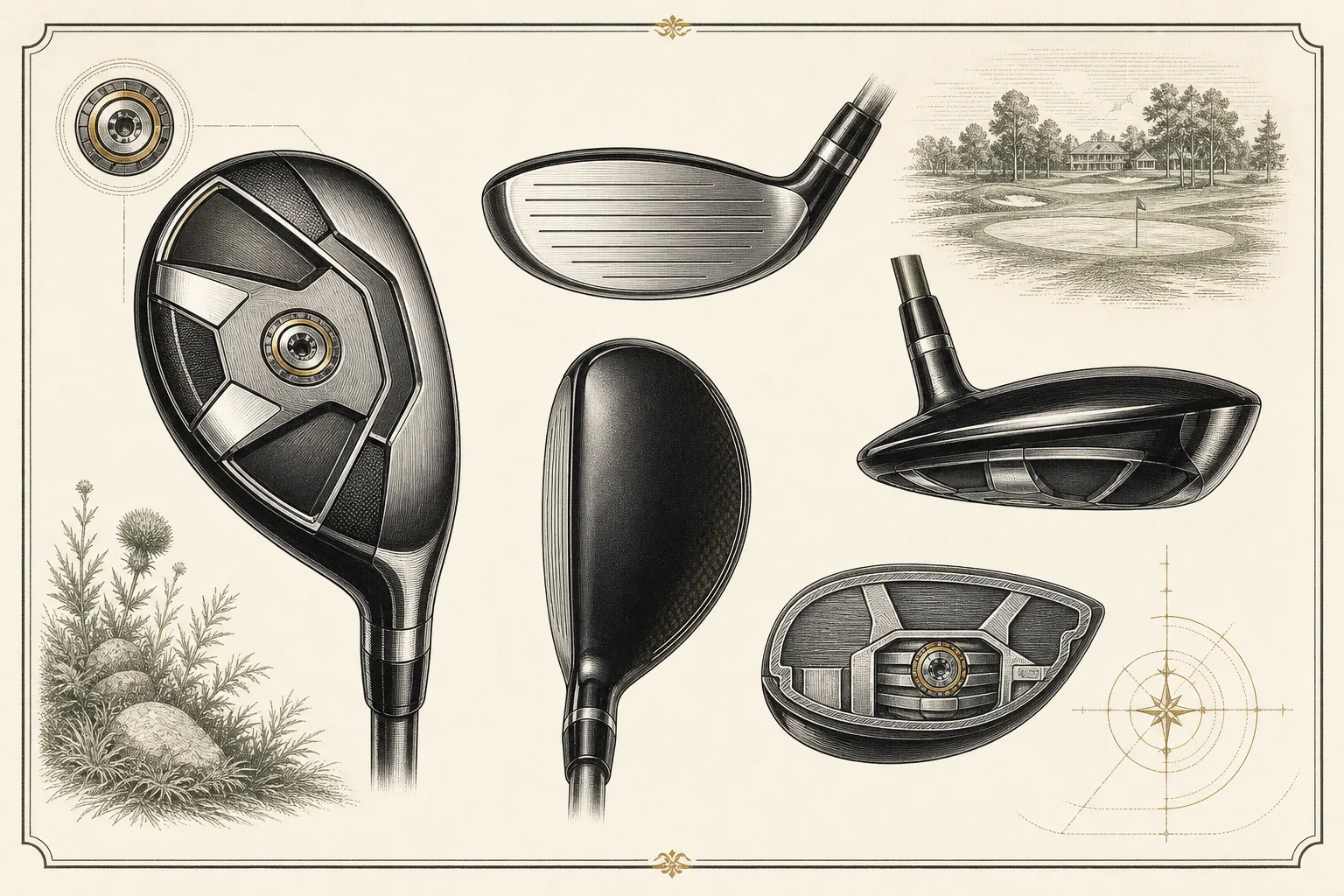
“One of the earlier Apex hybrids — a compact, iron-like head for a player who doesn't want a bulky game-improvement shape in the bag.”
The first hybrid built specifically to accompany Callaway's flagship Apex/Apex Pro irons, launched in 2014. Callaway pitched it as an iron-style hybrid — a driving-iron substitute rather than a scoop-and-launch club — using a neutral center of gravity for iron-like workability and trajectory control. It carried the forged Face Cup (Carpenter 455 steel) for ball speed, an internal Standing Wave low in the head, and a 6-gram sole weight for stability. Reviewers described it as hot, forgiving for its class, and genuinely workable — a rare combination for a hybrid of that era, which helped establish the template Callaway carried into the 2019 and 2021 Apex hybrids.
Reviewed favorably (Golfstead, Golfalot, The Sand Trap) as a strong performer for skilled players, but it never developed independent collector or cult interest — it is remembered, if at all, as the first entry in a hybrid sub-line that Callaway has iterated on every two-to-three years since, not as a standalone icon.
Suited to low-to-mid handicap players wanting an iron-replacement hybrid they can work left-to-right, particularly those already gaming the original Apex/Apex Pro irons. Not a fit for higher handicappers wanting an easy-launching, forgiving bailout club — Callaway's contemporary Big Bertha/X2 Hot hybrids filled that role instead.
Launched into a market where TaylorMade's SLDR/RocketBallz and Titleist's 913H hybrids were the chief rivals. Directly succeeded by the 2019 Apex Hybrid and eventually the 2021 Apex 21/Apex Pro 21 hybrids as Callaway kept refreshing the Apex hybrid sub-line roughly every 2-5 years.
The Standing Wave weighting and forged Face Cup kept ball speed high even on mis-hits according to contemporary testing, but the iron-style shaping and neutral CG were built for workability and shot-shaping rather than maximum forgiveness — off-center hits cost more distance than they would on a wide-sole game-improvement hybrid of the same year.
Calibrated across the whole catalog — a tour blade scores low here on purpose; it means control, not ease.
2nd Swing pre-owned examples run roughly $50–$80 in 2026 depending on condition, against a launch retail 2nd Swing lists as $219.99 (the roster's $259 could not be independently corroborated); private-party eBay pricing tracks similarly low given the club's age.
Reading is one thing — hitting is another. Book a bay and see the numbers for yourself before you buy anywhere.
“One of the earlier Apex hybrids — a compact, iron-like head for a player who doesn't want a bulky game-improvement shape in the bag.”
The first hybrid built specifically to accompany Callaway's flagship Apex/Apex Pro irons, launched in 2014. Callaway pitched it as an iron-style hybrid — a driving-iron substitute rather than a scoop-and-launch club — using a neutral center of gravity for iron-like workability and trajectory control. It carried the forged Face Cup (Carpenter 455 steel) for ball speed, an internal Standing Wave low in the head, and a 6-gram sole weight for stability. Reviewers described it as hot, forgiving for its class, and genuinely workable — a rare combination for a hybrid of that era, which helped establish the template Callaway carried into the 2019 and 2021 Apex hybrids.
Reviewed favorably (Golfstead, Golfalot, The Sand Trap) as a strong performer for skilled players, but it never developed independent collector or cult interest — it is remembered, if at all, as the first entry in a hybrid sub-line that Callaway has iterated on every two-to-three years since, not as a standalone icon.
Suited to low-to-mid handicap players wanting an iron-replacement hybrid they can work left-to-right, particularly those already gaming the original Apex/Apex Pro irons. Not a fit for higher handicappers wanting an easy-launching, forgiving bailout club — Callaway's contemporary Big Bertha/X2 Hot hybrids filled that role instead.
Launched into a market where TaylorMade's SLDR/RocketBallz and Titleist's 913H hybrids were the chief rivals. Directly succeeded by the 2019 Apex Hybrid and eventually the 2021 Apex 21/Apex Pro 21 hybrids as Callaway kept refreshing the Apex hybrid sub-line roughly every 2-5 years.
The Standing Wave weighting and forged Face Cup kept ball speed high even on mis-hits according to contemporary testing, but the iron-style shaping and neutral CG were built for workability and shot-shaping rather than maximum forgiveness — off-center hits cost more distance than they would on a wide-sole game-improvement hybrid of the same year.
Calibrated across the whole catalog — a tour blade scores low here on purpose; it means control, not ease.
2nd Swing pre-owned examples run roughly $50–$80 in 2026 depending on condition, against a launch retail 2nd Swing lists as $219.99 (the roster's $259 could not be independently corroborated); private-party eBay pricing tracks similarly low given the club's age.
Reading is one thing — hitting is another. Book a bay and see the numbers for yourself before you buy anywhere.