“A rung-1 game-improvement iron with strong lofts and a forgiving forged body built for distance and launch. Aimed at slower swings that want yards and help. Dated now and cheap used, but effective for its target buyer.”
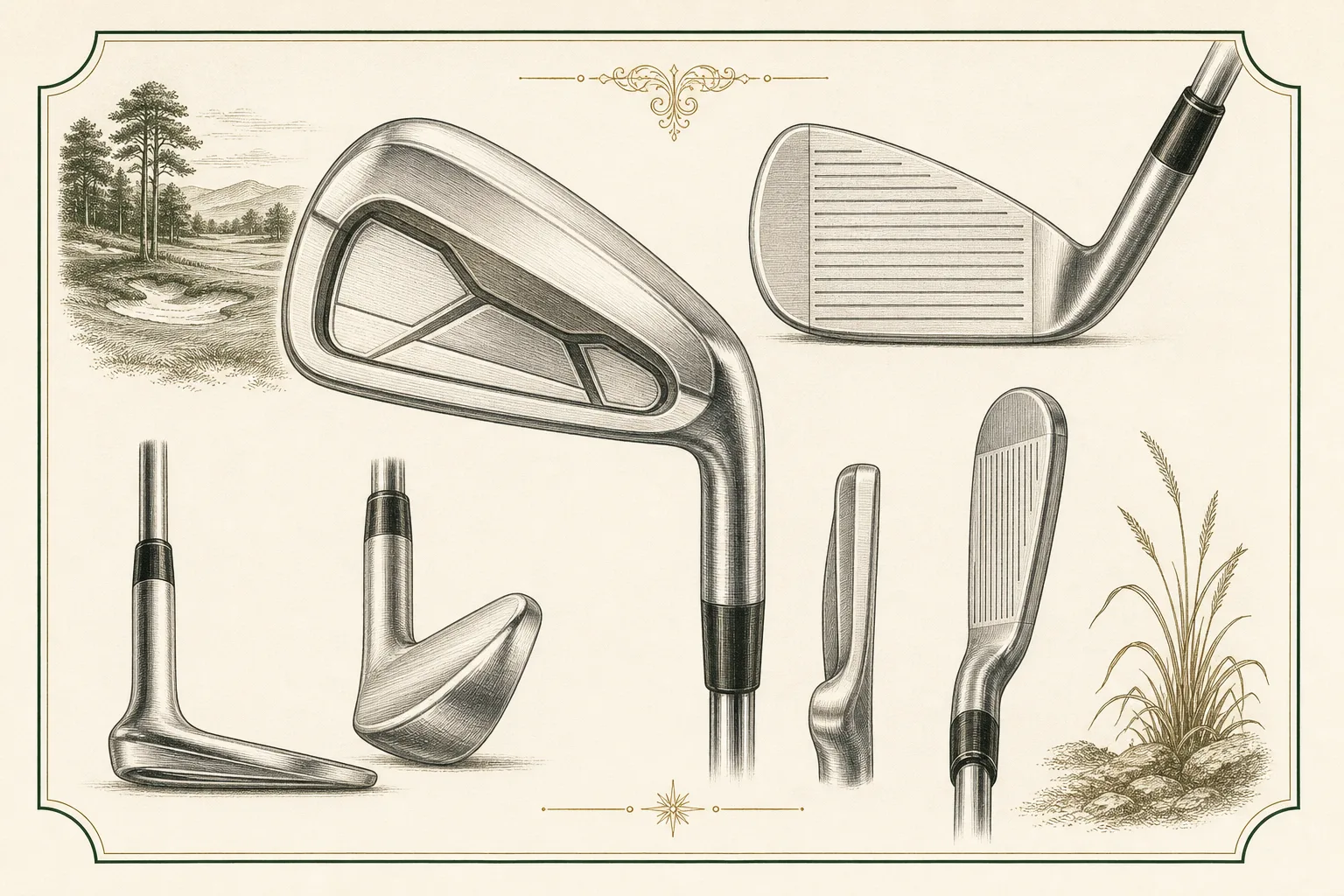
Positioned for mid-to-high handicappers, the JGR CB Forged iron was Bridgestone's pitch that a game-improvement iron didn't have to feel like one: forged from 1020 carbon steel rather than the cast construction typical of the category. Versus Bridgestone's own preceding J15 CB, it carried a wider sole for better turf interaction, a longer head for more MOI, a lower CG and more offset to help launch, and a claimed 4% larger sweet spot. Strong, modern lofts (23° 5-iron down to 39° 9-iron) and a stock True Temper XP 95 shaft with Flex Chamber technology rounded out a set built to launch high and land soft with minimal swing compensation required.
Reviewers praised the feel emphatically at launch ('one of the best feeling sweet spots in memory'), but that praise sat inside a normal two-year Bridgestone GI refresh cycle — it was superseded by later JGR/Tour B HF-series irons, and there's no forum reverence, scarcity, or resale premium today. A genuinely nice-feeling forged GI iron with a completely ordinary market afterlife.
Built explicitly for mid-to-high handicappers who want help launching the ball high with distance control on approach shots, but who also value a softer, more premium feel than typical cast GI irons deliver. Not aimed at low-handicap shot-shapers, who would find the offset and strong lofts limiting for workability.
Released in 2016 alongside the rest of the JGR family (driver, fairway, hybrid), competing against Callaway's Big Bertha OS/Rogue-era irons, TaylorMade's M2, and Ping's G-series game-improvement irons — all of which, like the JGR CB, chased forgiving distance with progressively stronger lofts.
Wide sole, extra offset, larger effective sweet spot and a low, deep CG relative to Bridgestone's own prior CB model all point squarely at game-improvement forgiveness — mis-hits launch and hold line well for a mid-to-high handicap swing. Forged construction affects feel, not forgiveness; this is not a players' cavity despite the soft-forged feel reviewers highlighted.
Calibrated across the whole catalog — a tour blade scores low here on purpose; it means control, not ease.
A complete steel-shafted 5-AW set realistically sells for roughly $180–$300 in 2026 private-party condition, well down from its $799 original set price; graphite-shafted sets and cleaner cosmetic condition sit at the top of that range. It is a functional bargain-buy set, not a collectible.
Reading is one thing — hitting is another. Book a bay and see the numbers for yourself before you buy anywhere.
“A rung-1 game-improvement iron with strong lofts and a forgiving forged body built for distance and launch. Aimed at slower swings that want yards and help. Dated now and cheap used, but effective for its target buyer.”
Positioned for mid-to-high handicappers, the JGR CB Forged iron was Bridgestone's pitch that a game-improvement iron didn't have to feel like one: forged from 1020 carbon steel rather than the cast construction typical of the category. Versus Bridgestone's own preceding J15 CB, it carried a wider sole for better turf interaction, a longer head for more MOI, a lower CG and more offset to help launch, and a claimed 4% larger sweet spot. Strong, modern lofts (23° 5-iron down to 39° 9-iron) and a stock True Temper XP 95 shaft with Flex Chamber technology rounded out a set built to launch high and land soft with minimal swing compensation required.
Reviewers praised the feel emphatically at launch ('one of the best feeling sweet spots in memory'), but that praise sat inside a normal two-year Bridgestone GI refresh cycle — it was superseded by later JGR/Tour B HF-series irons, and there's no forum reverence, scarcity, or resale premium today. A genuinely nice-feeling forged GI iron with a completely ordinary market afterlife.
Built explicitly for mid-to-high handicappers who want help launching the ball high with distance control on approach shots, but who also value a softer, more premium feel than typical cast GI irons deliver. Not aimed at low-handicap shot-shapers, who would find the offset and strong lofts limiting for workability.
Released in 2016 alongside the rest of the JGR family (driver, fairway, hybrid), competing against Callaway's Big Bertha OS/Rogue-era irons, TaylorMade's M2, and Ping's G-series game-improvement irons — all of which, like the JGR CB, chased forgiving distance with progressively stronger lofts.
Wide sole, extra offset, larger effective sweet spot and a low, deep CG relative to Bridgestone's own prior CB model all point squarely at game-improvement forgiveness — mis-hits launch and hold line well for a mid-to-high handicap swing. Forged construction affects feel, not forgiveness; this is not a players' cavity despite the soft-forged feel reviewers highlighted.
Calibrated across the whole catalog — a tour blade scores low here on purpose; it means control, not ease.
A complete steel-shafted 5-AW set realistically sells for roughly $180–$300 in 2026 private-party condition, well down from its $799 original set price; graphite-shafted sets and cleaner cosmetic condition sit at the top of that range. It is a functional bargain-buy set, not a collectible.
Reading is one thing — hitting is another. Book a bay and see the numbers for yourself before you buy anywhere.