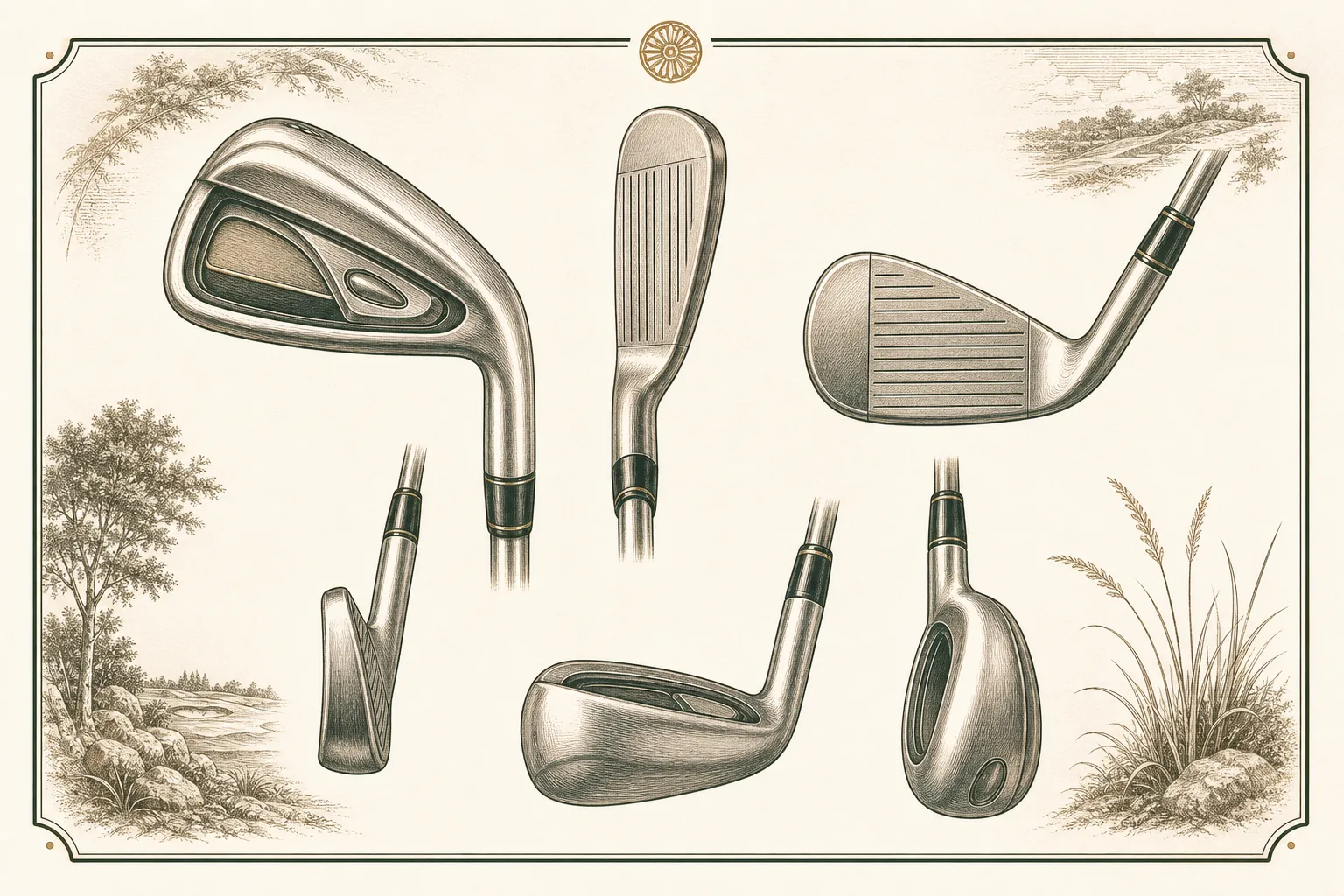
“Adams pioneered the hybrid-plus-iron combo set with the original Idea. A game-improvement cavity rung that swaps hard-to-hit long irons for forgiving hybrids.”
The set that made the hybrid-iron combo a mainstream category. Off the runaway success of the Tight Lies fairway woods, Adams applied the same shallow-profile, low-CG, easy-launch philosophy to the hardest clubs in the bag: the long irons. The original Idea set replaced the traditional 3-4-5 irons with matched hybrids built to the same lengths and lie angles as the cavity-back short irons, so a golfer moved through the set without switching swing feels. That 'integrated set' idea, hybrids up top flowing into progressively bladed short irons, was novel at retail and became the template the entire industry copied. Adams leaned so hard into it that the concept became the brand's identity, spawning the long-running Idea a-series (a1, a2, a3, a7, a12) that followed.
Notable on reflected prestige, not an established cult classic in its own right. The Idea line is repeatedly credited across golf media and retail histories with pioneering and popularizing the integrated hybrid-iron combo set, a format now standard from every major maker, and Adams built its post-Tight-Lies reputation on it. But that reverence attaches to the Idea CONCEPT and the later a-series line, not demonstrably to this specific, thinly-documented first-generation 2003 set. Without direct evidence collectors or feel-chasers seek out THIS SKU the way they hunt an MP-32, 'cult classic' would overstate it; 'notable' credits the line's genuine category-defining role while being honest that this particular set rides on borrowed reputation.
Made for high-handicap, senior, and moderate-speed players who lose the most strokes to unhittable long irons, plus improvers who want height and forgiveness through the bag. Lofts (3H=20 through PW=47) are moderately traditional by modern standards, so it flies shorter but stops softer than a jacked-loft modern set. A low-handicap ball-striker wanting a workable, compact look should not buy it.
Debuted 2003 as Adams pivoted from being a fairway-wood specialist to a hybrid-iron pioneer; the a1 and a1 Pro followed in 2004, then a2 (2005), a3 (2007), a7 (2009), and a12. It competed against early game-improvement sets from Callaway, TaylorMade, and Ping that still used conventional or oversized long irons, and it beat them on long-club playability. Modern descendants include essentially every current combo/hybrid set (e.g. Callaway, Cobra, and Cleveland launcher-style sets) that hybridizes the long irons.
Genuinely forgiving and deliberately so. Swapping the notoriously hard-to-hit 3/4/5 irons for low-CG hybrids is one of the single biggest playability upgrades available to a slower or less consistent player, getting the long clubs airborne with far less penalty, while the cavity-back short irons add perimeter weighting and offset. It is not a compact players' set and makes no pretense of workability; that's the point. It sits a notch below max-game-improvement one-piece sets only because the short irons are conventional cavity-backs rather than oversized.
Calibrated across the whole catalog — a tour blade scores low here on purpose; it means control, not ease.
Plentiful and cheap on the used market: a realistic 2026 private-party price for a complete original Idea combo set is roughly $60-150 depending on completeness, shaft, and wear, with graphite senior-flex sets common. Reconditioned-retail listings run higher but overstate private-party value. It's a value buy for a high-handicapper, not a collectible; the a3/a7 successors are often easier to find.
Reading is one thing — hitting is another. Book a bay and see the numbers for yourself before you buy anywhere.
“Adams pioneered the hybrid-plus-iron combo set with the original Idea. A game-improvement cavity rung that swaps hard-to-hit long irons for forgiving hybrids.”
The set that made the hybrid-iron combo a mainstream category. Off the runaway success of the Tight Lies fairway woods, Adams applied the same shallow-profile, low-CG, easy-launch philosophy to the hardest clubs in the bag: the long irons. The original Idea set replaced the traditional 3-4-5 irons with matched hybrids built to the same lengths and lie angles as the cavity-back short irons, so a golfer moved through the set without switching swing feels. That 'integrated set' idea, hybrids up top flowing into progressively bladed short irons, was novel at retail and became the template the entire industry copied. Adams leaned so hard into it that the concept became the brand's identity, spawning the long-running Idea a-series (a1, a2, a3, a7, a12) that followed.
Notable on reflected prestige, not an established cult classic in its own right. The Idea line is repeatedly credited across golf media and retail histories with pioneering and popularizing the integrated hybrid-iron combo set, a format now standard from every major maker, and Adams built its post-Tight-Lies reputation on it. But that reverence attaches to the Idea CONCEPT and the later a-series line, not demonstrably to this specific, thinly-documented first-generation 2003 set. Without direct evidence collectors or feel-chasers seek out THIS SKU the way they hunt an MP-32, 'cult classic' would overstate it; 'notable' credits the line's genuine category-defining role while being honest that this particular set rides on borrowed reputation.
Made for high-handicap, senior, and moderate-speed players who lose the most strokes to unhittable long irons, plus improvers who want height and forgiveness through the bag. Lofts (3H=20 through PW=47) are moderately traditional by modern standards, so it flies shorter but stops softer than a jacked-loft modern set. A low-handicap ball-striker wanting a workable, compact look should not buy it.
Debuted 2003 as Adams pivoted from being a fairway-wood specialist to a hybrid-iron pioneer; the a1 and a1 Pro followed in 2004, then a2 (2005), a3 (2007), a7 (2009), and a12. It competed against early game-improvement sets from Callaway, TaylorMade, and Ping that still used conventional or oversized long irons, and it beat them on long-club playability. Modern descendants include essentially every current combo/hybrid set (e.g. Callaway, Cobra, and Cleveland launcher-style sets) that hybridizes the long irons.
Genuinely forgiving and deliberately so. Swapping the notoriously hard-to-hit 3/4/5 irons for low-CG hybrids is one of the single biggest playability upgrades available to a slower or less consistent player, getting the long clubs airborne with far less penalty, while the cavity-back short irons add perimeter weighting and offset. It is not a compact players' set and makes no pretense of workability; that's the point. It sits a notch below max-game-improvement one-piece sets only because the short irons are conventional cavity-backs rather than oversized.
Calibrated across the whole catalog — a tour blade scores low here on purpose; it means control, not ease.
Plentiful and cheap on the used market: a realistic 2026 private-party price for a complete original Idea combo set is roughly $60-150 depending on completeness, shaft, and wear, with graphite senior-flex sets common. Reconditioned-retail listings run higher but overstate private-party value. It's a value buy for a high-handicapper, not a collectible; the a3/a7 successors are often easier to find.
Reading is one thing — hitting is another. Book a bay and see the numbers for yourself before you buy anywhere.