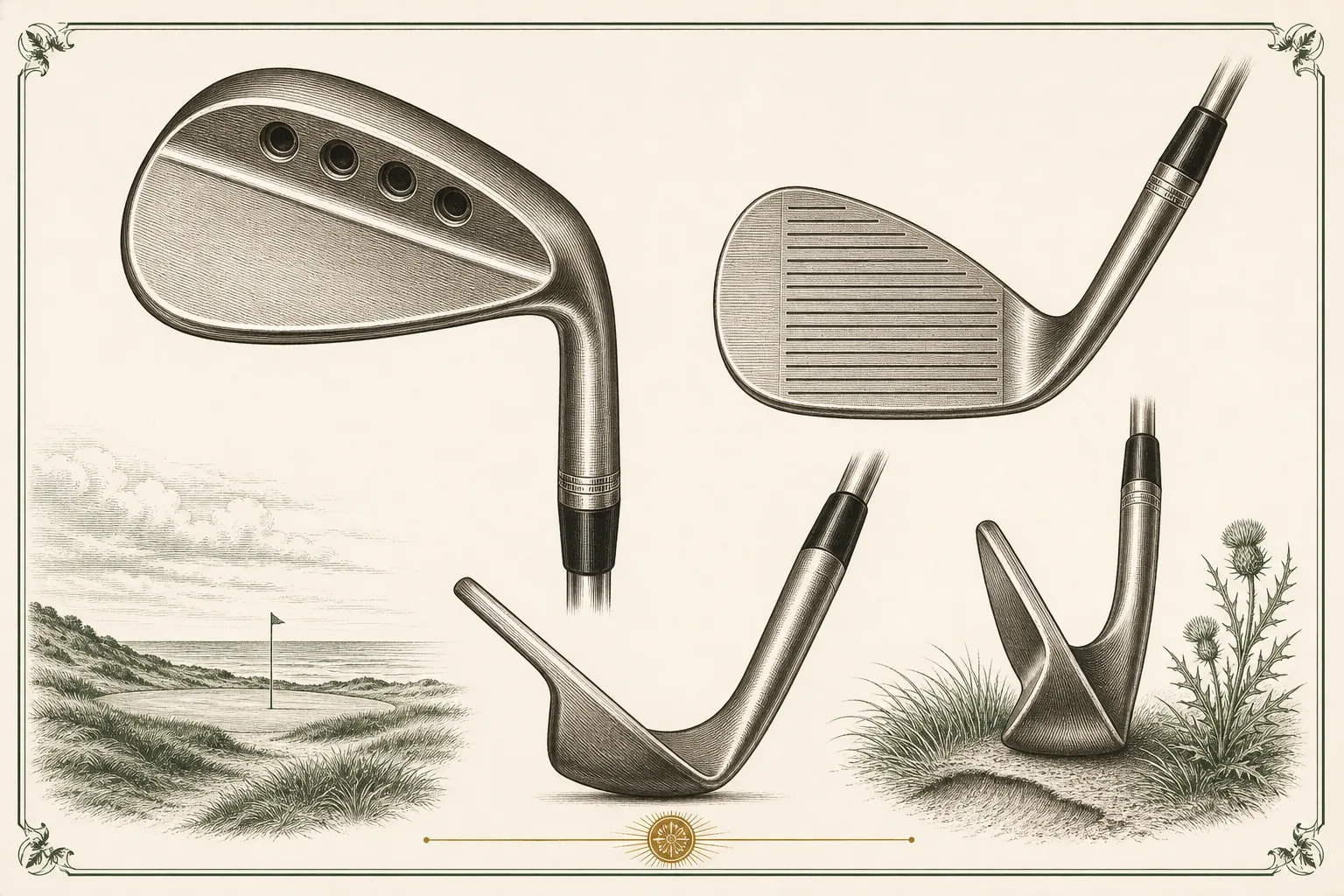
“Phil Mickelson's extreme high-toe, aggressive C-grind for flops. Steel players' wedge; a specialist identity club for the creative short game.”
The PM Grind is Phil Mickelson's signature wedge, born as a one-off prototype Roger Cleveland built for him around 2014 after Phil kept reaching for an old high-toe Ping wedge that let him open the face for flops from the rough. Cleveland took a Mack Daddy 2, ground out an oversized high toe with grooves extended all the way to the toe (so the face looks bigger when opened), added offset, and swapped the U-grind for a modified C-grind with a tight heel-toe radius for face-opening versatility. Phil tested it on Tour until it matched what he wanted, and Callaway released it publicly in 2015-16 (later refreshed as the PM Grind 19). Its face carries micro-grooves milled at a 20-degree angle so they sit square to target when the face is open. It is unapologetically a short-game artist's tool.
It has a genuine claim to cult status on two independent grounds documented across golf media (Golf Digest, Golf.com, MyGolfSpy, Links): it is the signature wedge of the greatest short-game player of his era, born from his own gamer, and it helped launch the modern high-toe wedge category that later spawned the Cleveland RTX Full-Face, Callaway's own MD5/JAWS Raw high-toe and others. Its unmistakable oversized high-toe silhouette makes it a sought-after piece for short-game enthusiasts. Note the honest caveat: reviews were polarized (MyGolfSpy literally asked 'Is this even a good idea?') — it is coveted as a distinctive specialist, not universally loved as an everyday wedge.
Low-handicap and skilled short-game players who open the face, hit flops and creative shots, and play enough soft/variable lies to exploit the high-toe C-grind. It is fundamentally a lob/sand-wedge concept (offered 56-64 degrees). Higher-handicap or steep, dig-prone players, and anyone wanting a simple set-and-forget full-swing wedge, should choose a more conventional wide-sole wedge — the PM Grind's versatility is wasted on, and can hurt, a mechanical short game.
Launched into the mid-2010s premium wedge market against the Titleist Vokey SM6, Cleveland RTX-3 and TaylorMade Milled Grind. It sat above the standard Mack Daddy line as a specialty model and was refreshed as the PM Grind 19. Historically it is a pivotal high-toe design: the concept it popularized became a whole sub-category, from the Cleveland RTX Full-Face and Ping Glide Forged high-toe to Callaway's own high-toe raw wedges.
Low, and by design — this is a specialist creative-short-game wedge, not a forgiving one. Wedge forgiveness is a different axis from iron GI scoring; here it means turf versatility and off-center behavior. The high toe does add mass up the face where thin/toey mishits happen, which helps those strikes, but the aggressive C-grind, added offset and open-face bias reward a skilled hand and punish an inconsistent one on full and stock shots. A 3 reflects a demanding specialist tool: it makes hard flops easier for a good player, not golf easier for everyone.
Calibrated across the whole catalog — a tour blade scores low here on purpose; it means control, not ease.
A used specialty wedge: realistic 2026 private-party prices run roughly $60-110 depending on loft, finish (Chrome vs Matte Black) and groove wear, with clean examples and the rarer high lofts (the 64-degree) commanding the top of that range from short-game enthusiasts. Reconditioned-retail listings (Callaway Pre-Owned, 2nd Swing) run higher and graded/warrantied and overstate resale value. Groove wear is the main value killer on any used wedge — spin is the whole point of this one.
Reading is one thing — hitting is another. Book a bay and see the numbers for yourself before you buy anywhere.
“Phil Mickelson's extreme high-toe, aggressive C-grind for flops. Steel players' wedge; a specialist identity club for the creative short game.”
The PM Grind is Phil Mickelson's signature wedge, born as a one-off prototype Roger Cleveland built for him around 2014 after Phil kept reaching for an old high-toe Ping wedge that let him open the face for flops from the rough. Cleveland took a Mack Daddy 2, ground out an oversized high toe with grooves extended all the way to the toe (so the face looks bigger when opened), added offset, and swapped the U-grind for a modified C-grind with a tight heel-toe radius for face-opening versatility. Phil tested it on Tour until it matched what he wanted, and Callaway released it publicly in 2015-16 (later refreshed as the PM Grind 19). Its face carries micro-grooves milled at a 20-degree angle so they sit square to target when the face is open. It is unapologetically a short-game artist's tool.
It has a genuine claim to cult status on two independent grounds documented across golf media (Golf Digest, Golf.com, MyGolfSpy, Links): it is the signature wedge of the greatest short-game player of his era, born from his own gamer, and it helped launch the modern high-toe wedge category that later spawned the Cleveland RTX Full-Face, Callaway's own MD5/JAWS Raw high-toe and others. Its unmistakable oversized high-toe silhouette makes it a sought-after piece for short-game enthusiasts. Note the honest caveat: reviews were polarized (MyGolfSpy literally asked 'Is this even a good idea?') — it is coveted as a distinctive specialist, not universally loved as an everyday wedge.
Low-handicap and skilled short-game players who open the face, hit flops and creative shots, and play enough soft/variable lies to exploit the high-toe C-grind. It is fundamentally a lob/sand-wedge concept (offered 56-64 degrees). Higher-handicap or steep, dig-prone players, and anyone wanting a simple set-and-forget full-swing wedge, should choose a more conventional wide-sole wedge — the PM Grind's versatility is wasted on, and can hurt, a mechanical short game.
Launched into the mid-2010s premium wedge market against the Titleist Vokey SM6, Cleveland RTX-3 and TaylorMade Milled Grind. It sat above the standard Mack Daddy line as a specialty model and was refreshed as the PM Grind 19. Historically it is a pivotal high-toe design: the concept it popularized became a whole sub-category, from the Cleveland RTX Full-Face and Ping Glide Forged high-toe to Callaway's own high-toe raw wedges.
Low, and by design — this is a specialist creative-short-game wedge, not a forgiving one. Wedge forgiveness is a different axis from iron GI scoring; here it means turf versatility and off-center behavior. The high toe does add mass up the face where thin/toey mishits happen, which helps those strikes, but the aggressive C-grind, added offset and open-face bias reward a skilled hand and punish an inconsistent one on full and stock shots. A 3 reflects a demanding specialist tool: it makes hard flops easier for a good player, not golf easier for everyone.
Calibrated across the whole catalog — a tour blade scores low here on purpose; it means control, not ease.
A used specialty wedge: realistic 2026 private-party prices run roughly $60-110 depending on loft, finish (Chrome vs Matte Black) and groove wear, with clean examples and the rarer high lofts (the 64-degree) commanding the top of that range from short-game enthusiasts. Reconditioned-retail listings (Callaway Pre-Owned, 2nd Swing) run higher and graded/warrantied and overstate resale value. Groove wear is the main value killer on any used wedge — spin is the whole point of this one.
Reading is one thing — hitting is another. Book a bay and see the numbers for yourself before you buy anywhere.