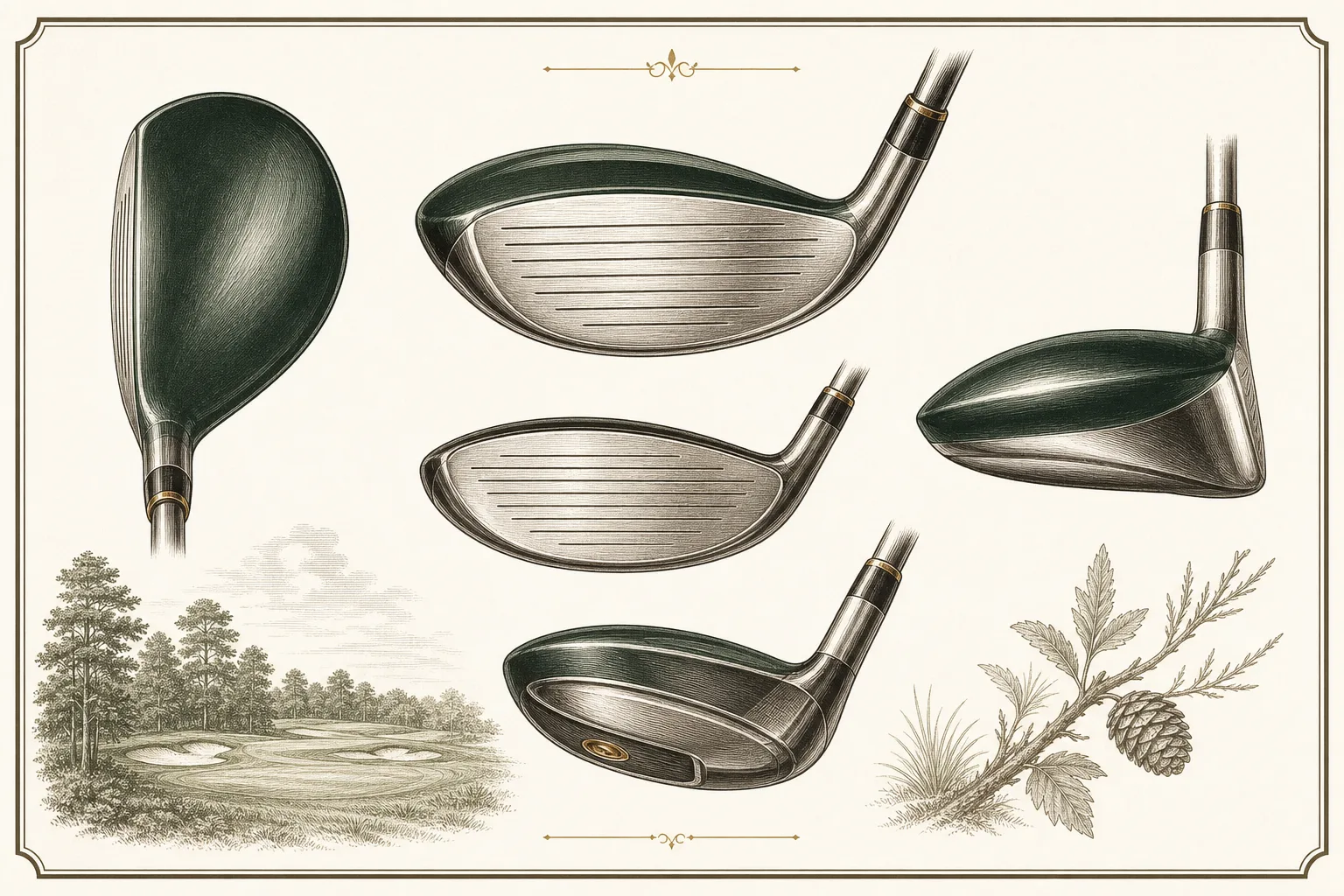
“The club that built Adams: a shallow, upside-down tri-sole design that launches sky-high from tight lies. One of the easiest fairways ever made to get airborne, and a genuine rung-1 confidence club.”
The Tight Lies fairway wood is the club that saved Adams Golf. Founder Barney Adams sketched its upside-down, trapezoidal Tri-Sole shape on a legal pad in about twenty minutes, flipping the conventional sole to put mass low and forward and make the ball almost impossible not to get airborne. It debuted in 1995-96, and a 1996 Golf Channel infomercial with Jack Whitaker and Hank Haney turned it into a phenomenon: Adams sold more than $30 million of Tight Lies in 1997 alone, and by 1998 nearly a million were in play. This listing's 2003 start date reflects a later-generation Tight Lies SKU rather than the 1995 original -- Adams kept the name and tri-sole concept in continuous, numbered production (Tight Lies 2, GT, ST) through the mid-2010s and relaunched it again as late as 2021.
This isn't a borderline call: the original Tight Lies is credited with keeping Adams Golf in business and driving the company's 1998 IPO, and GolfWRX lists it among its 'top 10 modern classic fairway woods of all time.' Adams revived the name and tri-sole concept repeatedly -- 2013/2014's Ghost Slot generation and again in 2021 -- specifically to cash in on nostalgia for the original, itself strong evidence of lasting cult status; few discontinued 1990s fairway woods get three separate 21st-century relaunches.
Any handicap level struggling to get a fairway wood or long iron airborne from the fairway, rough, or a tight/bare lie -- explicitly the club's reason for existing, and true of every generation sold under the name. A better player who wants a fairway wood with a more penetrating, controllable flight would find the tri-sole shape's high launch bias limiting.
Launched into a market where fairway woods were still shaped like small drivers and struggled from anything but a perfect lie; Tight Lies redefined the category and pushed competitors (Callaway, TaylorMade, Titleist) toward shallow-face, low-CG fairway wood designs through the 2000s. Adams kept revisiting the name across its own history -- Tight Lies 2/GT/ST generations through the 2000s, a Ghost Slot-technology relaunch in 2014, and another in 2021 -- always returning to the same core tri-sole shape.
The entire point of the tri-sole, upside-down design is forgiveness and easy launch from bad lies -- it was marketed and remembered specifically for making fairway woods playable for golfers who couldn't hit one before. It isn't a 9-10 because the shallow face and compact profile (chosen to reduce turf drag) trade away some outright mis-hit tolerance versus a modern deep-faced, max-forgiveness GI fairway wood.
Calibrated across the whole catalog — a tour blade scores low here on purpose; it means control, not ease.
Genuinely cheap despite the cult reputation: Golf Avenue's trade-in data shows an average payout around $89, and realistic 2026 private-party resale for a clean original-era Tight Lies fairway (various generations, 1990s-2000s) runs roughly $25-$60 depending on generation and condition -- millions were sold, so supply is high even though the name still carries real nostalgia.
Reading is one thing — hitting is another. Book a bay and see the numbers for yourself before you buy anywhere.
“The club that built Adams: a shallow, upside-down tri-sole design that launches sky-high from tight lies. One of the easiest fairways ever made to get airborne, and a genuine rung-1 confidence club.”
The Tight Lies fairway wood is the club that saved Adams Golf. Founder Barney Adams sketched its upside-down, trapezoidal Tri-Sole shape on a legal pad in about twenty minutes, flipping the conventional sole to put mass low and forward and make the ball almost impossible not to get airborne. It debuted in 1995-96, and a 1996 Golf Channel infomercial with Jack Whitaker and Hank Haney turned it into a phenomenon: Adams sold more than $30 million of Tight Lies in 1997 alone, and by 1998 nearly a million were in play. This listing's 2003 start date reflects a later-generation Tight Lies SKU rather than the 1995 original -- Adams kept the name and tri-sole concept in continuous, numbered production (Tight Lies 2, GT, ST) through the mid-2010s and relaunched it again as late as 2021.
This isn't a borderline call: the original Tight Lies is credited with keeping Adams Golf in business and driving the company's 1998 IPO, and GolfWRX lists it among its 'top 10 modern classic fairway woods of all time.' Adams revived the name and tri-sole concept repeatedly -- 2013/2014's Ghost Slot generation and again in 2021 -- specifically to cash in on nostalgia for the original, itself strong evidence of lasting cult status; few discontinued 1990s fairway woods get three separate 21st-century relaunches.
Any handicap level struggling to get a fairway wood or long iron airborne from the fairway, rough, or a tight/bare lie -- explicitly the club's reason for existing, and true of every generation sold under the name. A better player who wants a fairway wood with a more penetrating, controllable flight would find the tri-sole shape's high launch bias limiting.
Launched into a market where fairway woods were still shaped like small drivers and struggled from anything but a perfect lie; Tight Lies redefined the category and pushed competitors (Callaway, TaylorMade, Titleist) toward shallow-face, low-CG fairway wood designs through the 2000s. Adams kept revisiting the name across its own history -- Tight Lies 2/GT/ST generations through the 2000s, a Ghost Slot-technology relaunch in 2014, and another in 2021 -- always returning to the same core tri-sole shape.
The entire point of the tri-sole, upside-down design is forgiveness and easy launch from bad lies -- it was marketed and remembered specifically for making fairway woods playable for golfers who couldn't hit one before. It isn't a 9-10 because the shallow face and compact profile (chosen to reduce turf drag) trade away some outright mis-hit tolerance versus a modern deep-faced, max-forgiveness GI fairway wood.
Calibrated across the whole catalog — a tour blade scores low here on purpose; it means control, not ease.
Genuinely cheap despite the cult reputation: Golf Avenue's trade-in data shows an average payout around $89, and realistic 2026 private-party resale for a clean original-era Tight Lies fairway (various generations, 1990s-2000s) runs roughly $25-$60 depending on generation and condition -- millions were sold, so supply is high even though the name still carries real nostalgia.
Reading is one thing — hitting is another. Book a bay and see the numbers for yourself before you buy anywhere.