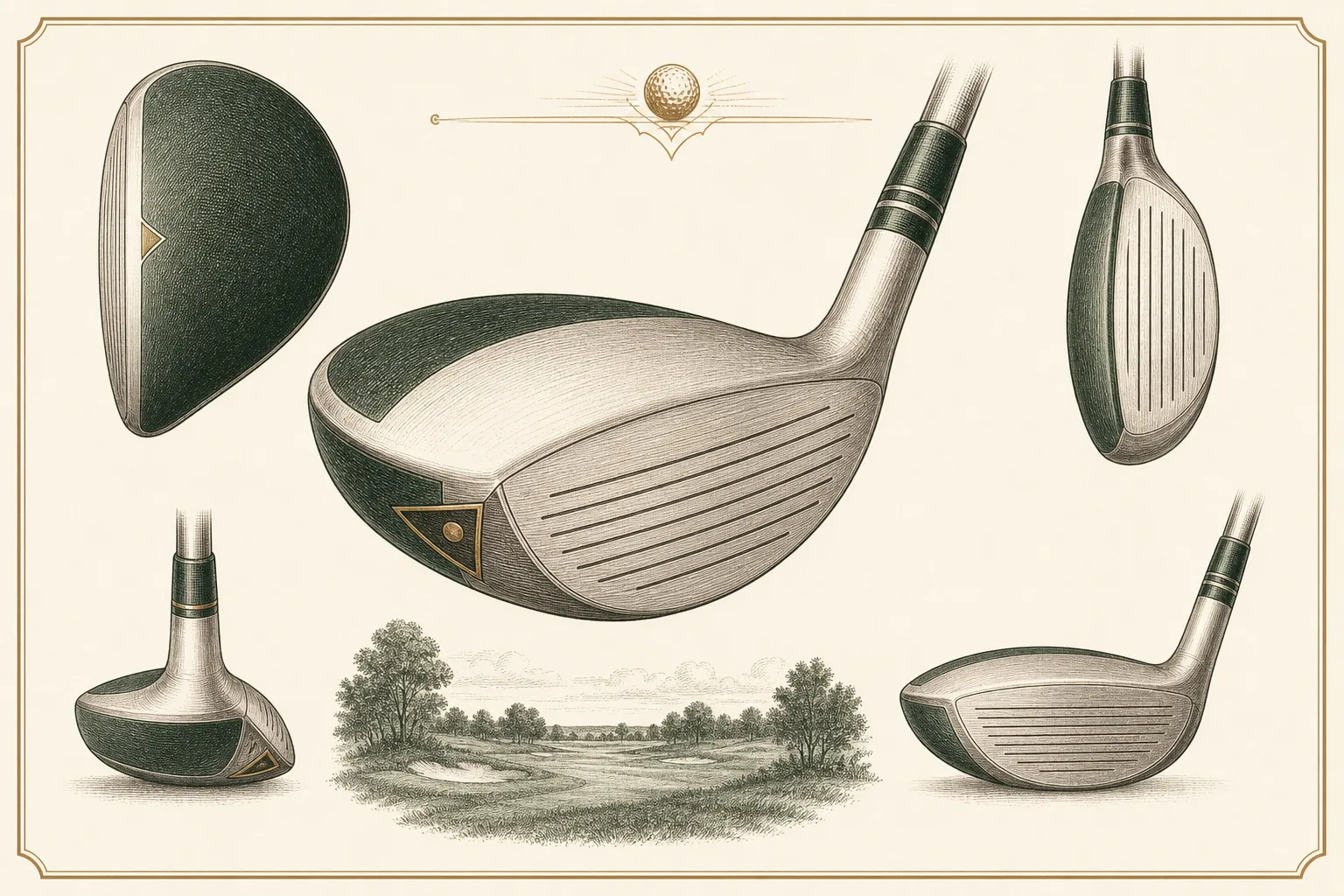
The original Tight Lies is the club that built Adams Golf. Founder Barney Adams reportedly sketched the concept on a legal pad in about 20 minutes: an upright, trapezoidal head shape — literally upside-down relative to a conventional fairway wood or long iron, wider at the sole than the crown — with a shallow face and low center of gravity, designed to replace the long irons that ordinary golfers dreaded hitting. It debuted in fall 1995 and became a genuine phenomenon: Adams' sales crossed $1 million in 1995, jumped to $3.5 million in 1996, and then exploded to $36.7 million in 1997 after a Tight Lies infomercial aired nationally — an almost unheard-of growth curve for a golf equipment company built on a single product. The International Network of Golf named it the 1996 Breakthrough Golf Product of the Year.
Independently documented as a genuine industry phenomenon rather than enthusiast nostalgia: PGA Tour's own equipment desk, golf-industry histories (FundingUniverse, Encyclopedia.com), and multiple equipment outlets all cite its infomercial-driven sales explosion (from ~$1M to $36.7M in two years) and its 1996 Breakthrough Product of the Year award; Adams Golf reintroduced the Tight Lies name in 2015 and again in 2021 specifically to trade on the enduring recognition of the original shape.
Ideal historically (and still, for a budget/collector buy) for mid-to-high handicappers who struggled with long irons and wanted an easy-to-launch club for shots off the deck. Modern buyers wanting current distance and forgiveness numbers should look at Adams' own 2015/2021 Tight Lies reissues or a modern hybrid instead — the 1995 original is a piece of golf-industry history more than a competitive tool today.
Launched into a market where 1990s long irons (2-4 iron) were the default, difficult-to-hit option for approach and fairway shots; the Tight Lies effectively kickstarted the utility/fairway-wood-as-long-iron-replacement category that hybrids later dominated. Adams followed it with Tight Lies 2 (1999) and Tight Lies Ti (2002), then relaunched the name in 2015 and again in 2021 (under TaylorMade ownership) as a nostalgia-driven callback; the modern conceptual equivalent is any game-improvement hybrid.
The shallow face and upside-down, wide-soled profile were engineered specifically to be easy to hit off tight fairway lies where a long iron would dig or thin — reviewers and Adams' own marketing consistently frame it as forgiving and confidence-inspiring versus the long irons it was designed to replace, though its shallow face makes it less suited to teeing it up than a standard fairway wood.
Calibrated across the whole catalog — a tour blade scores low here on purpose; it means control, not ease.
As a 30-year-old original, value is nostalgic/collector-adjacent rather than performance-driven: complete original Tight Lies fairway woods commonly trade for roughly $30-$90 on eBay depending on condition and loft, with trade-in/sell-back estimators showing figures around $89 for average condition — modest prices reflecting its age despite its historical importance.
Reading is one thing — hitting is another. Book a bay and see the numbers for yourself before you buy anywhere.
The original Tight Lies is the club that built Adams Golf. Founder Barney Adams reportedly sketched the concept on a legal pad in about 20 minutes: an upright, trapezoidal head shape — literally upside-down relative to a conventional fairway wood or long iron, wider at the sole than the crown — with a shallow face and low center of gravity, designed to replace the long irons that ordinary golfers dreaded hitting. It debuted in fall 1995 and became a genuine phenomenon: Adams' sales crossed $1 million in 1995, jumped to $3.5 million in 1996, and then exploded to $36.7 million in 1997 after a Tight Lies infomercial aired nationally — an almost unheard-of growth curve for a golf equipment company built on a single product. The International Network of Golf named it the 1996 Breakthrough Golf Product of the Year.
Independently documented as a genuine industry phenomenon rather than enthusiast nostalgia: PGA Tour's own equipment desk, golf-industry histories (FundingUniverse, Encyclopedia.com), and multiple equipment outlets all cite its infomercial-driven sales explosion (from ~$1M to $36.7M in two years) and its 1996 Breakthrough Product of the Year award; Adams Golf reintroduced the Tight Lies name in 2015 and again in 2021 specifically to trade on the enduring recognition of the original shape.
Ideal historically (and still, for a budget/collector buy) for mid-to-high handicappers who struggled with long irons and wanted an easy-to-launch club for shots off the deck. Modern buyers wanting current distance and forgiveness numbers should look at Adams' own 2015/2021 Tight Lies reissues or a modern hybrid instead — the 1995 original is a piece of golf-industry history more than a competitive tool today.
Launched into a market where 1990s long irons (2-4 iron) were the default, difficult-to-hit option for approach and fairway shots; the Tight Lies effectively kickstarted the utility/fairway-wood-as-long-iron-replacement category that hybrids later dominated. Adams followed it with Tight Lies 2 (1999) and Tight Lies Ti (2002), then relaunched the name in 2015 and again in 2021 (under TaylorMade ownership) as a nostalgia-driven callback; the modern conceptual equivalent is any game-improvement hybrid.
The shallow face and upside-down, wide-soled profile were engineered specifically to be easy to hit off tight fairway lies where a long iron would dig or thin — reviewers and Adams' own marketing consistently frame it as forgiving and confidence-inspiring versus the long irons it was designed to replace, though its shallow face makes it less suited to teeing it up than a standard fairway wood.
Calibrated across the whole catalog — a tour blade scores low here on purpose; it means control, not ease.
As a 30-year-old original, value is nostalgic/collector-adjacent rather than performance-driven: complete original Tight Lies fairway woods commonly trade for roughly $30-$90 on eBay depending on condition and loft, with trade-in/sell-back estimators showing figures around $89 for average condition — modest prices reflecting its age despite its historical importance.
Reading is one thing — hitting is another. Book a bay and see the numbers for yourself before you buy anywhere.