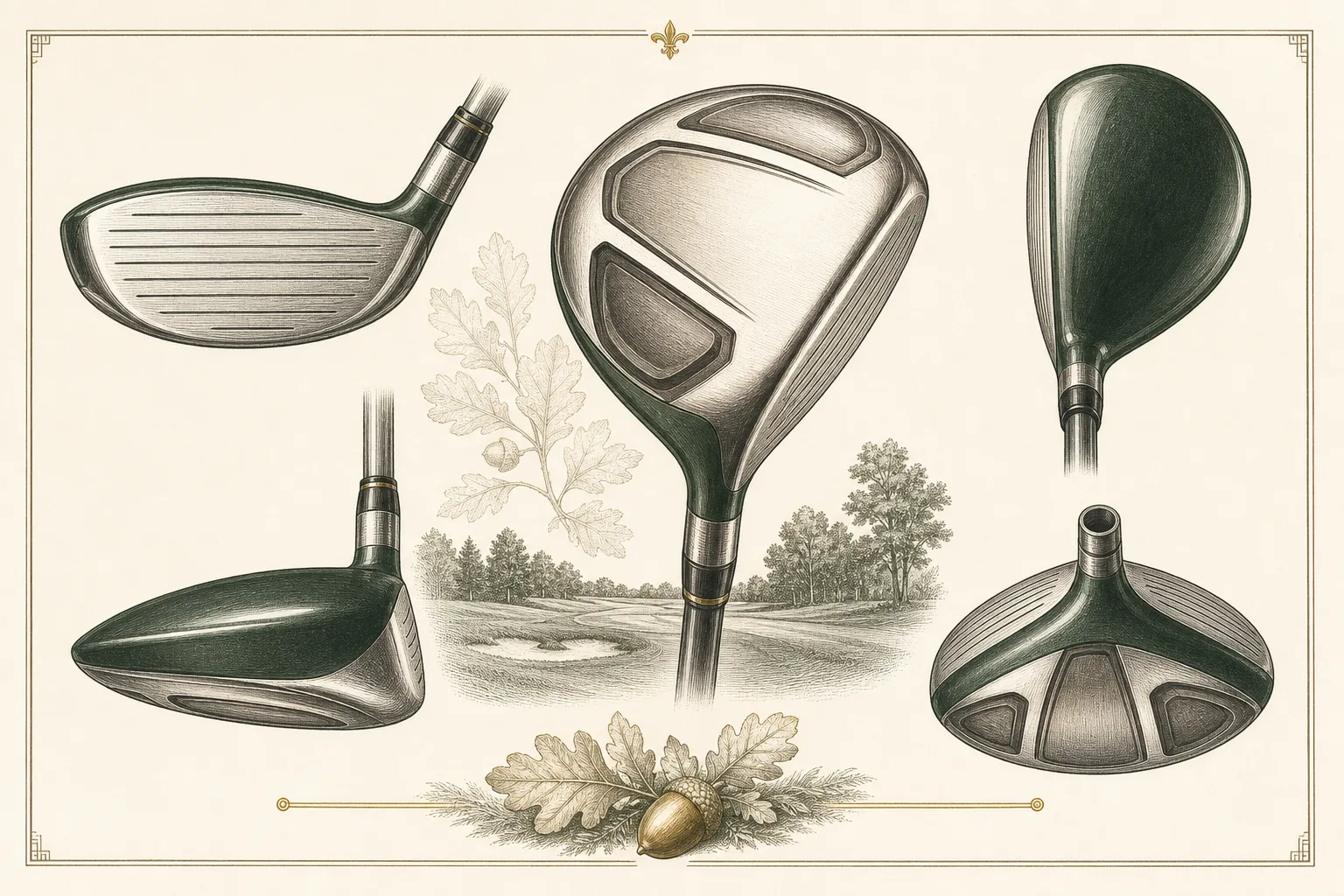
The HiBore fairway wood extended Cleveland's HiBore driver concept — a radically low, deep crown that pushed the center of gravity lower than any driver on the market at launch — down into the fairway wood category in 2006. The distinctive scooped, stepped crown (nicknamed a 'satellite dish' by some golfers for its unusual look) packed 57 grams of discretionary weight low and deep in a head Cleveland called its most stable fairway wood to date, with a face carrying a 10% larger hitting area than its predecessor. It traded a conventional silhouette for launch and stability, arriving as Cleveland leaned into the buzz the original 2005 HiBore driver had built.
The HiBore driver was a genuine sales and buzz phenomenon in 2005-2006 for its record-low CG and unconventional look, and the fairway wood inherited that visual identity and market attention; but the look itself split opinion ('satellite dish' comments were often mockery, not reverence), and the fairway wood specifically has no distinct cult following of its own beyond that shared halo.
Fits mid-to-high handicappers who want an easy-launching, forgiving fairway wood and don't mind an unconventional profile at address; a better player who prioritizes a compact, traditional look should look elsewhere.
Arrived in 2006 riding the buzz of Cleveland's 2005 HiBore driver, competing against Callaway's Big Bertha/Fusion and TaylorMade's Burner fairway woods of the same period; Cleveland followed it with the larger-faced HiBore XLS in 2008.
The stepped, deep crown and 57 grams of low/deep weighting were built explicitly to raise launch and add stability, and Cleveland called it the most stable fairway wood it had made; some testers found the unusual shape polarizing at address, but reported results — higher flight and better ball speed replacing older woods — back up the forgiveness claim.
Calibrated across the whole catalog — a tour blade scores low here on purpose; it means control, not ease.
Cheap and plentiful in 2026: complete heads or single woods typically run $20-$50 on eBay, reflecting a 20-year-old mid-2000s metalwood with no collector premium despite its once-notable buzz.
Reading is one thing — hitting is another. Book a bay and see the numbers for yourself before you buy anywhere.
The HiBore fairway wood extended Cleveland's HiBore driver concept — a radically low, deep crown that pushed the center of gravity lower than any driver on the market at launch — down into the fairway wood category in 2006. The distinctive scooped, stepped crown (nicknamed a 'satellite dish' by some golfers for its unusual look) packed 57 grams of discretionary weight low and deep in a head Cleveland called its most stable fairway wood to date, with a face carrying a 10% larger hitting area than its predecessor. It traded a conventional silhouette for launch and stability, arriving as Cleveland leaned into the buzz the original 2005 HiBore driver had built.
The HiBore driver was a genuine sales and buzz phenomenon in 2005-2006 for its record-low CG and unconventional look, and the fairway wood inherited that visual identity and market attention; but the look itself split opinion ('satellite dish' comments were often mockery, not reverence), and the fairway wood specifically has no distinct cult following of its own beyond that shared halo.
Fits mid-to-high handicappers who want an easy-launching, forgiving fairway wood and don't mind an unconventional profile at address; a better player who prioritizes a compact, traditional look should look elsewhere.
Arrived in 2006 riding the buzz of Cleveland's 2005 HiBore driver, competing against Callaway's Big Bertha/Fusion and TaylorMade's Burner fairway woods of the same period; Cleveland followed it with the larger-faced HiBore XLS in 2008.
The stepped, deep crown and 57 grams of low/deep weighting were built explicitly to raise launch and add stability, and Cleveland called it the most stable fairway wood it had made; some testers found the unusual shape polarizing at address, but reported results — higher flight and better ball speed replacing older woods — back up the forgiveness claim.
Calibrated across the whole catalog — a tour blade scores low here on purpose; it means control, not ease.
Cheap and plentiful in 2026: complete heads or single woods typically run $20-$50 on eBay, reflecting a 20-year-old mid-2000s metalwood with no collector premium despite its once-notable buzz.
Reading is one thing — hitting is another. Book a bay and see the numbers for yourself before you buy anywhere.