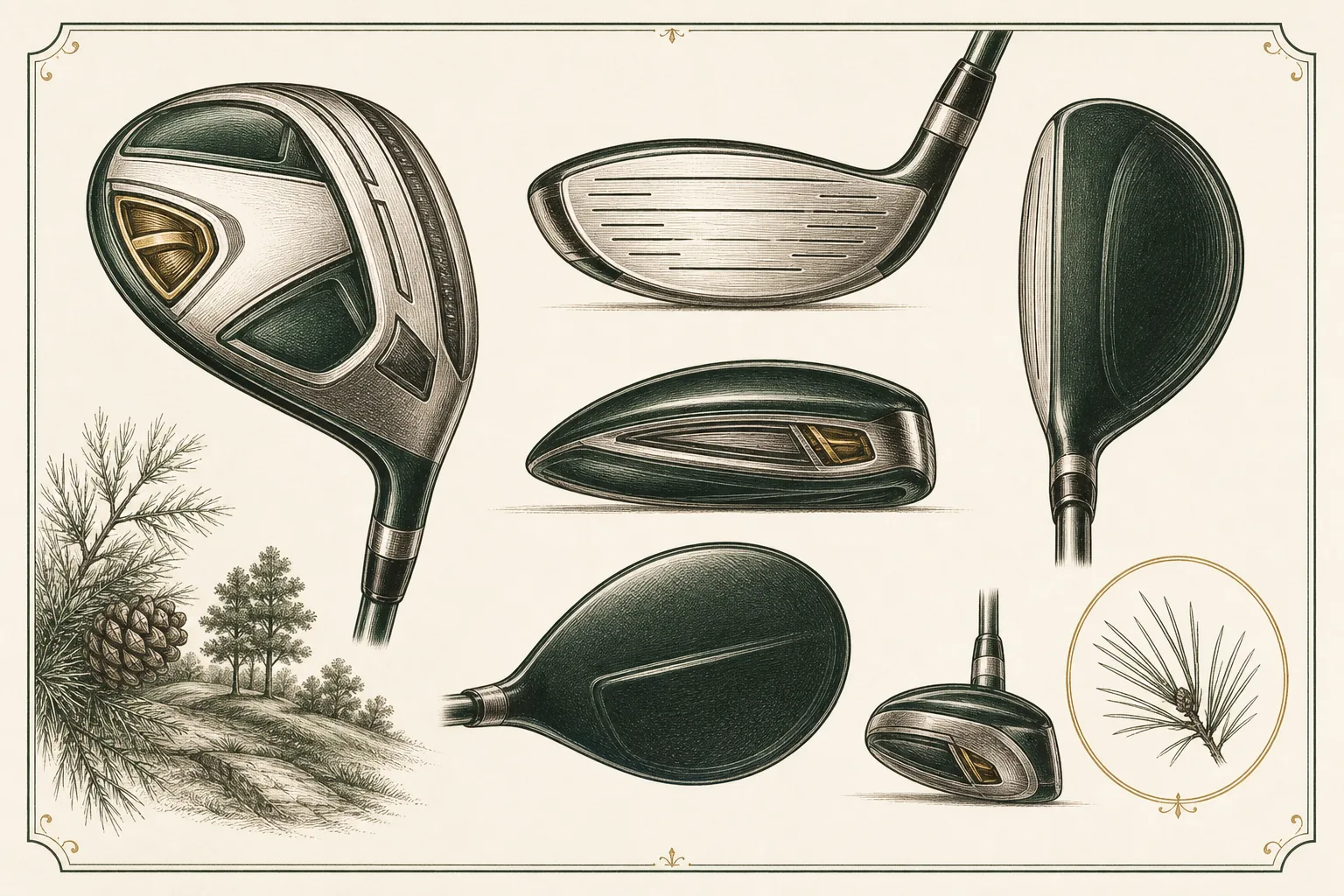
“The T-Rail fairway rides two sole rails to glide through turf and rough, so it lands squarely on the max-forgiveness rung. Ideal for players who hit fat or struggle from tight lies. Cheap and genuinely easy to hit.”
The T-Rail revived Cobra's long-running Baffler name -- a lineage of turf-friendly utility woods dating back decades -- around a visible T-shaped tungsten rail running the length of the sole. The rail's job is turf interaction: it lets the head glide through fairway and rough lies, fairway bunkers, and hardpan rather than digging, while also helping push the CG low and deep. A thin, high-strength 455 steel face was welded to the body to keep ball speeds up despite the weight spent on the rail and low CG, and the shallow face promoted a high, penetrating flight. It shipped in four lofts -- a strong 13-degree 3-wood, a standard 16-degree 3-wood, an 18-degree 5-wood, and a 20-degree 7-wood -- with the strong 3- and 7-wood offered right-handed only.
No scarcity or forum-hunting behavior, but consistently strong, specific praise across contemporary reviews (Today's Golfer, CheckYourGolf) for turf versatility from difficult lies specifically -- reviewers repeatedly called out its ability to work from tight lies, rough, and fairway bunkers rather than just praising generic forgiveness. That is genuine functional respect within the fairway-wood category, not cult status.
Any player who struggles hitting fairway woods cleanly off the deck, from tight lies, or out of light rough -- the rail sole is specifically engineered for exactly those situations. A confident ball-striker who already flushes fairway woods off a tee or the turf gains less from the rail's turf-interaction benefit and may prefer a more conventional, lower-spin fairway wood.
Launched in 2012 into a fairway-wood market where most rivals (TaylorMade RocketBallz, Callaway RAZR Fit, Titleist 913F) competed on distance and adjustability rather than turf interaction. The visible sole rail was a distinctive Cobra signature revived from its earlier Baffler utility clubs and was carried forward into later Cobra fairway lines (e.g., the King F6/F7 Baffler rails a few years later).
Built for exactly this: the tungsten rail and deep, low CG combine with a shallow face to launch the ball easily and resist digging on fat or off-center strikes, and testers specifically noted forgiving results on mis-hits. It ranks near the top of the forgiveness scale for a fairway wood of its era, second only to true max-forgiveness/high-launch designs.
Calibrated across the whole catalog — a tour blade scores low here on purpose; it means control, not ease.
Realistic 2026 private-party pricing runs roughly $50-$110 for a single head depending on loft and shaft, consistent with typical trade-in/resale values reported for fairway woods of this age and tier; there is no collector premium attached to the rail-sole design.
Reading is one thing — hitting is another. Book a bay and see the numbers for yourself before you buy anywhere.