“This is the category the Bag Engine's woods/hybrids ladder calls out explicitly — a low-lofted, narrow-profile crossover built for a fast, repeatable strike, not a forgiveness play.”
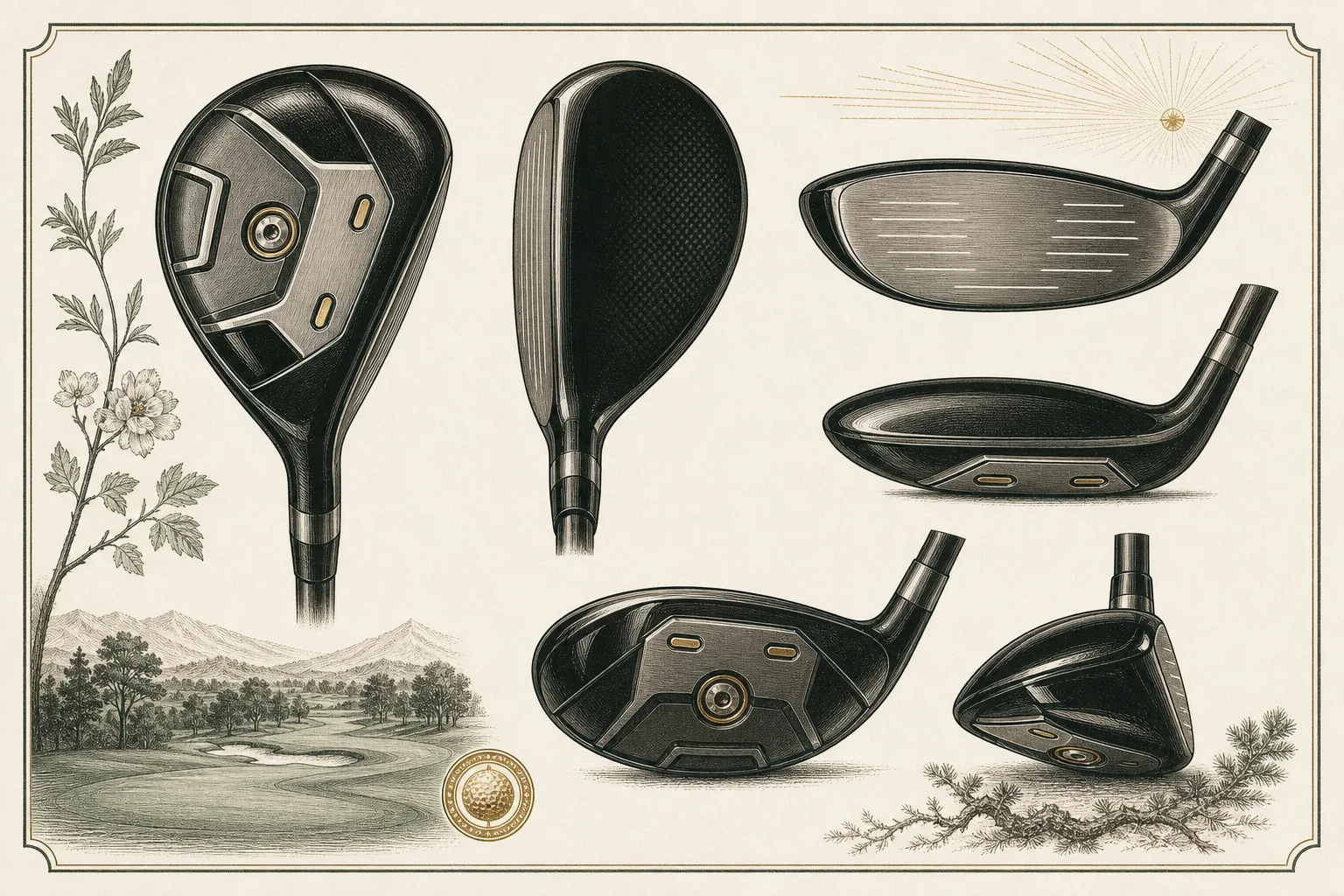
The Apex UW filled a gap between a long iron and a full-size fairway wood: co-developed with input from Phil Mickelson, it pairs a fairway-wood-sized head with a shaft cut about 1.5 inches shorter than a same-lofted fairway wood, so it swings and controls more like a long iron while launching like a wood. A forged C300 maraging-steel face (Callaway's AI-designed 'Flash Face SS21') plus roughly 18 grams of MIM'd tungsten weighting sit the CG in a neutral spot to promote a higher, steeper-landing flight without the heavy draw bias baked into most game-improvement hybrids, and Jailbreak bars connect crown to sole for added ball speed. Callaway measured a 17% tighter dispersion pattern in its own testing versus comparable hybrid/wood options.
Notable rather than cult: it effectively created and named a durable equipment sub-category ('utility wood') that Callaway has carried through multiple generations (Apex UW 24, 25, 26), and its Mickelson-driven design story is documented across independent outlets (GOLF.com, Golf Monthly, MyGolfSpy). There is no scarcity or forum-hunting behavior around the original 2021 version — it's simply a well-reviewed idea that stuck.
Better players (low-to-mid single-digit handicap) who need a reliable, controllable replacement for a 2- or 3-iron and want a penetrating, mid-teens-launch flight rather than the high, spinny flight of a game-improvement hybrid. A high-handicapper wanting maximum ease from a long club should buy a standard hybrid instead — this is a control tool, not a forgiveness tool.
Launched in 2021 alongside the Apex 21/Apex TCB iron family as the driving-iron/hybrid answer for better players, competing with Titleist's TS2/TSi utility concepts and TaylorMade's Stealth/SIM UDI. Its 'utility wood' framing proved durable — Callaway kept the name and shorter-shaft concept through the Apex 24, 25 and 26 utility woods rather than folding it back into a standard hybrid line.
More forgiving than a traditional long iron or driving iron thanks to a larger, hybrid-style head and neutral-CG tungsten weighting, but Callaway explicitly built it for control and a penetrating flight rather than maximum forgiveness — the shorter, iron-like shaft and narrower sole than a full fairway wood trade away some mis-hit tolerance. It sits well below a max-forgiveness hybrid but above a 2-iron or driving iron on any absolute forgiveness scale.
Calibrated across the whole catalog — a tour blade scores low here on purpose; it means control, not ease.
As a single specialty club (not a set) it depreciates like most hybrids: expect roughly $110-170 used in 2026 for a clean example with the stock shaft, with the 19-degree loft the most commonly available on the secondhand market since it was the most popular fitting.
Reading is one thing — hitting is another. Book a bay and see the numbers for yourself before you buy anywhere.
“This is the category the Bag Engine's woods/hybrids ladder calls out explicitly — a low-lofted, narrow-profile crossover built for a fast, repeatable strike, not a forgiveness play.”
The Apex UW filled a gap between a long iron and a full-size fairway wood: co-developed with input from Phil Mickelson, it pairs a fairway-wood-sized head with a shaft cut about 1.5 inches shorter than a same-lofted fairway wood, so it swings and controls more like a long iron while launching like a wood. A forged C300 maraging-steel face (Callaway's AI-designed 'Flash Face SS21') plus roughly 18 grams of MIM'd tungsten weighting sit the CG in a neutral spot to promote a higher, steeper-landing flight without the heavy draw bias baked into most game-improvement hybrids, and Jailbreak bars connect crown to sole for added ball speed. Callaway measured a 17% tighter dispersion pattern in its own testing versus comparable hybrid/wood options.
Notable rather than cult: it effectively created and named a durable equipment sub-category ('utility wood') that Callaway has carried through multiple generations (Apex UW 24, 25, 26), and its Mickelson-driven design story is documented across independent outlets (GOLF.com, Golf Monthly, MyGolfSpy). There is no scarcity or forum-hunting behavior around the original 2021 version — it's simply a well-reviewed idea that stuck.
Better players (low-to-mid single-digit handicap) who need a reliable, controllable replacement for a 2- or 3-iron and want a penetrating, mid-teens-launch flight rather than the high, spinny flight of a game-improvement hybrid. A high-handicapper wanting maximum ease from a long club should buy a standard hybrid instead — this is a control tool, not a forgiveness tool.
Launched in 2021 alongside the Apex 21/Apex TCB iron family as the driving-iron/hybrid answer for better players, competing with Titleist's TS2/TSi utility concepts and TaylorMade's Stealth/SIM UDI. Its 'utility wood' framing proved durable — Callaway kept the name and shorter-shaft concept through the Apex 24, 25 and 26 utility woods rather than folding it back into a standard hybrid line.
More forgiving than a traditional long iron or driving iron thanks to a larger, hybrid-style head and neutral-CG tungsten weighting, but Callaway explicitly built it for control and a penetrating flight rather than maximum forgiveness — the shorter, iron-like shaft and narrower sole than a full fairway wood trade away some mis-hit tolerance. It sits well below a max-forgiveness hybrid but above a 2-iron or driving iron on any absolute forgiveness scale.
Calibrated across the whole catalog — a tour blade scores low here on purpose; it means control, not ease.
As a single specialty club (not a set) it depreciates like most hybrids: expect roughly $110-170 used in 2026 for a clean example with the stock shaft, with the 19-degree loft the most commonly available on the secondhand market since it was the most popular fitting.
Reading is one thing — hitting is another. Book a bay and see the numbers for yourself before you buy anywhere.