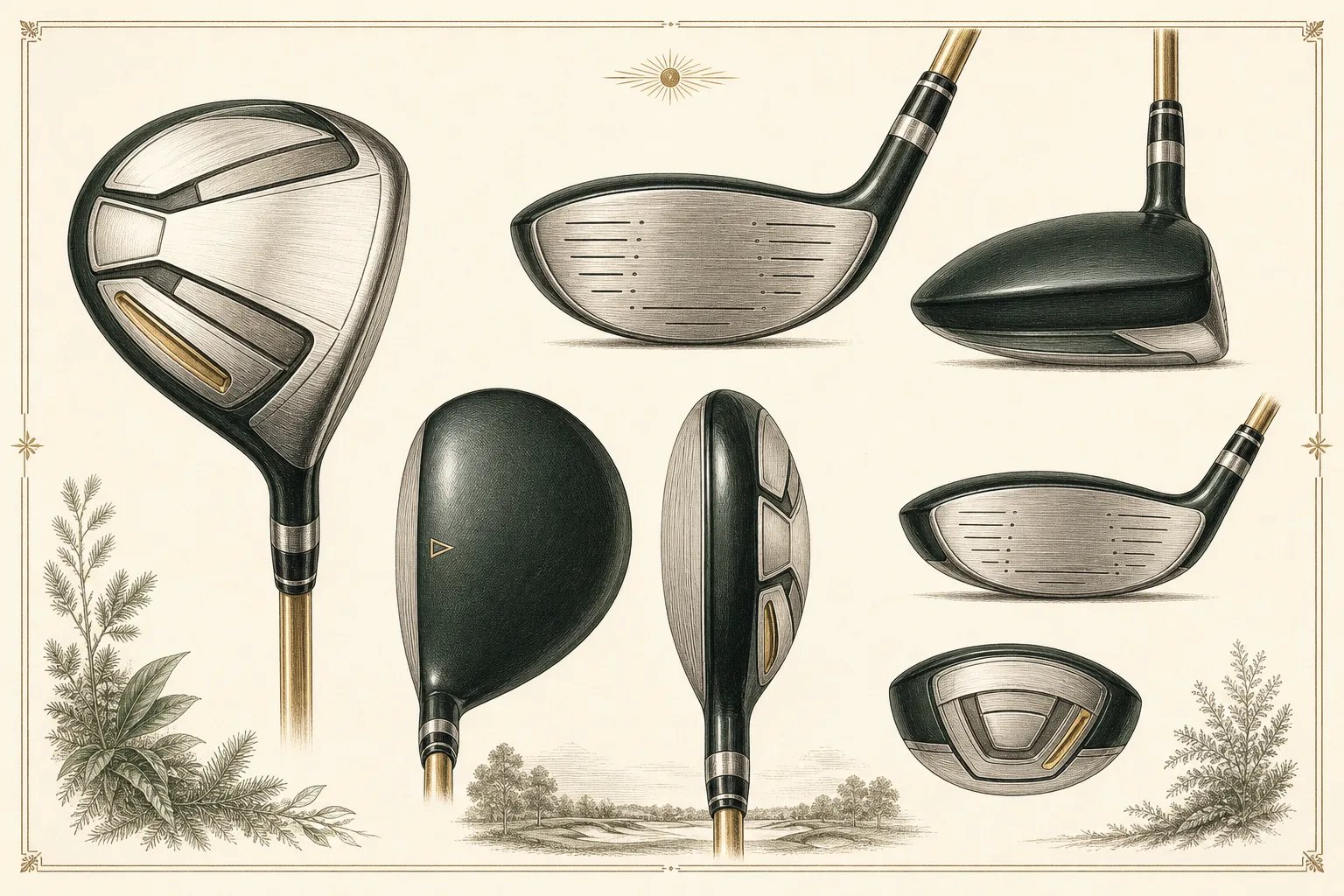
“Easy-launching, low-spin fairway that was a strong value in its day. A dependable used pickup, though the compact steel-body head gives up a touch of forgiveness to modern faces.”
The NVG2 fairway wood carried the same welded-titanium 'Cup Face' concept as MacGregor's NVG2 driver down into its metal-wood, with a titanium face plate fused to a steel body and two tungsten weights set into the sole. Because the face-to-body joint eliminated the usual weld seam across the face itself, MacGregor could claim the entire face as active hitting area rather than a shrinking sweet spot around a center weld — genuinely advanced framing for a 2005 mid-market fairway wood. Reviewers responded well: it sat cleanly at address, sounded distinctive, and launched easily thanks to the low, tungsten-shifted center of gravity. The one recurring gripe was cosmetic — the polished/mirrored face reportedly threw distracting glare in direct sun.
User review scores were consistently strong (mid-to-high 4-out-of-5 territory across multiple review sites) for a budget-tier brand fairway wood, and the cup-face framing was ahead of where fairway-wood face technology sat industry-wide in 2005. That said, there is no ongoing collector or forum-legend status — it is a well-executed, largely forgotten value club, not a chased one.
Mid-to-high handicappers and moderate swing speeds wanting an easy-launching, forgiving fairway option at a fraction of premium-brand pricing. A better player chasing today's ball speeds and adjustability from a modern fairway wood will find it clearly dated.
Released in 2005 opposite TaylorMade's Burner/R7 fairways, Callaway's Big Bertha woods, and Titleist's 906F — all bigger-name competitors with far larger marketing budgets. MacGregor's NVG2 line (driver, fairway, hybrid) was the value-conscious alternative running the same cup-face story a rung down in price.
Tungsten sole weighting pulls the CG low and back for easy launch, and the cup-face construction widens the effective hitting area versus a conventional welded face. It is a genuine game-improvement fairway wood profile, not a players'-shape compact head.
Calibrated across the whole catalog — a tour blade scores low here on purpose; it means control, not ease.
As an off-brand 20-year-old fairway wood, realistic 2026 private-party value is modest: roughly $20-$50 for a complete, playable example with its original graphite shaft; there is no reconditioned-retail premium market for it the way there is for major-brand equipment.
Reading is one thing — hitting is another. Book a bay and see the numbers for yourself before you buy anywhere.
“Easy-launching, low-spin fairway that was a strong value in its day. A dependable used pickup, though the compact steel-body head gives up a touch of forgiveness to modern faces.”
The NVG2 fairway wood carried the same welded-titanium 'Cup Face' concept as MacGregor's NVG2 driver down into its metal-wood, with a titanium face plate fused to a steel body and two tungsten weights set into the sole. Because the face-to-body joint eliminated the usual weld seam across the face itself, MacGregor could claim the entire face as active hitting area rather than a shrinking sweet spot around a center weld — genuinely advanced framing for a 2005 mid-market fairway wood. Reviewers responded well: it sat cleanly at address, sounded distinctive, and launched easily thanks to the low, tungsten-shifted center of gravity. The one recurring gripe was cosmetic — the polished/mirrored face reportedly threw distracting glare in direct sun.
User review scores were consistently strong (mid-to-high 4-out-of-5 territory across multiple review sites) for a budget-tier brand fairway wood, and the cup-face framing was ahead of where fairway-wood face technology sat industry-wide in 2005. That said, there is no ongoing collector or forum-legend status — it is a well-executed, largely forgotten value club, not a chased one.
Mid-to-high handicappers and moderate swing speeds wanting an easy-launching, forgiving fairway option at a fraction of premium-brand pricing. A better player chasing today's ball speeds and adjustability from a modern fairway wood will find it clearly dated.
Released in 2005 opposite TaylorMade's Burner/R7 fairways, Callaway's Big Bertha woods, and Titleist's 906F — all bigger-name competitors with far larger marketing budgets. MacGregor's NVG2 line (driver, fairway, hybrid) was the value-conscious alternative running the same cup-face story a rung down in price.
Tungsten sole weighting pulls the CG low and back for easy launch, and the cup-face construction widens the effective hitting area versus a conventional welded face. It is a genuine game-improvement fairway wood profile, not a players'-shape compact head.
Calibrated across the whole catalog — a tour blade scores low here on purpose; it means control, not ease.
As an off-brand 20-year-old fairway wood, realistic 2026 private-party value is modest: roughly $20-$50 for a complete, playable example with its original graphite shaft; there is no reconditioned-retail premium market for it the way there is for major-brand equipment.
Reading is one thing — hitting is another. Book a bay and see the numbers for yourself before you buy anywhere.