“Premium multi-material build pushed ~77% of head mass to the perimeter for very high MOI and stability; launched near $1,300 new. Extremely forgiving, but sells cheap used today.”
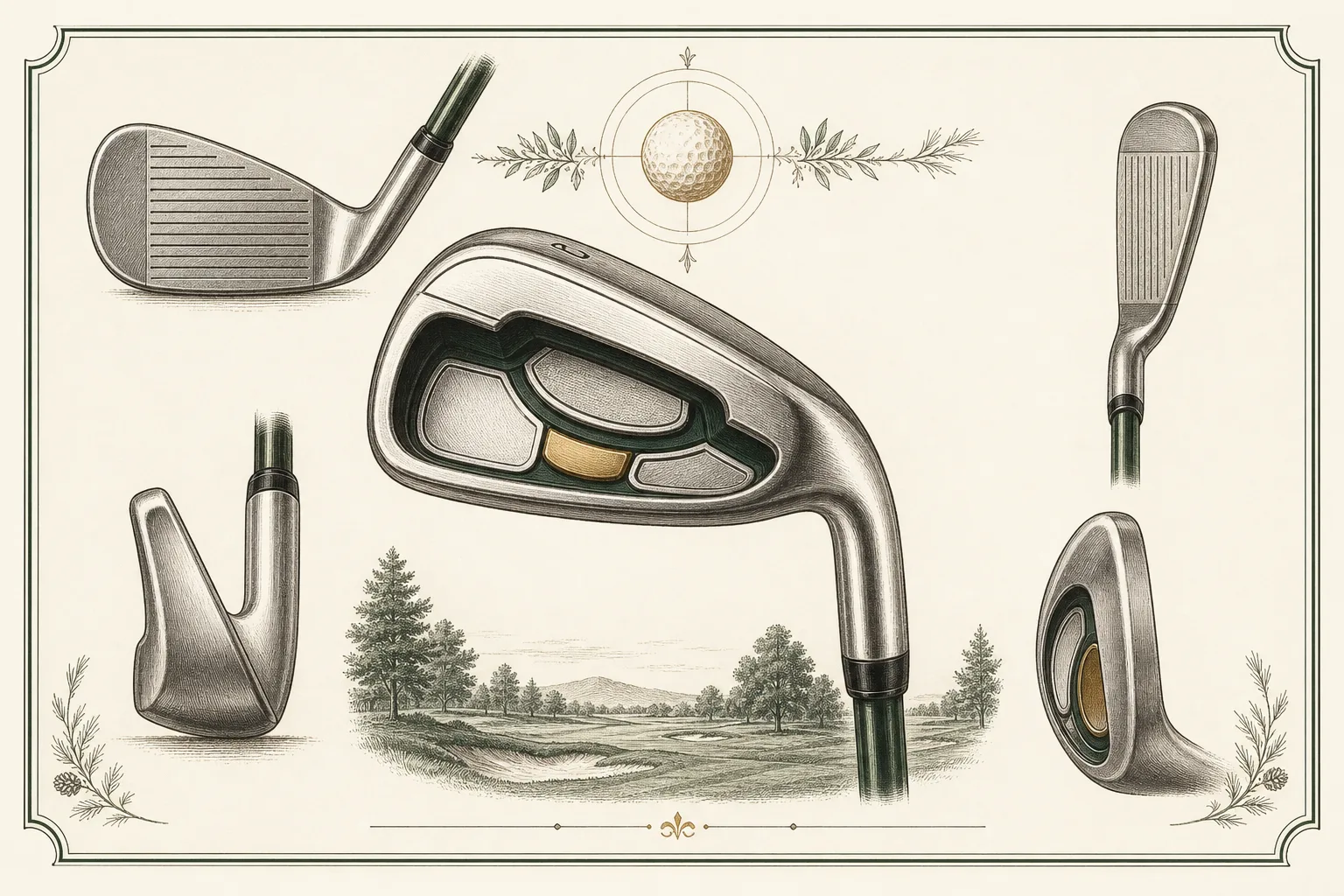
The Fusion was Callaway's most expensive iron ever at launch, retailing near $1,300 in steel and over $1,500 in graphite. The name described the construction: a dense, Callaway-patented 'Tunite' alloy cradle sat in the cavity to push roughly 77% of the clubhead's mass to the perimeter for high MOI, a milled 6-4 titanium face plate gave a hotter, thinner-faced strike than stainless steel could, and a thermoplastic polyurethane (TPU) insert filled the remaining cavity space to quiet vibration and improve sound/feel. It was Callaway's answer to the question of how to make a game-improvement iron feel and sound less 'clicky' than the tungsten/steel GI irons around it, while keeping the wide sole and offset the buyer expected from a Big Bertha. It sold for two seasons before Callaway moved the iron line forward again, and the exotic three-material recipe was not repeated in the same form.
No forum cult or price premium exists for the Fusion today — it trades like any other 20-year-old GI iron — but it is specifically remembered in gear-history write-ups (Liveabout, SirShanksAlot, Today's Golfer) as the priciest, most materially exotic Big Bertha iron Callaway ever built, a genuine engineering curiosity rather than an incremental refresh.
High-handicap and slower-swing-speed players who wanted extra ball speed on mis-hits without paying tour-iron prices for exotic materials chased a different problem — this was aimed at recreational golfers willing to pay a premium for feel and a hot face in a forgiving shape. Not for anyone wanting workability; the deep cavity and thick topline make shot-shaping difficult. A modern buyer priced out of $1,300 in 2005 dollars can get more distance and forgiveness today for a fraction of the (now used) cost.
Launched alongside the Fusion FT-3 driver as Callaway's 2005 flagship 'Fusion' technology platform, competing with TaylorMade's r7 irons and Titleist's game-improvement DCI/735 line. It sat above the standard steel Big Bertha 2004 irons in Callaway's own lineup as the premium option. Multi-material iron construction (steel body plus tungsten/titanium inserts) is now mainstream in players'-distance irons like the Titleist T200 or Callaway's own Apex — the Fusion was an early, expensive stab at that same idea two decades before it became standard.
A wide-sole, high-offset game-improvement head with an unusually aggressive perimeter-weighting scheme (Tunite pushing ~77% of mass to the edges) gives strong MOI and stability on mis-hits for its era. The thin titanium face adds ball speed even on off-center strikes, though it does not out-forgive the class-leading GI irons of the same period — it sits solidly in the 'very forgiving' tier rather than at the absolute top.
Calibrated across the whole catalog — a tour blade scores low here on purpose; it means control, not ease.
Reconditioned-retail listings (2nd Swing) show complete sets at roughly $250–$530 against a $999.99 recon-grade reference price; realistic private-party value in 2026 is lower, commonly $120–$250 for a clean steel set, reflecting typical 20-year GI-iron depreciation rather than any collector premium.
Reading is one thing — hitting is another. Book a bay and see the numbers for yourself before you buy anywhere.
“Premium multi-material build pushed ~77% of head mass to the perimeter for very high MOI and stability; launched near $1,300 new. Extremely forgiving, but sells cheap used today.”
The Fusion was Callaway's most expensive iron ever at launch, retailing near $1,300 in steel and over $1,500 in graphite. The name described the construction: a dense, Callaway-patented 'Tunite' alloy cradle sat in the cavity to push roughly 77% of the clubhead's mass to the perimeter for high MOI, a milled 6-4 titanium face plate gave a hotter, thinner-faced strike than stainless steel could, and a thermoplastic polyurethane (TPU) insert filled the remaining cavity space to quiet vibration and improve sound/feel. It was Callaway's answer to the question of how to make a game-improvement iron feel and sound less 'clicky' than the tungsten/steel GI irons around it, while keeping the wide sole and offset the buyer expected from a Big Bertha. It sold for two seasons before Callaway moved the iron line forward again, and the exotic three-material recipe was not repeated in the same form.
No forum cult or price premium exists for the Fusion today — it trades like any other 20-year-old GI iron — but it is specifically remembered in gear-history write-ups (Liveabout, SirShanksAlot, Today's Golfer) as the priciest, most materially exotic Big Bertha iron Callaway ever built, a genuine engineering curiosity rather than an incremental refresh.
High-handicap and slower-swing-speed players who wanted extra ball speed on mis-hits without paying tour-iron prices for exotic materials chased a different problem — this was aimed at recreational golfers willing to pay a premium for feel and a hot face in a forgiving shape. Not for anyone wanting workability; the deep cavity and thick topline make shot-shaping difficult. A modern buyer priced out of $1,300 in 2005 dollars can get more distance and forgiveness today for a fraction of the (now used) cost.
Launched alongside the Fusion FT-3 driver as Callaway's 2005 flagship 'Fusion' technology platform, competing with TaylorMade's r7 irons and Titleist's game-improvement DCI/735 line. It sat above the standard steel Big Bertha 2004 irons in Callaway's own lineup as the premium option. Multi-material iron construction (steel body plus tungsten/titanium inserts) is now mainstream in players'-distance irons like the Titleist T200 or Callaway's own Apex — the Fusion was an early, expensive stab at that same idea two decades before it became standard.
A wide-sole, high-offset game-improvement head with an unusually aggressive perimeter-weighting scheme (Tunite pushing ~77% of mass to the edges) gives strong MOI and stability on mis-hits for its era. The thin titanium face adds ball speed even on off-center strikes, though it does not out-forgive the class-leading GI irons of the same period — it sits solidly in the 'very forgiving' tier rather than at the absolute top.
Calibrated across the whole catalog — a tour blade scores low here on purpose; it means control, not ease.
Reconditioned-retail listings (2nd Swing) show complete sets at roughly $250–$530 against a $999.99 recon-grade reference price; realistic private-party value in 2026 is lower, commonly $120–$250 for a clean steel set, reflecting typical 20-year GI-iron depreciation rather than any collector premium.
Reading is one thing — hitting is another. Book a bay and see the numbers for yourself before you buy anywhere.