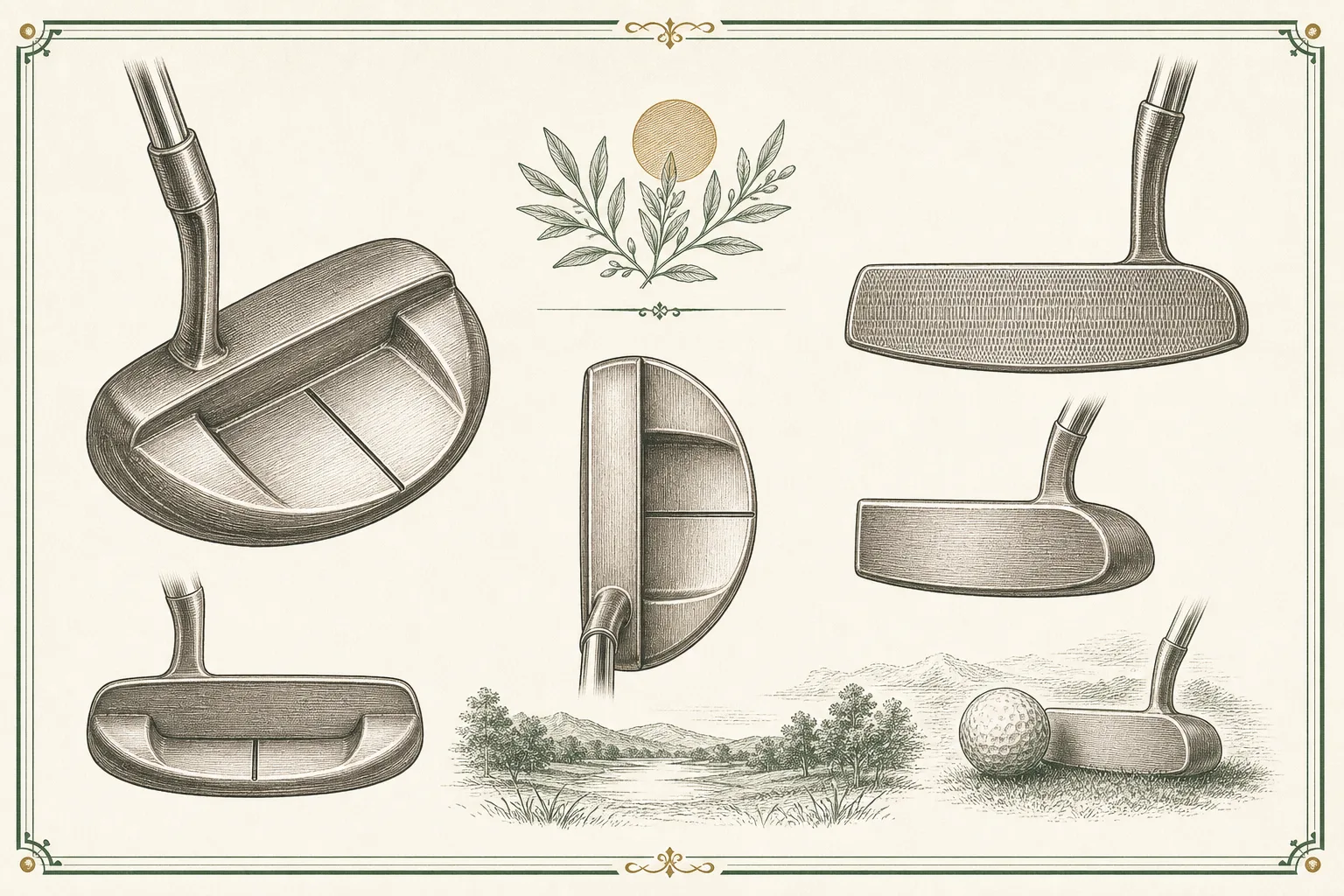
“The putter that helped launch the modern mallet craze: Nick Price put a Fat Lady prototype in play and won the 1994 PGA Championship wire-to-wire, and orders poured in. Reissues add a beryllium copper face and aircraft-grade aluminum with heavy perimeter weighting. A forgiving mallet for a straighter stroke.”
In August 1994, Bobby Grace showed Nick Price a prototype mallet putter he called 'The Fat Lady Swings' on the range at the St. Jude Classic in Memphis. Price liked it enough to put it in the bag for the weekend, kept it the following week at the PGA Championship at Southern Hills, led wire-to-wire and won by six. Bobby Grace Putters — then a tiny startup — received roughly 27,000 orders in the days after, instantly funding the company and establishing the wide, high-MOI mallet shape (rather than the traditional blade or small heel-toe cavity) as a mainstream putter category. Fortune Brands bought the company in 1997 and made it Cobra's premium putter line. The design has been periodically reissued in modern form with an aircraft-grade aluminum body, heavy perimeter weighting and a beryllium-copper face insert for softer feel.
A single major-championship win created an overnight order backlog (~27,000 units) for a putter that didn't exist as a mass-produced product yet, and that win directly led to a Fortune Brands acquisition three years later — a rare, well-documented case of one tour week making a putter company. The original name and shape are still sold today as a commemorative reissue three decades on, which is the mark of genuine, sustained collector/brand demand rather than a one-off news cycle.
A wide mallet body with perimeter-distributed weight gives real off-center stability compared to a blade or small heel-toe putter of its 1994 vintage, and modern reissues add tungsten/aluminum weighting and a softer BeCu-style insert that further evens out mis-hits. It is not a max-MOI modern mallet (no adjustable weights, no wings-style forgiveness engineering), so it lands in the middle of the putter forgiveness scale rather than at the top.
Original 1990s Fat Lady Swings putters and later Cobra-era commemoratives trade mostly as collector/nostalgia pieces: clean examples on eBay and Worthpoint commonly run roughly $80–$180, with 'Nick Price 1994 PGA Champion' commemorative-stamped versions sometimes fetching more depending on condition and shaft originality. Current-production reissues sell new for around $299, so a lightly used modern reissue tracks close to that rather than vintage-collector pricing — the two markets (1990s original vs. modern reissue) should not be confused.
Suits a straight-back-straight-through stroke looking for a stable, forgiving mallet with old-school pedigree rather than the newest MOI numbers. A player who prefers a toe-hang blade for an arced stroke, or someone chasing 2020s tungsten-perimeter MOI figures, should look at a current mallet instead.
It arrived in 1994 just as mallets were starting to challenge blade putters' dominance, ahead of Odyssey's 2-Ball (2000) and TaylorMade's Spider (2009) that later took the category mainstream. Bobby Grace is frequently credited by golf media as a pioneer of the modern oversized mallet look that those later designs built on. A modern equivalent in spirit is any high-MOI mallet with a soft polymer/BeCu-style face, such as Bobby Grace's own current Amazing Grace or Night and Day models.
Calibrated across the whole catalog — a tour blade scores low here on purpose; it means control, not ease.
Reading is one thing — hitting is another. Book a bay and see the numbers for yourself before you buy anywhere.