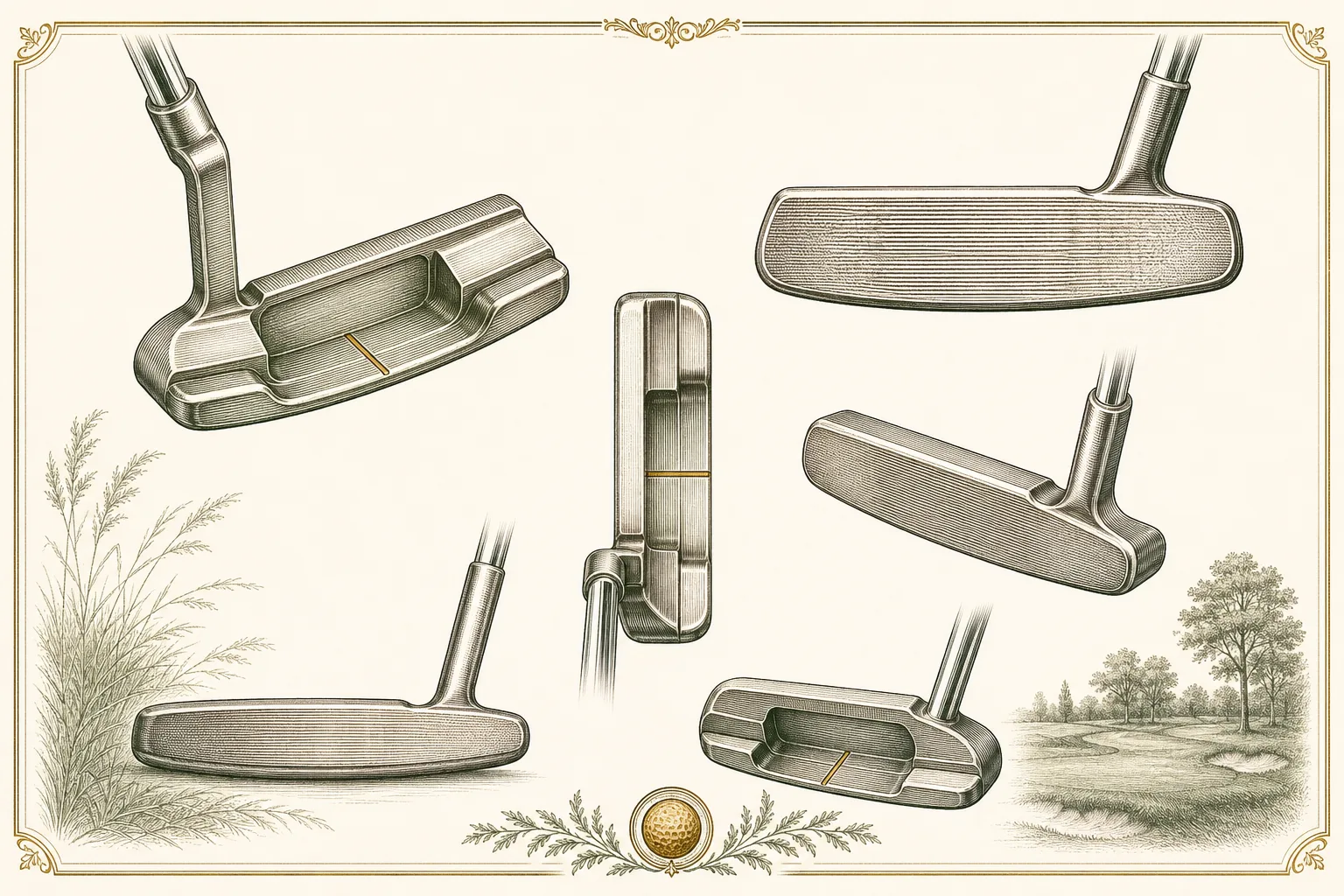
“The 750-gram Mid-Weight class balances Boccieri's back-weighting system between head and a counterweighted grip end to quiet the small muscles and steady tempo. Offered in blade and mallet shapes for any stroke.”
The Mid-Weight Series is Boccieri Golf's 750-gram class — about 20% lighter than the original 900-gram Heavy Putter — built specifically to fix the biggest complaint about the first Heavy Putter design: distance control fell apart on fast greens under the full 900-gram build. It keeps the same Back Weighting System (grip-end counterweight, balance point raised roughly 75%) but tunes the total mass down to a level independent reviewers described as 'the best of both worlds' — stroke stability on short putts without giving up long-putt touch. In field testing cited by one reviewer, 9 of 13 test golfers made more putts from 5, 10 and 15 feet with the Mid-Weight than with their own gamer putter.
This is the Heavy Putter line's best-reviewed, most-refined configuration — multiple independent outlets (The Hackers Paradise, Orlando Golf Blogger) credit it with solving the original design's fast-green weakness, and it's explicitly framed as the mainstream-friendly evolution of the counterbalancing idea that later became industry-standard. It stayed a niche, direct-sold product rather than breaking into wide consumer awareness, which is the definition of a sleeper: praised by those who tried it, unknown to most golfers who'd benefit from the now-ubiquitous counterbalancing concept it helped popularize.
Golfers who liked the tempo-steadying concept of the original Heavy Putter but found the 900-gram version too heavy-feeling or inconsistent on fast greens — described by reviewers as bringing Heavy Putter benefits 'to mainstream golfers without extreme specialization.' A strong pick for a player who wants counterbalancing's stability without a gimmicky feel.
Introduced as a deliberate refinement of the original 2005 Heavy-Weight (900g) design after real-world feedback on fast greens; sits between the Lite-Weight (600g) and Heavy-Weight/Deep-Weight (900g) classes in Boccieri's three-tier system, and represents the version of the counterbalancing concept closest to what eventually became mainstream OEM practice (lighter counterweights than Boccieri's original extreme builds).
Lighter than the Deep-Weight (900g) class, so it gives up a little of that model's raw MOI/stability ceiling, but reviewers specifically praised it for restoring feel and distance control on longer putts that the heaviest class struggled with — a genuine forgiveness-vs-feel balance point rather than a compromise that fails at both.
Calibrated across the whole catalog — a tour blade scores low here on purpose; it means control, not ease.
The best-reviewed and most in-demand Heavy Putter class on the secondary market as a result; a clean Mid-Weight head in 2026 typically sells for $40-70 privately — a modest premium over the E/H-Series shapes, reflecting its stronger review record rather than any brand-wide collector demand.
Reading is one thing — hitting is another. Book a bay and see the numbers for yourself before you buy anywhere.
“The 750-gram Mid-Weight class balances Boccieri's back-weighting system between head and a counterweighted grip end to quiet the small muscles and steady tempo. Offered in blade and mallet shapes for any stroke.”
The Mid-Weight Series is Boccieri Golf's 750-gram class — about 20% lighter than the original 900-gram Heavy Putter — built specifically to fix the biggest complaint about the first Heavy Putter design: distance control fell apart on fast greens under the full 900-gram build. It keeps the same Back Weighting System (grip-end counterweight, balance point raised roughly 75%) but tunes the total mass down to a level independent reviewers described as 'the best of both worlds' — stroke stability on short putts without giving up long-putt touch. In field testing cited by one reviewer, 9 of 13 test golfers made more putts from 5, 10 and 15 feet with the Mid-Weight than with their own gamer putter.
This is the Heavy Putter line's best-reviewed, most-refined configuration — multiple independent outlets (The Hackers Paradise, Orlando Golf Blogger) credit it with solving the original design's fast-green weakness, and it's explicitly framed as the mainstream-friendly evolution of the counterbalancing idea that later became industry-standard. It stayed a niche, direct-sold product rather than breaking into wide consumer awareness, which is the definition of a sleeper: praised by those who tried it, unknown to most golfers who'd benefit from the now-ubiquitous counterbalancing concept it helped popularize.
Golfers who liked the tempo-steadying concept of the original Heavy Putter but found the 900-gram version too heavy-feeling or inconsistent on fast greens — described by reviewers as bringing Heavy Putter benefits 'to mainstream golfers without extreme specialization.' A strong pick for a player who wants counterbalancing's stability without a gimmicky feel.
Introduced as a deliberate refinement of the original 2005 Heavy-Weight (900g) design after real-world feedback on fast greens; sits between the Lite-Weight (600g) and Heavy-Weight/Deep-Weight (900g) classes in Boccieri's three-tier system, and represents the version of the counterbalancing concept closest to what eventually became mainstream OEM practice (lighter counterweights than Boccieri's original extreme builds).
Lighter than the Deep-Weight (900g) class, so it gives up a little of that model's raw MOI/stability ceiling, but reviewers specifically praised it for restoring feel and distance control on longer putts that the heaviest class struggled with — a genuine forgiveness-vs-feel balance point rather than a compromise that fails at both.
Calibrated across the whole catalog — a tour blade scores low here on purpose; it means control, not ease.
The best-reviewed and most in-demand Heavy Putter class on the secondary market as a result; a clean Mid-Weight head in 2026 typically sells for $40-70 privately — a modest premium over the E/H-Series shapes, reflecting its stronger review record rather than any brand-wide collector demand.
Reading is one thing — hitting is another. Book a bay and see the numbers for yourself before you buy anywhere.