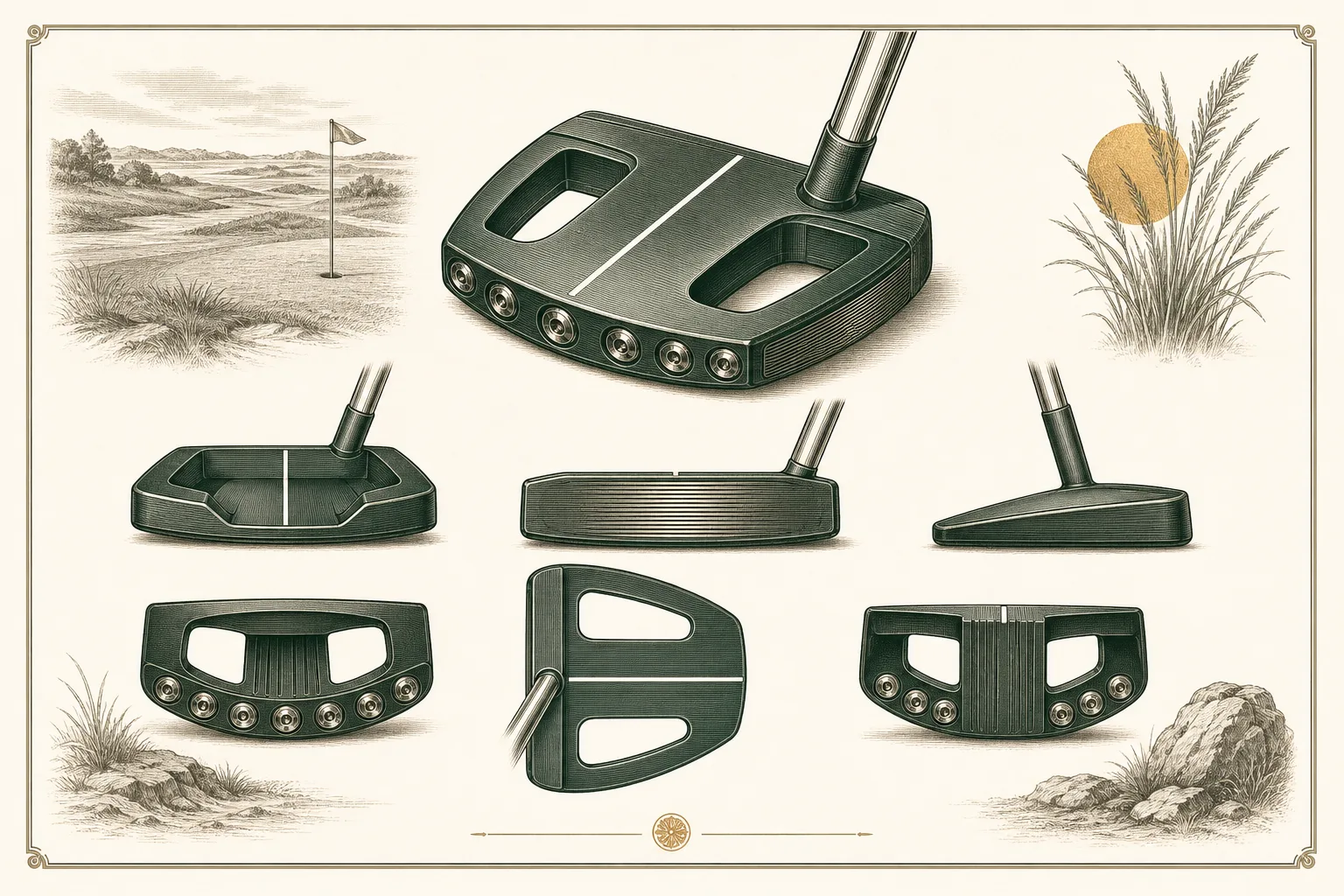
The DF 2.1 is L.A.B. Golf's flagship and the design that put an obscure Oregon startup on tour bags worldwide. Founder Bill Presse, a former mini-tour player, built the original Directed Force in 2014 to solve his own stroke inconsistency: a head shaped and weighted so its balance point sits directly below the shaft axis, removing the torque that twists a normal putter face open or closed off-center. The 2.1 refined that first cattle-brand-shaped head into the version that stuck, CNC milled from 6061 aircraft aluminum in Creswell, Oregon. Adam Scott experimented with a shorter version of the original design on Tour in 2019 before committing to it full-time, and his run of results turned L.A.B.'s odd-looking putter from a curiosity into a legitimate tour and retail category.
Independently reviewed as a category-defining design by MyGolfSpy, Golf.com and Today's Golfer, and credited by GolfWRX and PGA Tour equipment reporters as the putter that legitimized Lie Angle Balance on tour once Adam Scott adopted it. It remains L.A.B.'s reference/flagship model years after newer shapes (DF3, Mezz.1, Link.1) launched around it, and used examples are actively traded rather than dumped.
Best for golfers who fight face rotation through the stroke (an open-to-square-to-closed pattern) and are willing to adapt to a genuinely unconventional look and feel at address; many players need a real adjustment period. Not for anyone who wants a compact, traditional blade look or who already putts on a straight-back-straight-through stroke with no rotation issue — the technology solves a specific problem and is overkill if you don't have it.
Launched into a putter market still dominated by traditional blades and mallets from Scotty Cameron, Odyssey and Ping; it competed conceptually with SIK/Evnroll's face-insert forgiveness plays but with a completely different mechanism (balance, not face material). It was L.A.B.'s only mainstream shape until Mezz.1 (2022), Link.1 (2023) and DF3 (2024) diversified the range into more conventional-looking bodies built on the same balance principle.
The zero-torque balance point is the whole point: off-center strikes twist the face dramatically less than a conventional blade or mallet, so start-line consistency on mishits is unusually high for a design with a fairly compact, non-max-mallet head. It does not add MOI in the way a huge modern mallet does, so distance control on toe/heel strikes is only average — the forgiveness is specifically about face angle at impact, not about mass distribution.
Calibrated across the whole catalog — a tour blade scores low here on purpose; it means control, not ease.
Clean used DF 2.1 heads commonly sell for roughly $250-$400 privately (eBay/2nd Swing), well under the ~$400-$450+ new custom-build price once shaft/grip/finish options are stacked; a UK forum thread cited roughly £300-330 as a realistic resale range. Because the shape and tech haven't changed since introduction, depreciation is modest for a putter of its price class.
Reading is one thing — hitting is another. Book a bay and see the numbers for yourself before you buy anywhere.