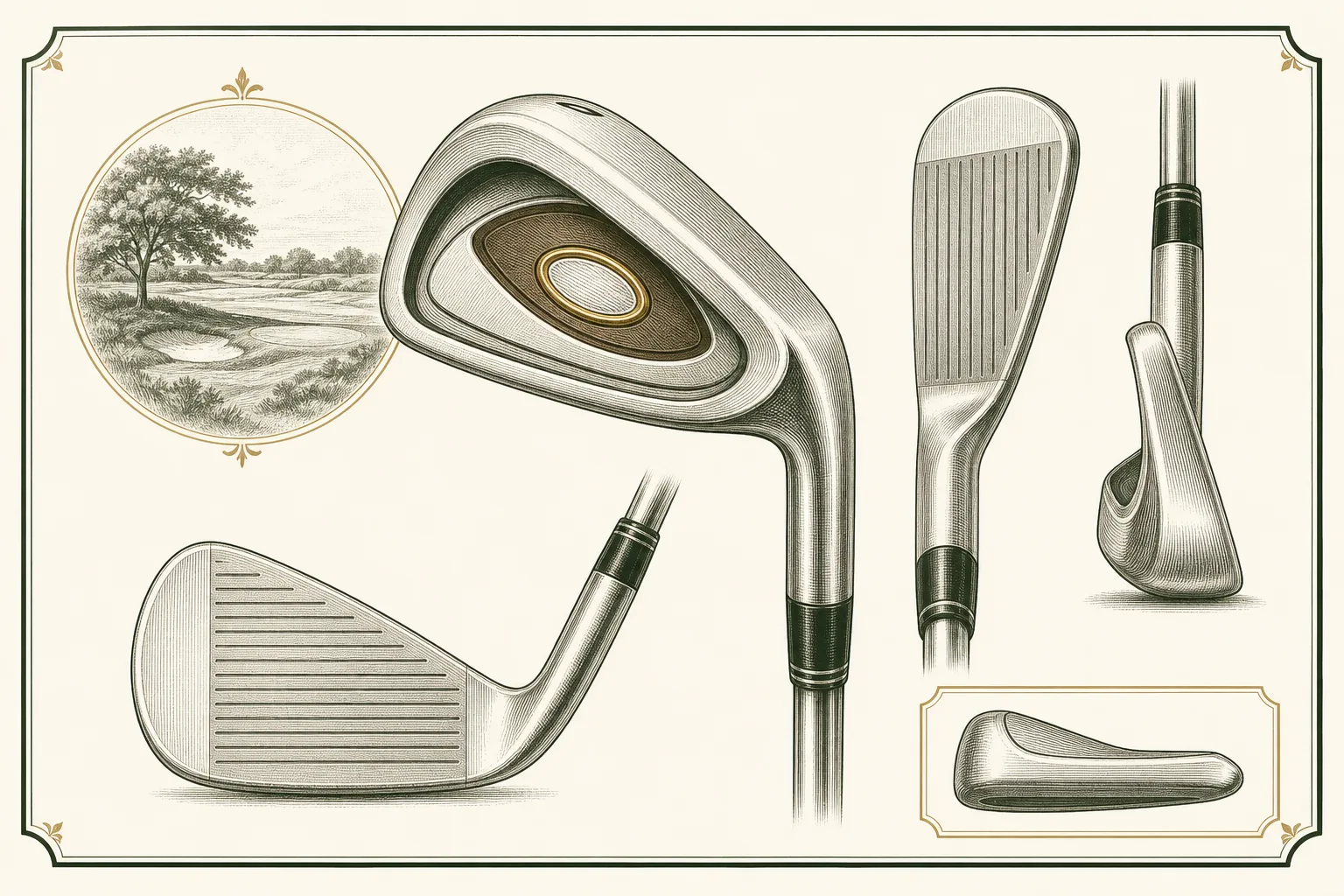
“The OS means oversize: extreme low-and-back CG claimed 11% lower than normal irons. A game-improvement cavity rung engineered to launch high for slower swings.”
Adams' second-generation Idea combo set, the 2005 a2 OS pushed the original a1 concept further into pure super-game-improvement territory: four progressive hybrids blending into a cavity-back short-iron run, a claimed 11%-lower and 2.5x-deeper center of gravity than conventional irons, and roughly 30% higher MOI for stability on mis-hits. It ran a fuller loft spread than most rivals (3-iron at 21 degrees down to a 50-degree pitching wedge) with steel shafts in the short irons and graphite in the hybrids -- a deliberate split to keep scoring-club control while maximizing distance and ease up top. It landed to solid but not outstanding user reviews (3.8/5 on golfreview.com, the softest score in this Adams family), a sign it did its job without breaking new ground beyond the original a1.
A capable, ordinary second-generation combo set -- no lawsuit, no tour legend, no scarcity, and its golfreview.com score (3.8/5) sits below its siblings in this same Adams lineup rather than above them. It is remembered, if at all, as one step in Adams' a-series iteration, not a standout on its own.
Mid-to-high handicappers wanting maximum ease and forgiveness from a full combo set, particularly players who struggled with traditional long irons. A good ball-striker will find the mid-to-high 3.8/5 user score a fair signal that it is competent rather than exceptional -- better players should look at the a1 Pro or a3 in this same catalog instead.
Released 2005-2007, the direct successor to the original Idea a1 and predecessor to the a3 OS two years later -- a mid-point in Adams' steady annual/biennial a-series refresh. It competed with Callaway's X-18 and TaylorMade's RAC OS as period super-game-improvement rivals. A modern equivalent is a current oversize GI combo like a Cobra Air-X.
The '11% lower, 2.5x deeper' CG claim and 30% MOI boost are genuine super-game-improvement engineering, and the wide sole helps from poor lies -- reviewers confirmed a big sweet spot and high, easy launch. It sits a point below the later, more refined a7 OS and a12 OS in this same family, consistent with Adams' own iterative improvement across the a-series.
Calibrated across the whole catalog — a tour blade scores low here on purpose; it means control, not ease.
Complete sets sell for roughly $50-$130 on eBay/SidelineSwap in 2026, in line with other 2005-2007-vintage Adams combo sets -- cheap, functional, and not appreciating.
Reading is one thing — hitting is another. Book a bay and see the numbers for yourself before you buy anywhere.
“The OS means oversize: extreme low-and-back CG claimed 11% lower than normal irons. A game-improvement cavity rung engineered to launch high for slower swings.”
Adams' second-generation Idea combo set, the 2005 a2 OS pushed the original a1 concept further into pure super-game-improvement territory: four progressive hybrids blending into a cavity-back short-iron run, a claimed 11%-lower and 2.5x-deeper center of gravity than conventional irons, and roughly 30% higher MOI for stability on mis-hits. It ran a fuller loft spread than most rivals (3-iron at 21 degrees down to a 50-degree pitching wedge) with steel shafts in the short irons and graphite in the hybrids -- a deliberate split to keep scoring-club control while maximizing distance and ease up top. It landed to solid but not outstanding user reviews (3.8/5 on golfreview.com, the softest score in this Adams family), a sign it did its job without breaking new ground beyond the original a1.
A capable, ordinary second-generation combo set -- no lawsuit, no tour legend, no scarcity, and its golfreview.com score (3.8/5) sits below its siblings in this same Adams lineup rather than above them. It is remembered, if at all, as one step in Adams' a-series iteration, not a standout on its own.
Mid-to-high handicappers wanting maximum ease and forgiveness from a full combo set, particularly players who struggled with traditional long irons. A good ball-striker will find the mid-to-high 3.8/5 user score a fair signal that it is competent rather than exceptional -- better players should look at the a1 Pro or a3 in this same catalog instead.
Released 2005-2007, the direct successor to the original Idea a1 and predecessor to the a3 OS two years later -- a mid-point in Adams' steady annual/biennial a-series refresh. It competed with Callaway's X-18 and TaylorMade's RAC OS as period super-game-improvement rivals. A modern equivalent is a current oversize GI combo like a Cobra Air-X.
The '11% lower, 2.5x deeper' CG claim and 30% MOI boost are genuine super-game-improvement engineering, and the wide sole helps from poor lies -- reviewers confirmed a big sweet spot and high, easy launch. It sits a point below the later, more refined a7 OS and a12 OS in this same family, consistent with Adams' own iterative improvement across the a-series.
Calibrated across the whole catalog — a tour blade scores low here on purpose; it means control, not ease.
Complete sets sell for roughly $50-$130 on eBay/SidelineSwap in 2026, in line with other 2005-2007-vintage Adams combo sets -- cheap, functional, and not appreciating.
Reading is one thing — hitting is another. Book a bay and see the numbers for yourself before you buy anywhere.