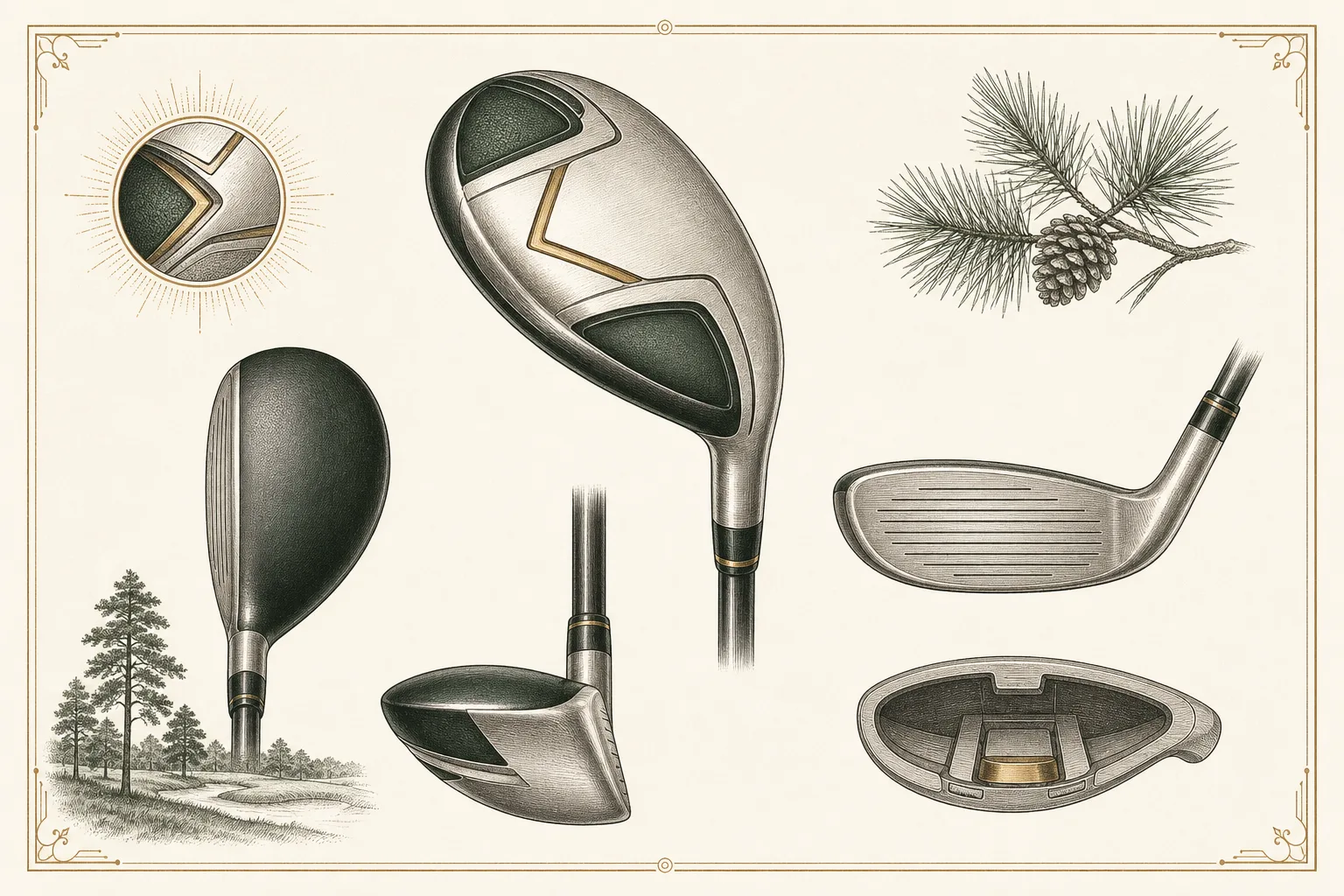
“Pinemeadow Excel EGI - a bargain-bin rescue club, sold individually for years. Rung-max-forgiveness.”
The Excel EGI is Pinemeadow's long-running budget hybrid, sold individually rather than as a matched set so a golfer can buy just the loft needed to replace a specific long iron. It has been on the market since at least the mid-2000s — a dated review documents it selling for $39 in November 2006 — and is still sold today, an unusually long run for a budget club in a category (hybrids) that most major brands refresh every 2–3 years. It ships in a spread of lofts (commonly cited as 17°/20°/23°/26° across a 2-, 3-, 4- and 5-iron replacement range, with additional lofts added over time) with a graphite shaft as standard and a steel alternative available, aimed squarely at golfers who struggle to get long irons airborne. Pinemeadow Golf, the Oregon-based direct-to-consumer maker behind it, has built its whole business on selling large volumes of clubs like this one at a fraction of major-brand pricing.
It has no cult following and was never meant to have one — it is a mass-market, direct-to-consumer bargain club — but it has earned unusually durable, genuinely positive word-of-mouth: Walmart's listing shows 2,972 customer reviews averaging 4.3 out of 5, and a 2006 independent review still holds up nearly two decades later, which is a longer track record of consistent satisfaction than most budget clubs achieve.
Ideal for high handicappers and beginners who need a cheap, easy-launching replacement for long irons they can't hit consistently, or as a bag-filler hybrid for a once-a-year golfer; a low handicapper chasing distance-control precision from 200 yards should look elsewhere.
It launched into a mid-2000s hybrid boom (Nickent, TaylorMade Rescue, Sonartec) that was pricing utility clubs at $89–$200+; Pinemeadow's pitch was, and remains, the same club concept at a fifth of the price, which is why period reviewers explicitly benchmarked it against those pricier rivals rather than against other budget brands.
Reviewers across nearly 20 years consistently describe the same effect: a wide, forgiving head that gets the ball up in the air easily and rescues golfers who top or chunk long irons, at the cost of shot-to-shot distance consistency — one longtime reviewer measured identical swings producing anywhere from 170 to 220 yards with the same club, so launch forgiveness is strong but distance control is not.
Calibrated across the whole catalog — a tour blade scores low here on purpose; it means control, not ease.
New units still sell for roughly $35–$45 directly from Pinemeadow depending on loft/shaft, making the used market almost beside the point; secondhand units on eBay typically go for $10–$20, reflecting how little room a sub-$40 new club has to depreciate.
Reading is one thing — hitting is another. Book a bay and see the numbers for yourself before you buy anywhere.
“Pinemeadow Excel EGI - a bargain-bin rescue club, sold individually for years. Rung-max-forgiveness.”
The Excel EGI is Pinemeadow's long-running budget hybrid, sold individually rather than as a matched set so a golfer can buy just the loft needed to replace a specific long iron. It has been on the market since at least the mid-2000s — a dated review documents it selling for $39 in November 2006 — and is still sold today, an unusually long run for a budget club in a category (hybrids) that most major brands refresh every 2–3 years. It ships in a spread of lofts (commonly cited as 17°/20°/23°/26° across a 2-, 3-, 4- and 5-iron replacement range, with additional lofts added over time) with a graphite shaft as standard and a steel alternative available, aimed squarely at golfers who struggle to get long irons airborne. Pinemeadow Golf, the Oregon-based direct-to-consumer maker behind it, has built its whole business on selling large volumes of clubs like this one at a fraction of major-brand pricing.
It has no cult following and was never meant to have one — it is a mass-market, direct-to-consumer bargain club — but it has earned unusually durable, genuinely positive word-of-mouth: Walmart's listing shows 2,972 customer reviews averaging 4.3 out of 5, and a 2006 independent review still holds up nearly two decades later, which is a longer track record of consistent satisfaction than most budget clubs achieve.
Ideal for high handicappers and beginners who need a cheap, easy-launching replacement for long irons they can't hit consistently, or as a bag-filler hybrid for a once-a-year golfer; a low handicapper chasing distance-control precision from 200 yards should look elsewhere.
It launched into a mid-2000s hybrid boom (Nickent, TaylorMade Rescue, Sonartec) that was pricing utility clubs at $89–$200+; Pinemeadow's pitch was, and remains, the same club concept at a fifth of the price, which is why period reviewers explicitly benchmarked it against those pricier rivals rather than against other budget brands.
Reviewers across nearly 20 years consistently describe the same effect: a wide, forgiving head that gets the ball up in the air easily and rescues golfers who top or chunk long irons, at the cost of shot-to-shot distance consistency — one longtime reviewer measured identical swings producing anywhere from 170 to 220 yards with the same club, so launch forgiveness is strong but distance control is not.
Calibrated across the whole catalog — a tour blade scores low here on purpose; it means control, not ease.
New units still sell for roughly $35–$45 directly from Pinemeadow depending on loft/shaft, making the used market almost beside the point; secondhand units on eBay typically go for $10–$20, reflecting how little room a sub-$40 new club has to depreciate.
Reading is one thing — hitting is another. Book a bay and see the numbers for yourself before you buy anywhere.