“A rung-1 forgiving fairway with a deeper Power Milled Face and variable face thickness to hold ball speed on mishits. Launches high and easy. Cheap used and a dependable get-airborne club.”
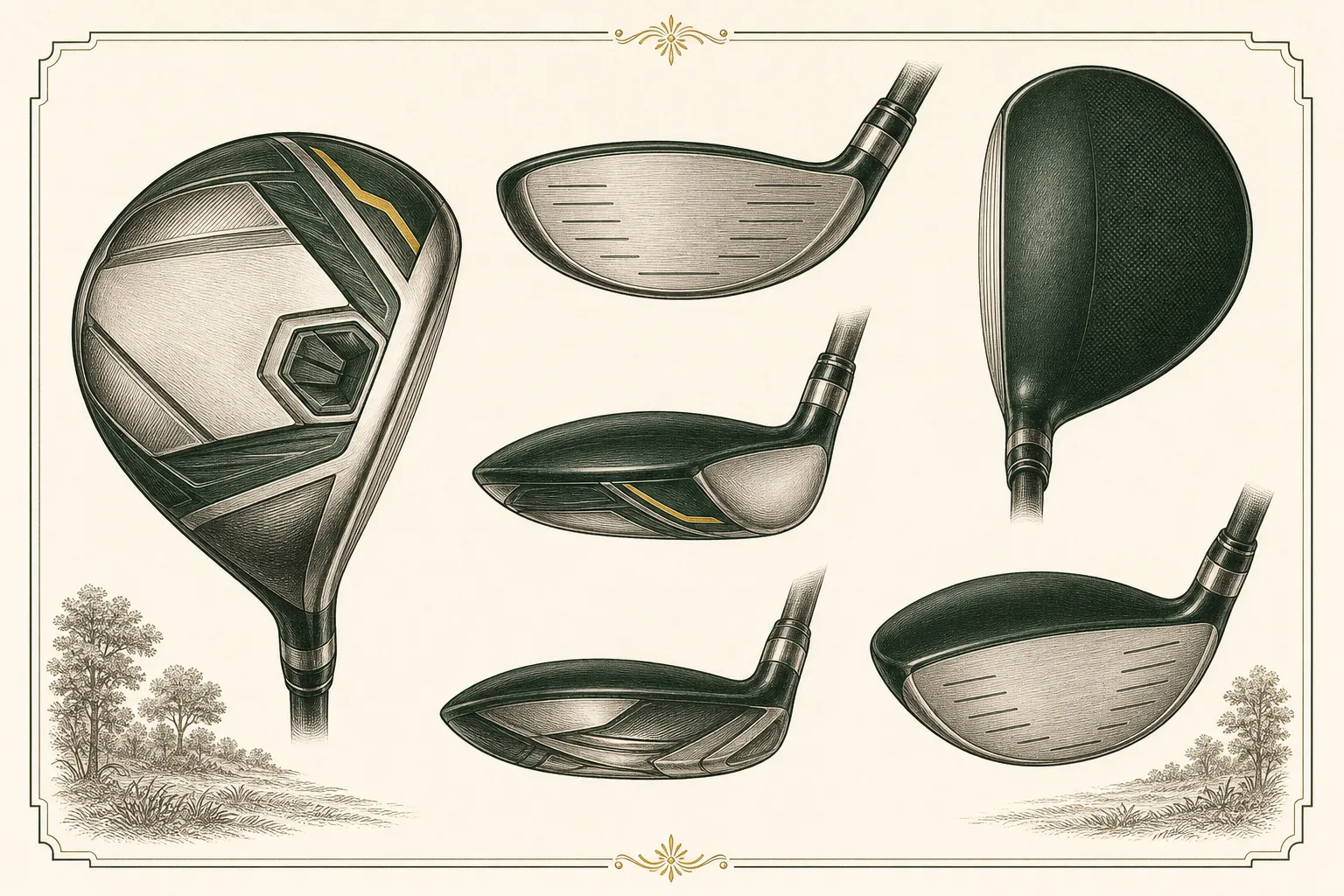
The Tour B JGR Fairway Wood arrived in 2018 as the second-generation replacement for the 2016 JGR Fairway Wood, built around a redesigned Power Milled Face that retailer technical copy describes as roughly double the milling depth of its predecessor's face treatment, aimed at reducing ball slippage and holding ball speed on off-center strikes. It paired that face with a Boost Wave Crown - an evolution of the earlier F.A.S.T. crown concept - and a Power Slit, an internal sole channel that lets specific zones of the face flex like a trampoline at impact, plus, for the first time in the JGR fairway line, variable face thickness to help maintain ball speed on mishits. Stock-shafted with the UST Mamiya Recoil 460 ES, it ships in a shallow-faced, draw-biased head that sits slightly closed at address.
Plugged In Golf's review went as far as saying, 'If you're thinking about giving up on fairway woods, check out the Bridgestone Tour B JGR first,' and both LINKS Magazine and The Hackers Paradise singled it out as one of the easiest fairway woods they tested that year - real praise for a club that never cracked mainstream Most Wanted rankings and is largely absent from GolfWRX buy-sell hype today.
Aimed squarely at recreational and higher-handicap golfers who struggle to get fairway woods airborne or fight a slice; Plugged In Golf explicitly steers players who already draw the ball away from it, reserving it for slicers and golfers wanting maximum forgiveness off the deck.
It launched in fall 2018 alongside the Tour B JGR driver, hybrids and HF1/HF2 irons, competing against Callaway's Rogue, TaylorMade's M4 and Titleist's 917F2 fairway woods in the game-improvement segment; MyGolfSpy ran an official forum-member test thread for the line rather than including it in that year's full lab-tested Most Wanted rankings.
The shallow, variable-thickness Power Milled Face and draw-biased, closed-at-address design are built specifically to bail out off-center strikes and slice-prone swings, per Plugged In Golf and The Hackers Paradise reviews - though the same draw bias becomes a liability for golfers who already hit a natural draw, a caveat Plugged In Golf makes explicitly.
Calibrated across the whole catalog — a tour blade scores low here on purpose; it means control, not ease.
Used Tour B JGR 3-woods and 5-woods trade well under the original $229 MSRP - 2nd Swing has listed graphite-shafted copies (Recoil 460 ES, various lofts and flexes) for as low as $90.99, marked down from a $229.99 reference price, with eBay and GlobalGolf private-party listings running in a similar $80-$150 band depending on shaft and condition.
Reading is one thing — hitting is another. Book a bay and see the numbers for yourself before you buy anywhere.
“A rung-1 forgiving fairway with a deeper Power Milled Face and variable face thickness to hold ball speed on mishits. Launches high and easy. Cheap used and a dependable get-airborne club.”
The Tour B JGR Fairway Wood arrived in 2018 as the second-generation replacement for the 2016 JGR Fairway Wood, built around a redesigned Power Milled Face that retailer technical copy describes as roughly double the milling depth of its predecessor's face treatment, aimed at reducing ball slippage and holding ball speed on off-center strikes. It paired that face with a Boost Wave Crown - an evolution of the earlier F.A.S.T. crown concept - and a Power Slit, an internal sole channel that lets specific zones of the face flex like a trampoline at impact, plus, for the first time in the JGR fairway line, variable face thickness to help maintain ball speed on mishits. Stock-shafted with the UST Mamiya Recoil 460 ES, it ships in a shallow-faced, draw-biased head that sits slightly closed at address.
Plugged In Golf's review went as far as saying, 'If you're thinking about giving up on fairway woods, check out the Bridgestone Tour B JGR first,' and both LINKS Magazine and The Hackers Paradise singled it out as one of the easiest fairway woods they tested that year - real praise for a club that never cracked mainstream Most Wanted rankings and is largely absent from GolfWRX buy-sell hype today.
Aimed squarely at recreational and higher-handicap golfers who struggle to get fairway woods airborne or fight a slice; Plugged In Golf explicitly steers players who already draw the ball away from it, reserving it for slicers and golfers wanting maximum forgiveness off the deck.
It launched in fall 2018 alongside the Tour B JGR driver, hybrids and HF1/HF2 irons, competing against Callaway's Rogue, TaylorMade's M4 and Titleist's 917F2 fairway woods in the game-improvement segment; MyGolfSpy ran an official forum-member test thread for the line rather than including it in that year's full lab-tested Most Wanted rankings.
The shallow, variable-thickness Power Milled Face and draw-biased, closed-at-address design are built specifically to bail out off-center strikes and slice-prone swings, per Plugged In Golf and The Hackers Paradise reviews - though the same draw bias becomes a liability for golfers who already hit a natural draw, a caveat Plugged In Golf makes explicitly.
Calibrated across the whole catalog — a tour blade scores low here on purpose; it means control, not ease.
Used Tour B JGR 3-woods and 5-woods trade well under the original $229 MSRP - 2nd Swing has listed graphite-shafted copies (Recoil 460 ES, various lofts and flexes) for as low as $90.99, marked down from a $229.99 reference price, with eBay and GlobalGolf private-party listings running in a similar $80-$150 band depending on shaft and condition.
Reading is one thing — hitting is another. Book a bay and see the numbers for yourself before you buy anywhere.