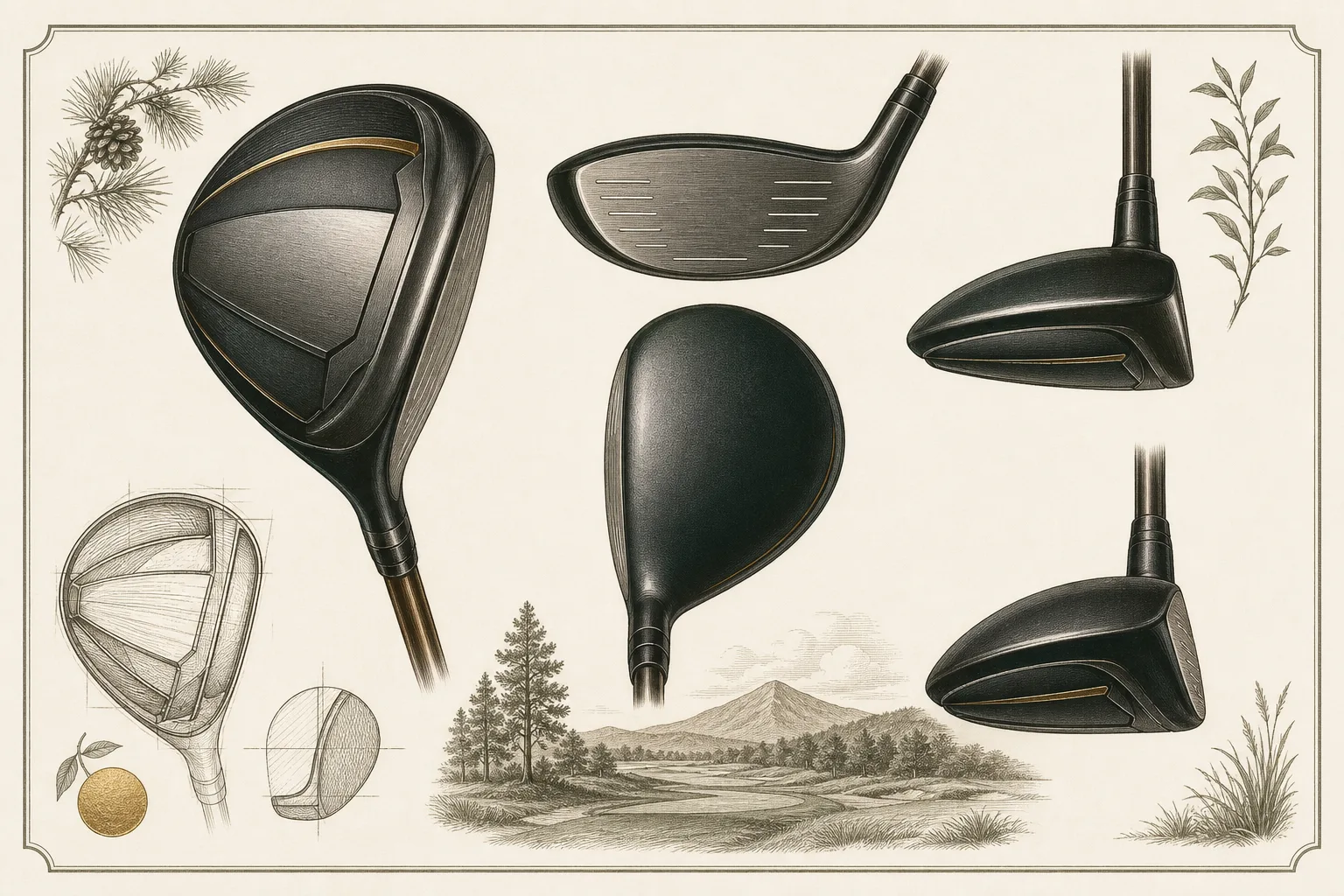
“PRGR's easy-launch fairway wood comes with an ultralight carbon shaft in five flex weights, so it can be tuned all the way down for a slower, smoother swing. The titanium face and tungsten sole help the ball climb quickly with very little effort. It is a Japan-market club that sold for roughly 470 dollars new, and a great fit for anyone who wants more carry without more swing effort.”
PRGR's 'egg' nameplate is a long-running, almost annually refreshed Japanese distance-club franchise built around an egg-shaped, deep-CG head paired with an ultralight total build - the idea being that shaving swingweight lets a slower-swinging golfer (typically senior players) generate more clubhead speed and launch easily. The 2019 NEW egg fairway wood continues that formula, following prior generations built with a titanium crown/face laser-welded to a heavier stainless sole plate to push mass low and deep, sold with PRGR's own stock lightweight graphite shaft as a complete, non-customized package.
The Egg line is close to an institution in Japan's senior-golfer market - it has iterated almost every year for over a decade (New egg, Super egg, and a Super egg 2026 model documented by TourSpecGolf), making it a recognizable go-to distance-club franchise domestically. It has essentially no profile in Western mainstream golf media outside JDM import specialists, so it is notable rather than cult in the enthusiast-reverence sense.
Best for senior golfers and higher-handicap players with slower swing speeds who want maximum ease of launch and distance from a featherweight club; not a fit for faster-swinging or better players, who will overpower the low-CG design and lose control of trajectory.
The 2019 NEW egg competed with PRGR's own contemporaneous Super Egg upgrades and with other Japan-market senior-oriented clubs (Bridgestone senior lines, Yonex EZONE); the nameplate has continued iterating well past this generation, with TourSpecGolf documenting a Super Egg 2026 fairway wood as the modern equivalent within PRGR's own catalog.
The featherweight total build and deep, egg-shaped CG are specifically tuned to maximize clubhead speed and launch for slower swingers, making it genuinely easy to get airborne. The tradeoff is feel and control at the extremes: the very light, deep-CG design that helps a slow swinger can produce a ballooning, hard-to-control flight in the hands of a faster-swinging player, and feedback/sound quality is typically sacrificed for the distance-first design brief.
Calibrated across the whole catalog — a tour blade scores low here on purpose; it means control, not ease.
Realistic used pricing runs roughly $50-200 on eBay/SidelineSwap depending on the specific generation and shaft condition; collector interest is negligible - it is priced and bought purely as a functional distance tool, not a collectible.
Reading is one thing — hitting is another. Book a bay and see the numbers for yourself before you buy anywhere.
“PRGR's easy-launch fairway wood comes with an ultralight carbon shaft in five flex weights, so it can be tuned all the way down for a slower, smoother swing. The titanium face and tungsten sole help the ball climb quickly with very little effort. It is a Japan-market club that sold for roughly 470 dollars new, and a great fit for anyone who wants more carry without more swing effort.”
PRGR's 'egg' nameplate is a long-running, almost annually refreshed Japanese distance-club franchise built around an egg-shaped, deep-CG head paired with an ultralight total build - the idea being that shaving swingweight lets a slower-swinging golfer (typically senior players) generate more clubhead speed and launch easily. The 2019 NEW egg fairway wood continues that formula, following prior generations built with a titanium crown/face laser-welded to a heavier stainless sole plate to push mass low and deep, sold with PRGR's own stock lightweight graphite shaft as a complete, non-customized package.
The Egg line is close to an institution in Japan's senior-golfer market - it has iterated almost every year for over a decade (New egg, Super egg, and a Super egg 2026 model documented by TourSpecGolf), making it a recognizable go-to distance-club franchise domestically. It has essentially no profile in Western mainstream golf media outside JDM import specialists, so it is notable rather than cult in the enthusiast-reverence sense.
Best for senior golfers and higher-handicap players with slower swing speeds who want maximum ease of launch and distance from a featherweight club; not a fit for faster-swinging or better players, who will overpower the low-CG design and lose control of trajectory.
The 2019 NEW egg competed with PRGR's own contemporaneous Super Egg upgrades and with other Japan-market senior-oriented clubs (Bridgestone senior lines, Yonex EZONE); the nameplate has continued iterating well past this generation, with TourSpecGolf documenting a Super Egg 2026 fairway wood as the modern equivalent within PRGR's own catalog.
The featherweight total build and deep, egg-shaped CG are specifically tuned to maximize clubhead speed and launch for slower swingers, making it genuinely easy to get airborne. The tradeoff is feel and control at the extremes: the very light, deep-CG design that helps a slow swinger can produce a ballooning, hard-to-control flight in the hands of a faster-swinging player, and feedback/sound quality is typically sacrificed for the distance-first design brief.
Calibrated across the whole catalog — a tour blade scores low here on purpose; it means control, not ease.
Realistic used pricing runs roughly $50-200 on eBay/SidelineSwap depending on the specific generation and shaft condition; collector interest is negligible - it is priced and bought purely as a functional distance tool, not a collectible.
Reading is one thing — hitting is another. Book a bay and see the numbers for yourself before you buy anywhere.