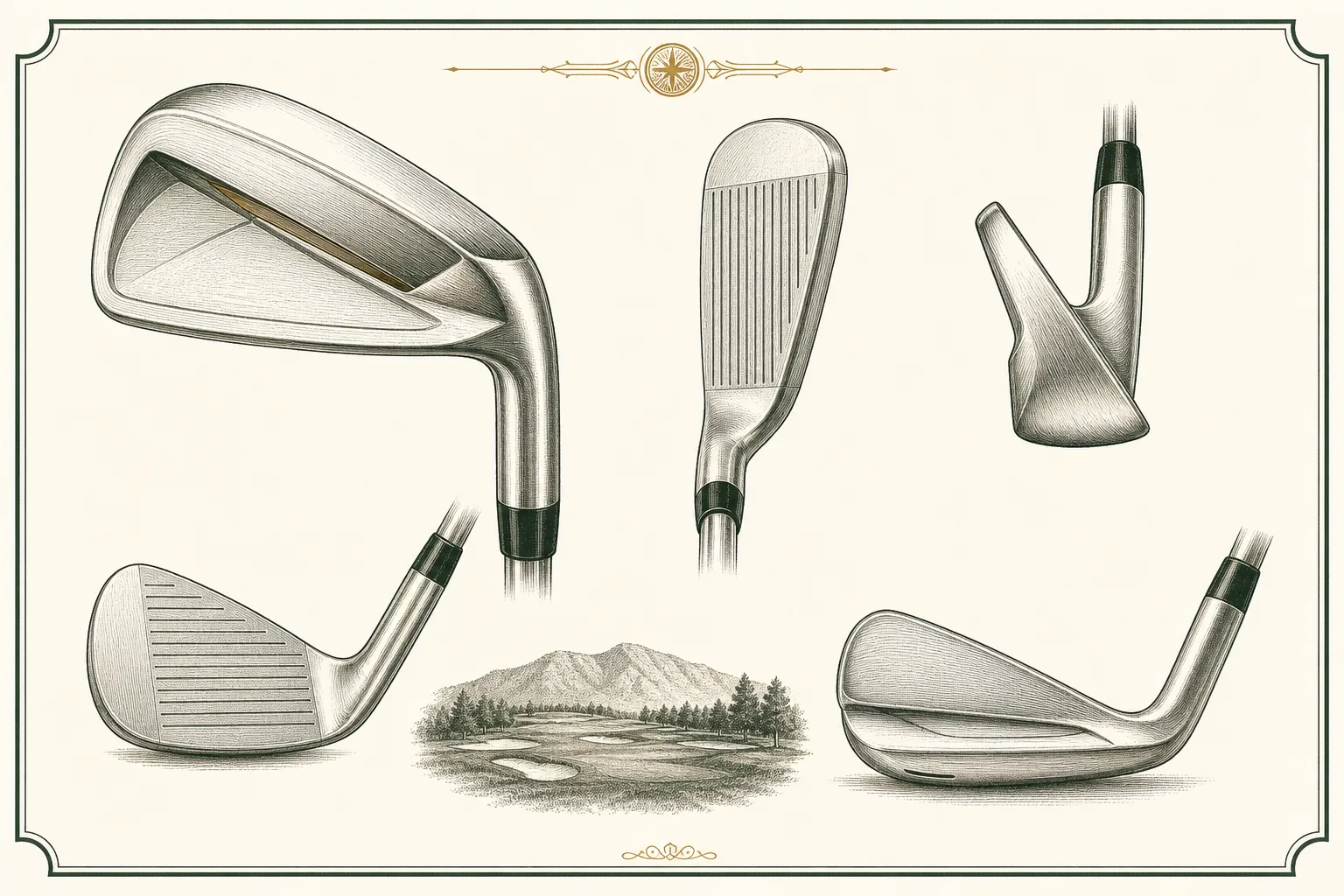
“The Edge - Hogan's forged game-improvement iron, a rare thing (most GI irons are cast). Rung-1.”
The modern Edge revives the name of the original 1988 Ben Hogan Edge, which golf historians credit as the first full-production forged, perimeter-weighted cavity-back iron from a major manufacturer and a club that reportedly kept the old Ben Hogan Company solvent through the late 1980s after Ping's Eye 2 had eaten into its blade-driven business. This 2020 relaunch, built by the direct-to-consumer Ben Hogan Golf Equipment Company under ExWorks Capital ownership (the post-2017-bankruptcy iteration of the brand), reused that heritage name for a two-piece forged iron: a 1025 carbon-steel forging laser-welded to a body and filled with foam to control vibration, with face thickness tapered thinner in the long irons for ball speed and thicker in the short irons for feel. It carried Hogan's Enhanced V-Sole, with more bounce at the leading edge and less at the trailing edge to resist digging on steep swings. Sold factory-direct only, with no retail markup, it undercut comparable forged game-improvement irons from major OEMs by hundreds of dollars per set.
Independent reviewers rated it competitive on feel with premium forged players'-distance irons like the Callaway X-Forged and Miura, a strong result for a sub-$100-per-club forged game-improvement iron, but there is no evidence of broad forum-driven demand or price appreciation the way there is for the vintage 1988 Edge it was named after. Coverage is limited to a handful of gear-review sites (Plugged In Golf, MyGolfSpy's retrospective on the name) rather than sustained GolfWRX-forum enthusiasm, and the brand's own instability cut its window to build a following.
Aimed at mid-to-high handicaps (roughly 15-30) who miss center face often and want maximum forgiveness and an easy, high ball flight without paying big-brand prices. Better ball-strikers and anyone who needs to flight shots down into wind or work the ball intentionally should look elsewhere - the design trades workability for consistency.
Launched in 2020 into a game-improvement market dominated by cast heads from Callaway (Rogue), Ping (G410/G710) and TaylorMade (SIM), the Edge stood out simply by being forged in a category where forging is rare and expensive. It followed the brand's own 2015-2017 Ft. Worth/Ft. Worth Hi era and was itself succeeded by the Edge EX after Golf Brands Inc relicensed the Ben Hogan name in 2023, following the ExWorks-era company's shutdown in mid-2022.
Wide sole, a deep progressive CG from the foam-filled two-piece build, and a V-Sole that resists digging combine for genuine game-improvement forgiveness - testers reported very high, consistent launch even on thin strikes. The tradeoff is a design so committed to high launch that reviewers found it 'very hard to flight down,' which limits shot-shaping versatility a better player would want.
Calibrated across the whole catalog — a tour blade scores low here on purpose; it means control, not ease.
Original Edge sets are largely gone from dealer inventory: 2nd Swing's own Edge (non-EX) listing shows no current stock, and eBay activity is scattered private-party sets rather than a deep, liquid market. Based on comparable Ben Hogan single-iron listings from the same era trading in the $60-$185 range at retail-grade resellers, a realistic 2026 private-party estimate for a clean 5-PW set is roughly $200-$350, well down from the original list price near $700, reflecting both the brand's niche status and its parent company's now-defunct status.
Reading is one thing — hitting is another. Book a bay and see the numbers for yourself before you buy anywhere.
“The Edge - Hogan's forged game-improvement iron, a rare thing (most GI irons are cast). Rung-1.”
The modern Edge revives the name of the original 1988 Ben Hogan Edge, which golf historians credit as the first full-production forged, perimeter-weighted cavity-back iron from a major manufacturer and a club that reportedly kept the old Ben Hogan Company solvent through the late 1980s after Ping's Eye 2 had eaten into its blade-driven business. This 2020 relaunch, built by the direct-to-consumer Ben Hogan Golf Equipment Company under ExWorks Capital ownership (the post-2017-bankruptcy iteration of the brand), reused that heritage name for a two-piece forged iron: a 1025 carbon-steel forging laser-welded to a body and filled with foam to control vibration, with face thickness tapered thinner in the long irons for ball speed and thicker in the short irons for feel. It carried Hogan's Enhanced V-Sole, with more bounce at the leading edge and less at the trailing edge to resist digging on steep swings. Sold factory-direct only, with no retail markup, it undercut comparable forged game-improvement irons from major OEMs by hundreds of dollars per set.
Independent reviewers rated it competitive on feel with premium forged players'-distance irons like the Callaway X-Forged and Miura, a strong result for a sub-$100-per-club forged game-improvement iron, but there is no evidence of broad forum-driven demand or price appreciation the way there is for the vintage 1988 Edge it was named after. Coverage is limited to a handful of gear-review sites (Plugged In Golf, MyGolfSpy's retrospective on the name) rather than sustained GolfWRX-forum enthusiasm, and the brand's own instability cut its window to build a following.
Aimed at mid-to-high handicaps (roughly 15-30) who miss center face often and want maximum forgiveness and an easy, high ball flight without paying big-brand prices. Better ball-strikers and anyone who needs to flight shots down into wind or work the ball intentionally should look elsewhere - the design trades workability for consistency.
Launched in 2020 into a game-improvement market dominated by cast heads from Callaway (Rogue), Ping (G410/G710) and TaylorMade (SIM), the Edge stood out simply by being forged in a category where forging is rare and expensive. It followed the brand's own 2015-2017 Ft. Worth/Ft. Worth Hi era and was itself succeeded by the Edge EX after Golf Brands Inc relicensed the Ben Hogan name in 2023, following the ExWorks-era company's shutdown in mid-2022.
Wide sole, a deep progressive CG from the foam-filled two-piece build, and a V-Sole that resists digging combine for genuine game-improvement forgiveness - testers reported very high, consistent launch even on thin strikes. The tradeoff is a design so committed to high launch that reviewers found it 'very hard to flight down,' which limits shot-shaping versatility a better player would want.
Calibrated across the whole catalog — a tour blade scores low here on purpose; it means control, not ease.
Original Edge sets are largely gone from dealer inventory: 2nd Swing's own Edge (non-EX) listing shows no current stock, and eBay activity is scattered private-party sets rather than a deep, liquid market. Based on comparable Ben Hogan single-iron listings from the same era trading in the $60-$185 range at retail-grade resellers, a realistic 2026 private-party estimate for a clean 5-PW set is roughly $200-$350, well down from the original list price near $700, reflecting both the brand's niche status and its parent company's now-defunct status.
Reading is one thing — hitting is another. Book a bay and see the numbers for yourself before you buy anywhere.