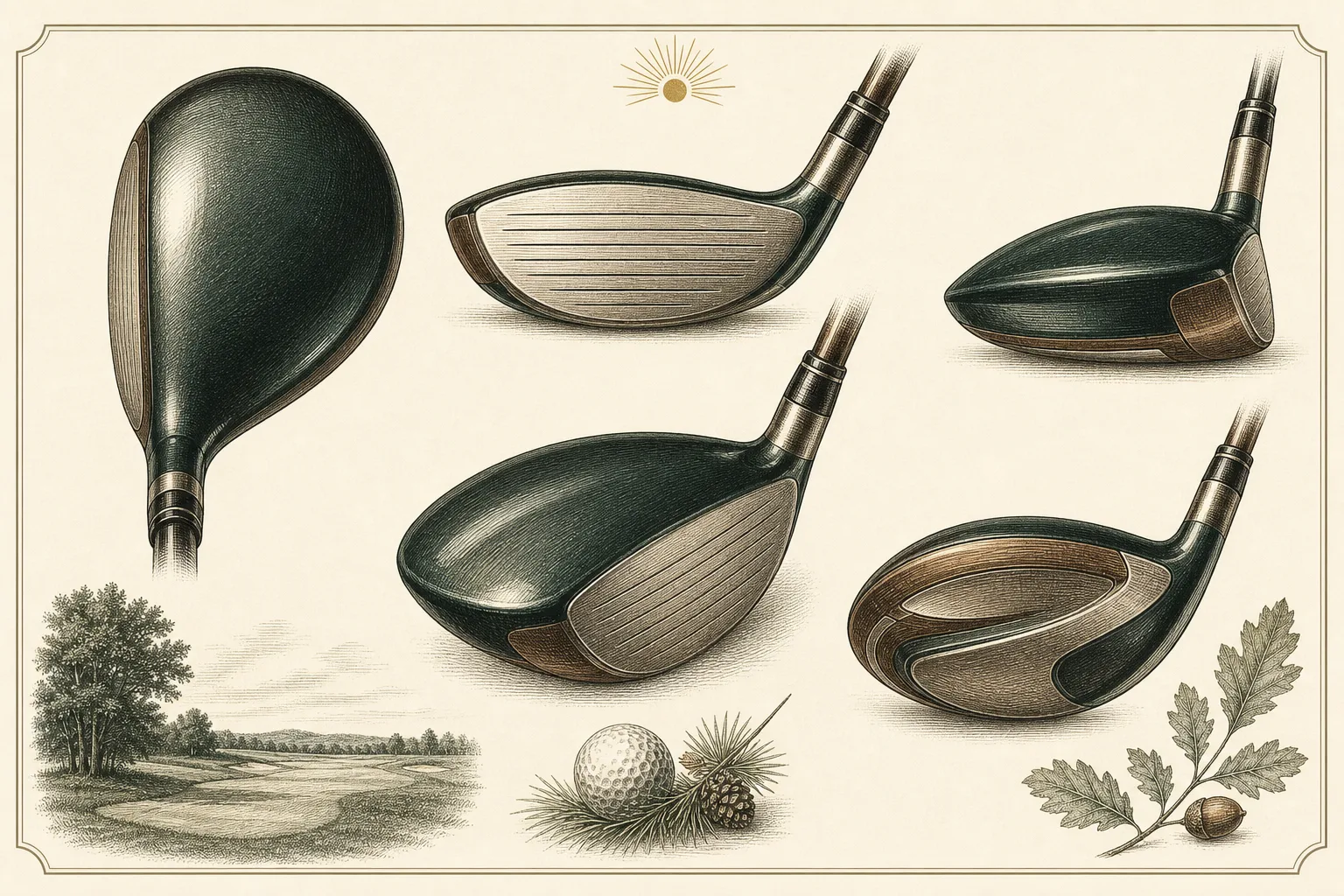
“The retro Raw-finish Mashie fairways used GlideRail soles to glide through turf on uneven lies and a light Miyazaki shaft for speed. A forgiving, easy-launch top-of-ladder fairway.”
Named for the old hickory-era mashie (roughly today's 5-iron), Cleveland's 2011 Mashie fairway wood paired throwback branding — a deliberately rugged 'Retro-Raw' unpolished finish — with a genuinely new sole innovation: Gliderail, a dual-rail design with a subtle center keel that reviewers found measurably cut turf drag and helped mitigate distance loss on fat strikes. Ultralite construction shaved about 20 grams off the head, paired with a featherweight aftermarket Miyazaki C. Kua 59 shaft to help slower swingers pick up clubhead speed. Gliderail went on to become a recurring Cleveland sole technology, reappearing on fairway woods and hybrids for a decade afterward, including the 2021-22 Launcher XL Halo family.
Notable as the origin point of Cleveland's Gliderail sole technology, which the company kept reusing on fairway woods and hybrids for roughly the next ten years — a real, traceable engineering lineage — but the Mashie itself has no cult following, scarcity, or tour story; it was a modestly priced, positively reviewed fairway wood that simply moved on to the next model year.
Slower-swing and higher-handicap golfers of its era who wanted an easy-launching fairway wood that forgave imperfect turf contact, particularly fat strikes. Today it is a budget curiosity rather than a real buying option for anyone chasing modern distance or forgiveness numbers.
Launched in 2011 at $199.99, competing with TaylorMade's RocketBallz and Callaway's RAZR Fit fairway woods; superseded within Cleveland's own lineup and largely forgotten as a standalone model, but its Gliderail sole concept persisted and was rebranded/expanded through the Launcher HB, CBX, and eventually the 2021-22 Launcher XL Halo fairway woods.
Forgiving for its 2011 vintage: The Hackers Paradise's review specifically noted the Gliderail sole mitigated distance loss on slightly fat strikes, sliding the sole through turf rather than digging, while the Ultralite build and light Miyazaki shaft helped slower swingers generate speed. It is meaningfully less forgiving than the MOI-chasing 2020s Cleveland fairway woods (Launcher XL Halo) that inherited its sole concept a decade later.
Calibrated across the whole catalog — a tour blade scores low here on purpose; it means control, not ease.
A 15-year-old budget fairway wood: realistic 2026 private-party value is roughly $20-40, mostly reflecting scrap/curiosity demand rather than any collector interest.
Reading is one thing — hitting is another. Book a bay and see the numbers for yourself before you buy anywhere.
“The retro Raw-finish Mashie fairways used GlideRail soles to glide through turf on uneven lies and a light Miyazaki shaft for speed. A forgiving, easy-launch top-of-ladder fairway.”
Named for the old hickory-era mashie (roughly today's 5-iron), Cleveland's 2011 Mashie fairway wood paired throwback branding — a deliberately rugged 'Retro-Raw' unpolished finish — with a genuinely new sole innovation: Gliderail, a dual-rail design with a subtle center keel that reviewers found measurably cut turf drag and helped mitigate distance loss on fat strikes. Ultralite construction shaved about 20 grams off the head, paired with a featherweight aftermarket Miyazaki C. Kua 59 shaft to help slower swingers pick up clubhead speed. Gliderail went on to become a recurring Cleveland sole technology, reappearing on fairway woods and hybrids for a decade afterward, including the 2021-22 Launcher XL Halo family.
Notable as the origin point of Cleveland's Gliderail sole technology, which the company kept reusing on fairway woods and hybrids for roughly the next ten years — a real, traceable engineering lineage — but the Mashie itself has no cult following, scarcity, or tour story; it was a modestly priced, positively reviewed fairway wood that simply moved on to the next model year.
Slower-swing and higher-handicap golfers of its era who wanted an easy-launching fairway wood that forgave imperfect turf contact, particularly fat strikes. Today it is a budget curiosity rather than a real buying option for anyone chasing modern distance or forgiveness numbers.
Launched in 2011 at $199.99, competing with TaylorMade's RocketBallz and Callaway's RAZR Fit fairway woods; superseded within Cleveland's own lineup and largely forgotten as a standalone model, but its Gliderail sole concept persisted and was rebranded/expanded through the Launcher HB, CBX, and eventually the 2021-22 Launcher XL Halo fairway woods.
Forgiving for its 2011 vintage: The Hackers Paradise's review specifically noted the Gliderail sole mitigated distance loss on slightly fat strikes, sliding the sole through turf rather than digging, while the Ultralite build and light Miyazaki shaft helped slower swingers generate speed. It is meaningfully less forgiving than the MOI-chasing 2020s Cleveland fairway woods (Launcher XL Halo) that inherited its sole concept a decade later.
Calibrated across the whole catalog — a tour blade scores low here on purpose; it means control, not ease.
A 15-year-old budget fairway wood: realistic 2026 private-party value is roughly $20-40, mostly reflecting scrap/curiosity demand rather than any collector interest.
Reading is one thing — hitting is another. Book a bay and see the numbers for yourself before you buy anywhere.