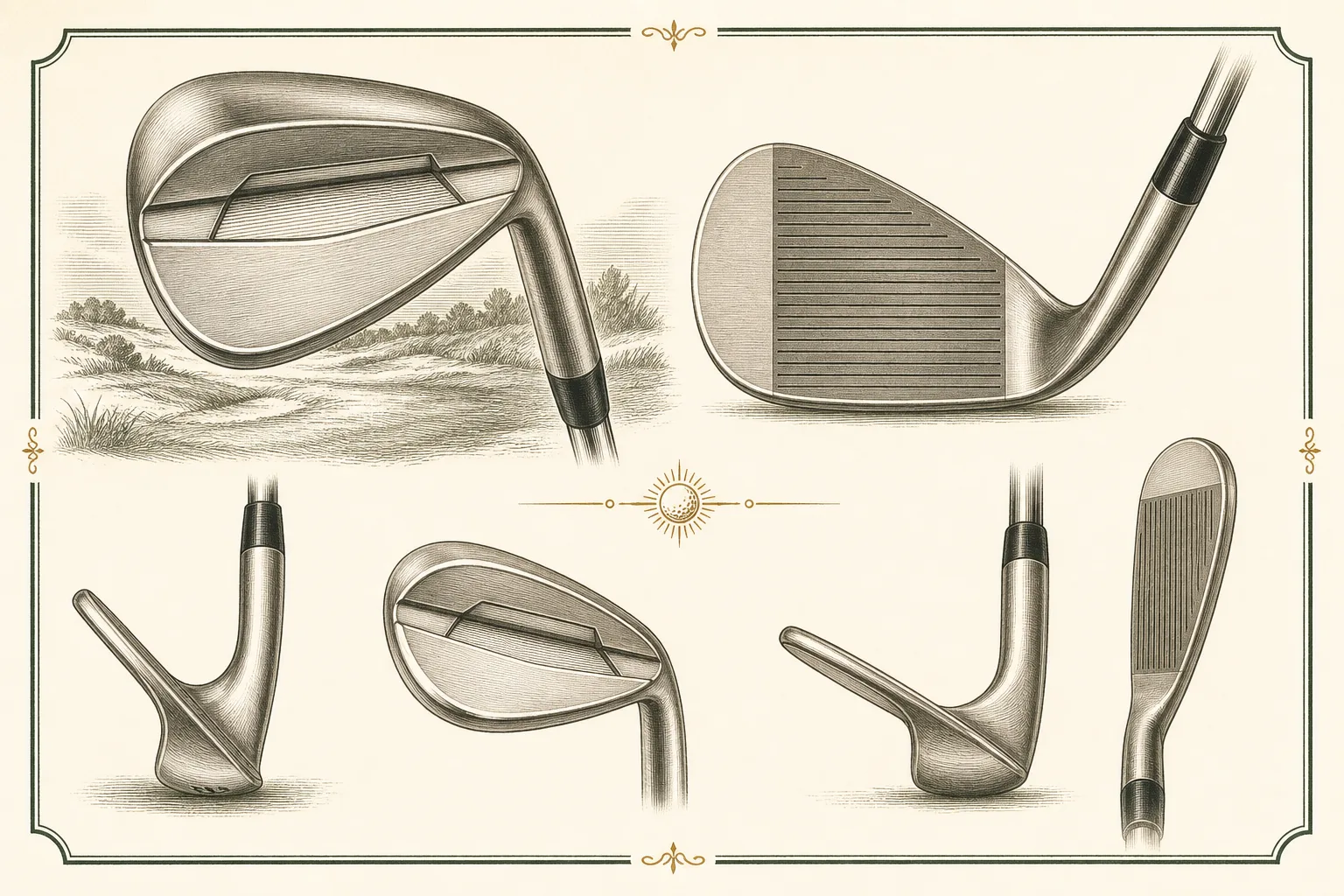
“Compact forged tour wedge with high bounce grinds and precision milling. Steel-dominant players' wedge; a fitter/better-player identity club.”
Launched in 2021 as the compact, tour-oriented sibling to Ping's cast Glide 3.0/4.0 line, the Glide Forged Pro is forged from 8620 carbon steel for the softer feel Ping's cast wedges can't match, then finished with 'Friction Face' - a micro-textured face blast layered under the grooves to add spin, especially from tight or wet lies. It ditches the visible milling of the original Glide Forged for a cleaner tour look and adds sole options: a versatile 'S' grind (moderate bounce, rounded leading edge) and a narrower, lower-bounce 'T' grind for steep, ball-first players, plus a 59-degree 'Eye2 Toe' grind with a higher toe nodding to Ping's own Eye2 wedge shape. It is explicitly built for the player who does not need forgiveness.
Reviewed favorably across Golf Monthly, Plugged In Golf, TGW and Golfalot as one of the higher-spinning wedges on the market, and MyGolfSpy ran a dedicated feature on Ping's wedge-customizer program built around it - but it is a five-year-old product with no forum mythology, no tour-legend story and no scarcity; 'well-regarded current tour wedge' is the honest ceiling here, not cult status.
Single-digit handicaps and better who want a small, blade-like wedge shape they can open, close and spin at will. Mid-to-high handicappers wanting help from tight lies or inconsistent strikes should look at Ping's own cavity-back Glide 4.0 instead - this wedge was not built for them.
Sits alongside the standard cast Glide 4.0 in Ping's 2021-era wedge lineup as the 'player's' option, competing directly with Titleist's Vokey SM8/SM9, Cleveland RTX 6 ZipCore and Mizuno T22 - all forged or forged-feel tour wedges chasing the same low-handicap buyer with milled/blasted face-friction tech.
A deliberately compact, low-offset players' wedge - the whole design brief is workability and spin control for a precise strike, not bailing out a mis-hit. The T grind in particular trims bounce further for skilled, steep attack angles, which punishes fat or thin contact more than a wider-soled game-improvement wedge would.
Calibrated across the whole catalog — a tour blade scores low here on purpose; it means control, not ease.
Individual used wedges commonly sell for $80-130 on eBay/Golf Avenue depending on loft and grind wear, with graded-retail listings sitting near the top of that band; a matched 3-wedge set realistically runs $220-320 private-party in 2026 - still fairly current stock so it has not yet depreciated to bargain-bin territory.
Reading is one thing — hitting is another. Book a bay and see the numbers for yourself before you buy anywhere.
“Compact forged tour wedge with high bounce grinds and precision milling. Steel-dominant players' wedge; a fitter/better-player identity club.”
Launched in 2021 as the compact, tour-oriented sibling to Ping's cast Glide 3.0/4.0 line, the Glide Forged Pro is forged from 8620 carbon steel for the softer feel Ping's cast wedges can't match, then finished with 'Friction Face' - a micro-textured face blast layered under the grooves to add spin, especially from tight or wet lies. It ditches the visible milling of the original Glide Forged for a cleaner tour look and adds sole options: a versatile 'S' grind (moderate bounce, rounded leading edge) and a narrower, lower-bounce 'T' grind for steep, ball-first players, plus a 59-degree 'Eye2 Toe' grind with a higher toe nodding to Ping's own Eye2 wedge shape. It is explicitly built for the player who does not need forgiveness.
Reviewed favorably across Golf Monthly, Plugged In Golf, TGW and Golfalot as one of the higher-spinning wedges on the market, and MyGolfSpy ran a dedicated feature on Ping's wedge-customizer program built around it - but it is a five-year-old product with no forum mythology, no tour-legend story and no scarcity; 'well-regarded current tour wedge' is the honest ceiling here, not cult status.
Single-digit handicaps and better who want a small, blade-like wedge shape they can open, close and spin at will. Mid-to-high handicappers wanting help from tight lies or inconsistent strikes should look at Ping's own cavity-back Glide 4.0 instead - this wedge was not built for them.
Sits alongside the standard cast Glide 4.0 in Ping's 2021-era wedge lineup as the 'player's' option, competing directly with Titleist's Vokey SM8/SM9, Cleveland RTX 6 ZipCore and Mizuno T22 - all forged or forged-feel tour wedges chasing the same low-handicap buyer with milled/blasted face-friction tech.
A deliberately compact, low-offset players' wedge - the whole design brief is workability and spin control for a precise strike, not bailing out a mis-hit. The T grind in particular trims bounce further for skilled, steep attack angles, which punishes fat or thin contact more than a wider-soled game-improvement wedge would.
Calibrated across the whole catalog — a tour blade scores low here on purpose; it means control, not ease.
Individual used wedges commonly sell for $80-130 on eBay/Golf Avenue depending on loft and grind wear, with graded-retail listings sitting near the top of that band; a matched 3-wedge set realistically runs $220-320 private-party in 2026 - still fairly current stock so it has not yet depreciated to bargain-bin territory.
Reading is one thing — hitting is another. Book a bay and see the numbers for yourself before you buy anywhere.