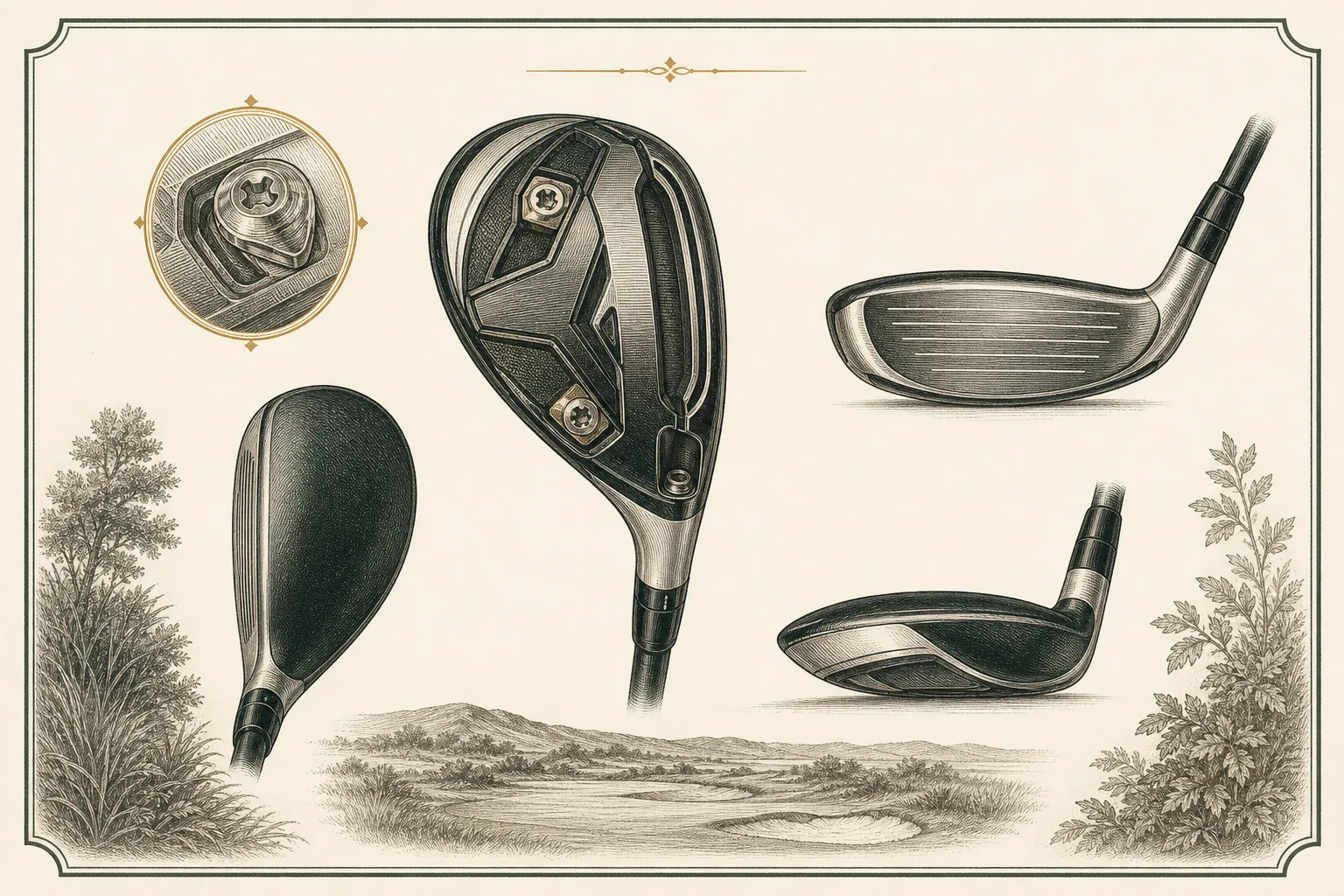
“First-ever sliding weight track in a TaylorMade Rescue — a 27g weight moves along the track for neutral/draw/fade bias, a real fitting tool for a fast, players'-caliber swing.”
TaylorMade's first hybrid built around genuine adjustable weighting rather than just a loft sleeve: the 2016 M1 Rescue shipped with two separate movable weights (a 25g piece and a 3g piece) that could be swapped between the back and toe ports to bias the head neutral or toward a fade. TaylorMade refined the idea for 2017 into a single 27g weight riding a real sliding track — the brand's first true weight-track system in a rescue club — adding a genuine draw option alongside neutral and fade. Both years paired the moving weight with the 1.5°-of-adjustment loft sleeve already standard across the M-family, aimed at a faster, better player's swing rather than maximum forgiveness.
It's a real technology first — TaylorMade's own materials and independent reviews credit it as the brand's first rescue club with genuine adjustable weighting for shot shape — but that claim to fame lives in equipment-history footnotes, not active forum demand or collector pricing. No lawsuit, no tour-legend status, no scarcity.
Fits a mid-to-low handicap player with fast enough hands to want shot-shape control from a hybrid, and who will actually use the weight positions rather than leave it neutral forever. A high-handicap golfer chasing pure ease-of-launch is better served by a simpler, max-forgiveness hybrid without the added weight-tuning complexity.
Launched in 2016 alongside the M1/M2 driver family as the hybrid half of that year's M-series, then meaningfully upgraded for 2017 when the two-piece weight system became a single sliding 27g weight on a real track. Competed against Callaway's Apex hybrid and Titleist's 816H2/H3 that generation; TaylorMade carried the sliding-weight rescue concept forward into the M3/M4 rescues.
Hybrids as a category are inherently more forgiving than a comparable long iron, and the M1 Rescue's default neutral setup puts real mass low and back for easy launch. But it was pitched as 'the only adjustable-weight hybrid' for shot-shaping control rather than maximum forgiveness, and reviewers noted the neutral setting carries more spin than rival hybrids like Callaway's Apex — a real trade-off for a player who wants the shaping option.
Calibrated across the whole catalog — a tour blade scores low here on purpose; it means control, not ease.
Realistic 2026 private-party pricing for a clean M1 Rescue runs roughly $35-70 — hybrids from this era depreciate hard once past their model cycle, and the two-piece 2016 weight system is a minor knock versus the 2017 single-track version among buyers who know the difference. Reconditioned-retail listings (2nd Swing, Global Golf) typically show $70-120 graded.
Reading is one thing — hitting is another. Book a bay and see the numbers for yourself before you buy anywhere.