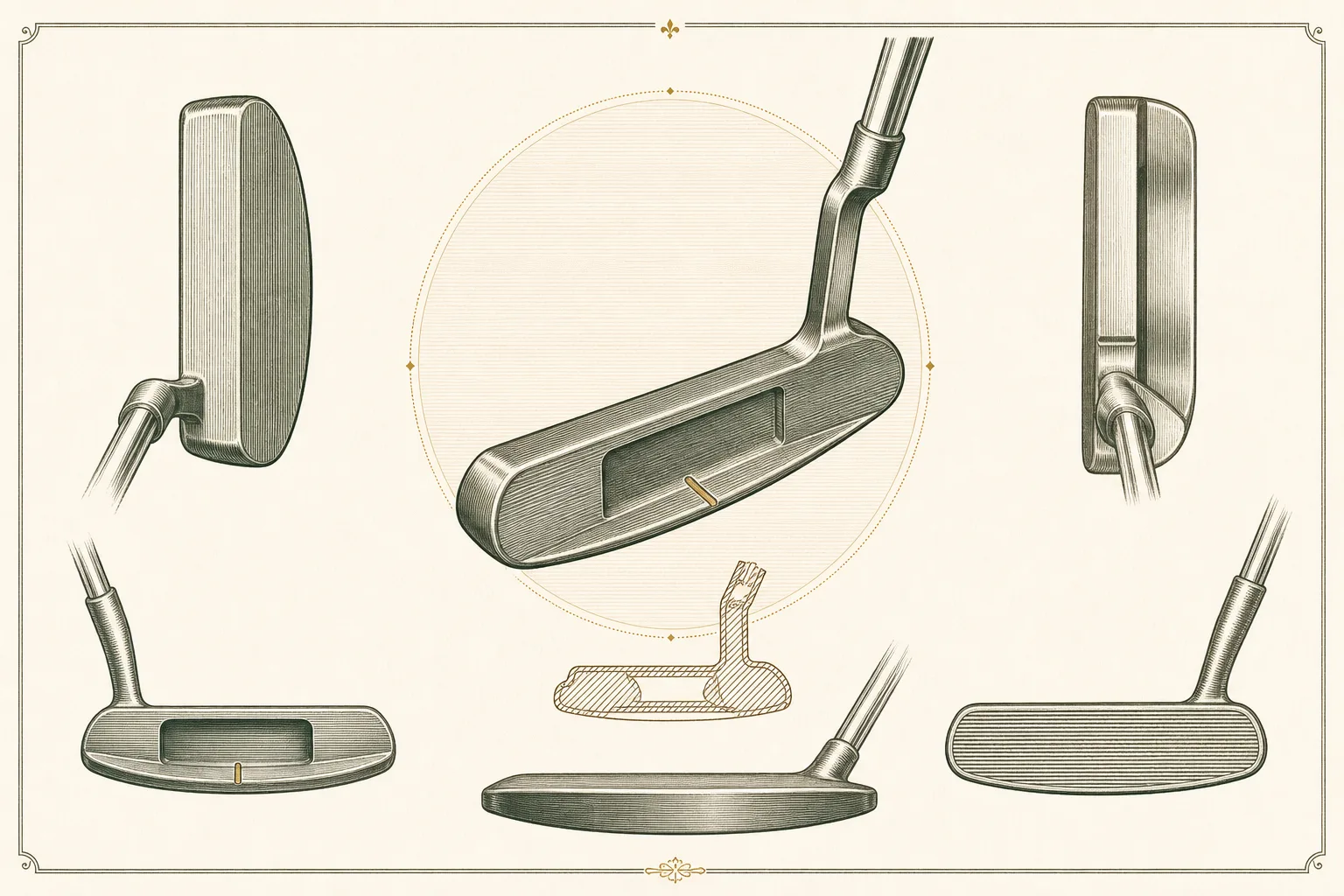
“Bobby Grace boutique designs (the famous Fat Lady Swings and HG mallets); mostly face-balanced high-MOI mallets for a straight stroke. A cult designer name; head style varies by model.”
Ask which putter 'a Bobby Grace' means and the honest answer is a lineage rather than a single model: over three decades Bobby Grace has sold his signature mallet design under a rotating cast of names (Fat Lady Swings, Amazing Grace/AMG, Fat Man, Little Man, Shiloh, the F-series) and through a rotating cast of corporate owners — his own shop, then Fortune Brands/Cobra from 1997, then MacGregor from 2003, then back to his own St. Petersburg and Highlands, North Carolina operation from 2009. The one product that unquestionably anchors the brand is The Fat Lady Swings, the aircraft-grade aluminum, high-MOI mallet Bobby handmade and put into Nick Price's bag in August 1994, which Price rode to victory at the PGA Championship days later, triggering a reported 25,000-27,000 orders in the following week. The MacGregor-era and later reissues of that same mallet shape — deep triangulated weighting, beryllium-copper or aluminum face, stepped mallet body — are the versions most commonly found on the used market today, because Bobby Grace has kept redesigning and reselling the same core silhouette under new names for 30 years.
The Fat Lady Swings is the one Bobby Grace product with an actual paper trail of fame: a major-championship win in the bag (Nick Price, 1994 PGA Championship), tens of thousands of orders in its first week, and it still gets tracked down specifically by name on secondary-market sites like SwingPoint Golf and AHG Golf decades later, with the Cobra-era version pulling a 4.6-out-of-5 average across reviews on golfreview.com. That is a real, documented following for a specific model — not the brand's whole catalog, which is otherwise a maze of limited-run one-offs with little independent coverage.
Aimed at higher-handicap and average golfers who miss the center of the face on a meaningful share of putts; the face-balanced, high-MOI mallet shape forgives mis-hits far more than the blade putters that dominated tour bags in the mid-1990s, which is exactly why Nick Price could pick one up cold in a tournament warm-up and trust it days later.
It launched into a putter market still dominated by Ping Anser-style blades and early Scotty Cameron blades/half-mallets; Bobby Grace was pushing an oversized, aircraft-aluminum mallet shape years before Odyssey's 2-Ball (2000) and TaylorMade's Spider (2010s) made big-head mallets the industry default, which is the basis for his being credited as an early pioneer of that category.
Deep triangulated rear weighting and a wide, aluminum-bodied mallet shape push the center of gravity well back from the face, giving high MOI and strong resistance to twisting on off-center hits — the whole design thesis Bobby Grace built his reputation on well before mallets went mainstream.
Calibrated across the whole catalog — a tour blade scores low here on purpose; it means control, not ease.
Vintage and MacGregor-era Fat Lady Swings mallets circulate mainly through boutique used-club sellers rather than big-box retailers; SwingPoint Golf and AHG Golf list used examples in roughly the $100-$250 range depending on shaft length and condition, well under the catalog $199-$300+ MSRP range these models carried new.
Reading is one thing — hitting is another. Book a bay and see the numbers for yourself before you buy anywhere.
“Bobby Grace boutique designs (the famous Fat Lady Swings and HG mallets); mostly face-balanced high-MOI mallets for a straight stroke. A cult designer name; head style varies by model.”
Ask which putter 'a Bobby Grace' means and the honest answer is a lineage rather than a single model: over three decades Bobby Grace has sold his signature mallet design under a rotating cast of names (Fat Lady Swings, Amazing Grace/AMG, Fat Man, Little Man, Shiloh, the F-series) and through a rotating cast of corporate owners — his own shop, then Fortune Brands/Cobra from 1997, then MacGregor from 2003, then back to his own St. Petersburg and Highlands, North Carolina operation from 2009. The one product that unquestionably anchors the brand is The Fat Lady Swings, the aircraft-grade aluminum, high-MOI mallet Bobby handmade and put into Nick Price's bag in August 1994, which Price rode to victory at the PGA Championship days later, triggering a reported 25,000-27,000 orders in the following week. The MacGregor-era and later reissues of that same mallet shape — deep triangulated weighting, beryllium-copper or aluminum face, stepped mallet body — are the versions most commonly found on the used market today, because Bobby Grace has kept redesigning and reselling the same core silhouette under new names for 30 years.
The Fat Lady Swings is the one Bobby Grace product with an actual paper trail of fame: a major-championship win in the bag (Nick Price, 1994 PGA Championship), tens of thousands of orders in its first week, and it still gets tracked down specifically by name on secondary-market sites like SwingPoint Golf and AHG Golf decades later, with the Cobra-era version pulling a 4.6-out-of-5 average across reviews on golfreview.com. That is a real, documented following for a specific model — not the brand's whole catalog, which is otherwise a maze of limited-run one-offs with little independent coverage.
Aimed at higher-handicap and average golfers who miss the center of the face on a meaningful share of putts; the face-balanced, high-MOI mallet shape forgives mis-hits far more than the blade putters that dominated tour bags in the mid-1990s, which is exactly why Nick Price could pick one up cold in a tournament warm-up and trust it days later.
It launched into a putter market still dominated by Ping Anser-style blades and early Scotty Cameron blades/half-mallets; Bobby Grace was pushing an oversized, aircraft-aluminum mallet shape years before Odyssey's 2-Ball (2000) and TaylorMade's Spider (2010s) made big-head mallets the industry default, which is the basis for his being credited as an early pioneer of that category.
Deep triangulated rear weighting and a wide, aluminum-bodied mallet shape push the center of gravity well back from the face, giving high MOI and strong resistance to twisting on off-center hits — the whole design thesis Bobby Grace built his reputation on well before mallets went mainstream.
Calibrated across the whole catalog — a tour blade scores low here on purpose; it means control, not ease.
Vintage and MacGregor-era Fat Lady Swings mallets circulate mainly through boutique used-club sellers rather than big-box retailers; SwingPoint Golf and AHG Golf list used examples in roughly the $100-$250 range depending on shaft length and condition, well under the catalog $199-$300+ MSRP range these models carried new.
Reading is one thing — hitting is another. Book a bay and see the numbers for yourself before you buy anywhere.