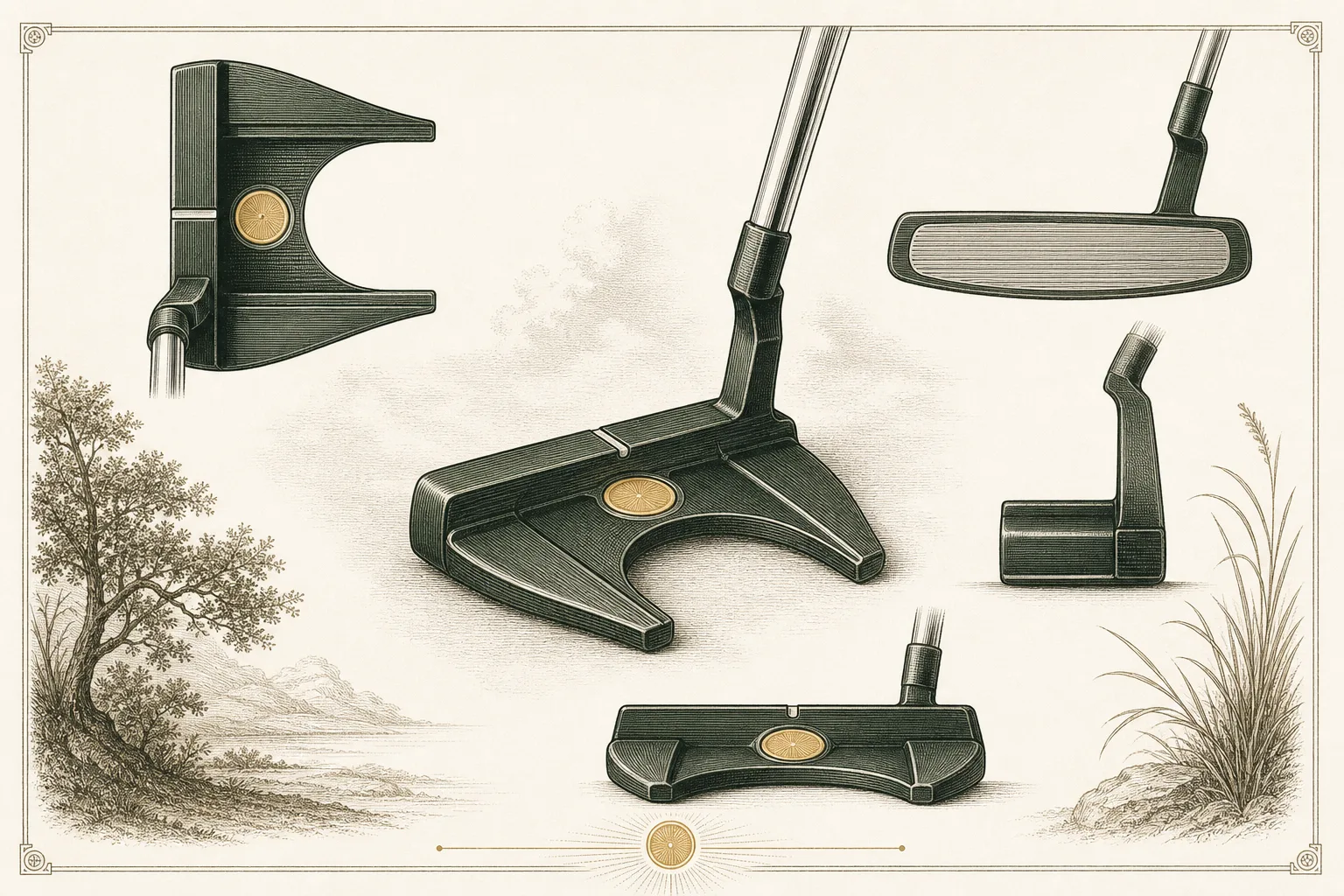
“A modern high-MOI mallet with a bold alignment bar and black-ion finish, offered in a heavier version too. Axis1's torque-free balance places CG on the face center in line with the shaft, self-squaring the face for any stroke.”
Axis1 was founded in 2006 by designer Luis Pedraza, who argued most putters are 'out of balance' - true CG sits off the shaft axis, so the face wants to twist through the stroke. His patented 'torque-free' balancing places the CG on the face center in line with the shaft, and won Best in Show/Most Innovative Product at the 2009 PGA Merchandise Show. The Umbra (2016) puts that balancing into a black-ion-plated head that reads as a blade at address but carries L-frame alignment bars for mallet-style visual feedback. Each head gets stainless counterweight screws in the sole for individual zero-torque calibration rather than a mass-produced spec, which is why the Umbra runs heavier (350g) than a standard blade.
Independent reviewers at Master of the Greens, Independent Golf Reviews and Three Guys Golf Blog each separately concluded the torque-free claim is real rather than marketing, describing 'instant success' and putts that track where the face is aimed regardless of stroke type. The underlying patent's tour credibility grew after the fact: Justin Rose signed with Axis1 in 2020 and worked directly with the company on a new prototype putter revealed on PGA Tour in January 2025. None of that has translated into mainstream sales volume - Axis1 remains a small player against Scotty Cameron/Odyssey/Ping, and the Umbra itself is out of first-party stock as of this writing, which is the honest shape of a sleeper: real, verified performance that most golfers have simply never tried.
Best for golfers who fight push/pull misses from face rotation, on any stroke shape (straight-back-straight or arc) since the balancing doesn't care which you use. Less obviously beneficial for a golfer who already putts well with a traditional toe-hang blade and relies on subtle face feedback through the stroke as part of their feel - and it costs more ($149 new) than typical mid-market mallets for a company most fitters won't have on the wall to demo.
Released in 2016, three years before its highest-profile tour validation (Rose, 2020), into a putter market dominated by Scotty Cameron Newport-style blades and heel-toe mallets like the Odyssey O-Works. The Umbra's blade-shaped-mallet-with-alignment-bars look anticipated the 'blallet' hybrid shapes (Odyssey Ten, Cameron Phantom X) that became mainstream several years later, though Axis1 got there via a balancing patent rather than a pure MOI/forgiveness argument.
The torque-free balancing is specifically engineered to resist face rotation on strokes that aren't a pure pendulum arc, which is the main mechanism of missed putts for most amateurs - it does the forgiveness job of a high-MOI mallet without needing a giant head. It is not a full MOI-monster shape like an Odyssey Ten or a wraparound mallet, so it does not get a 9-10; within putters it sits toward the forgiving end because the face-rotation problem it targets is the single biggest source of amateur miss-direction.
Calibrated across the whole catalog — a tour blade scores low here on purpose; it means control, not ease.
Retailed at $149. Used listings on eBay run roughly $100-$145 depending on condition, length and whether the headcover is included; it is not a collectible so prices track close to original retail rather than crashing (mass-market blades of similar age often sell for less) or appreciating - it is simply a lower-volume niche product that never flooded the used market.
Reading is one thing — hitting is another. Book a bay and see the numbers for yourself before you buy anywhere.
“A modern high-MOI mallet with a bold alignment bar and black-ion finish, offered in a heavier version too. Axis1's torque-free balance places CG on the face center in line with the shaft, self-squaring the face for any stroke.”
Axis1 was founded in 2006 by designer Luis Pedraza, who argued most putters are 'out of balance' - true CG sits off the shaft axis, so the face wants to twist through the stroke. His patented 'torque-free' balancing places the CG on the face center in line with the shaft, and won Best in Show/Most Innovative Product at the 2009 PGA Merchandise Show. The Umbra (2016) puts that balancing into a black-ion-plated head that reads as a blade at address but carries L-frame alignment bars for mallet-style visual feedback. Each head gets stainless counterweight screws in the sole for individual zero-torque calibration rather than a mass-produced spec, which is why the Umbra runs heavier (350g) than a standard blade.
Independent reviewers at Master of the Greens, Independent Golf Reviews and Three Guys Golf Blog each separately concluded the torque-free claim is real rather than marketing, describing 'instant success' and putts that track where the face is aimed regardless of stroke type. The underlying patent's tour credibility grew after the fact: Justin Rose signed with Axis1 in 2020 and worked directly with the company on a new prototype putter revealed on PGA Tour in January 2025. None of that has translated into mainstream sales volume - Axis1 remains a small player against Scotty Cameron/Odyssey/Ping, and the Umbra itself is out of first-party stock as of this writing, which is the honest shape of a sleeper: real, verified performance that most golfers have simply never tried.
Best for golfers who fight push/pull misses from face rotation, on any stroke shape (straight-back-straight or arc) since the balancing doesn't care which you use. Less obviously beneficial for a golfer who already putts well with a traditional toe-hang blade and relies on subtle face feedback through the stroke as part of their feel - and it costs more ($149 new) than typical mid-market mallets for a company most fitters won't have on the wall to demo.
Released in 2016, three years before its highest-profile tour validation (Rose, 2020), into a putter market dominated by Scotty Cameron Newport-style blades and heel-toe mallets like the Odyssey O-Works. The Umbra's blade-shaped-mallet-with-alignment-bars look anticipated the 'blallet' hybrid shapes (Odyssey Ten, Cameron Phantom X) that became mainstream several years later, though Axis1 got there via a balancing patent rather than a pure MOI/forgiveness argument.
The torque-free balancing is specifically engineered to resist face rotation on strokes that aren't a pure pendulum arc, which is the main mechanism of missed putts for most amateurs - it does the forgiveness job of a high-MOI mallet without needing a giant head. It is not a full MOI-monster shape like an Odyssey Ten or a wraparound mallet, so it does not get a 9-10; within putters it sits toward the forgiving end because the face-rotation problem it targets is the single biggest source of amateur miss-direction.
Calibrated across the whole catalog — a tour blade scores low here on purpose; it means control, not ease.
Retailed at $149. Used listings on eBay run roughly $100-$145 depending on condition, length and whether the headcover is included; it is not a collectible so prices track close to original retail rather than crashing (mass-market blades of similar age often sell for less) or appreciating - it is simply a lower-volume niche product that never flooded the used market.
Reading is one thing — hitting is another. Book a bay and see the numbers for yourself before you buy anywhere.