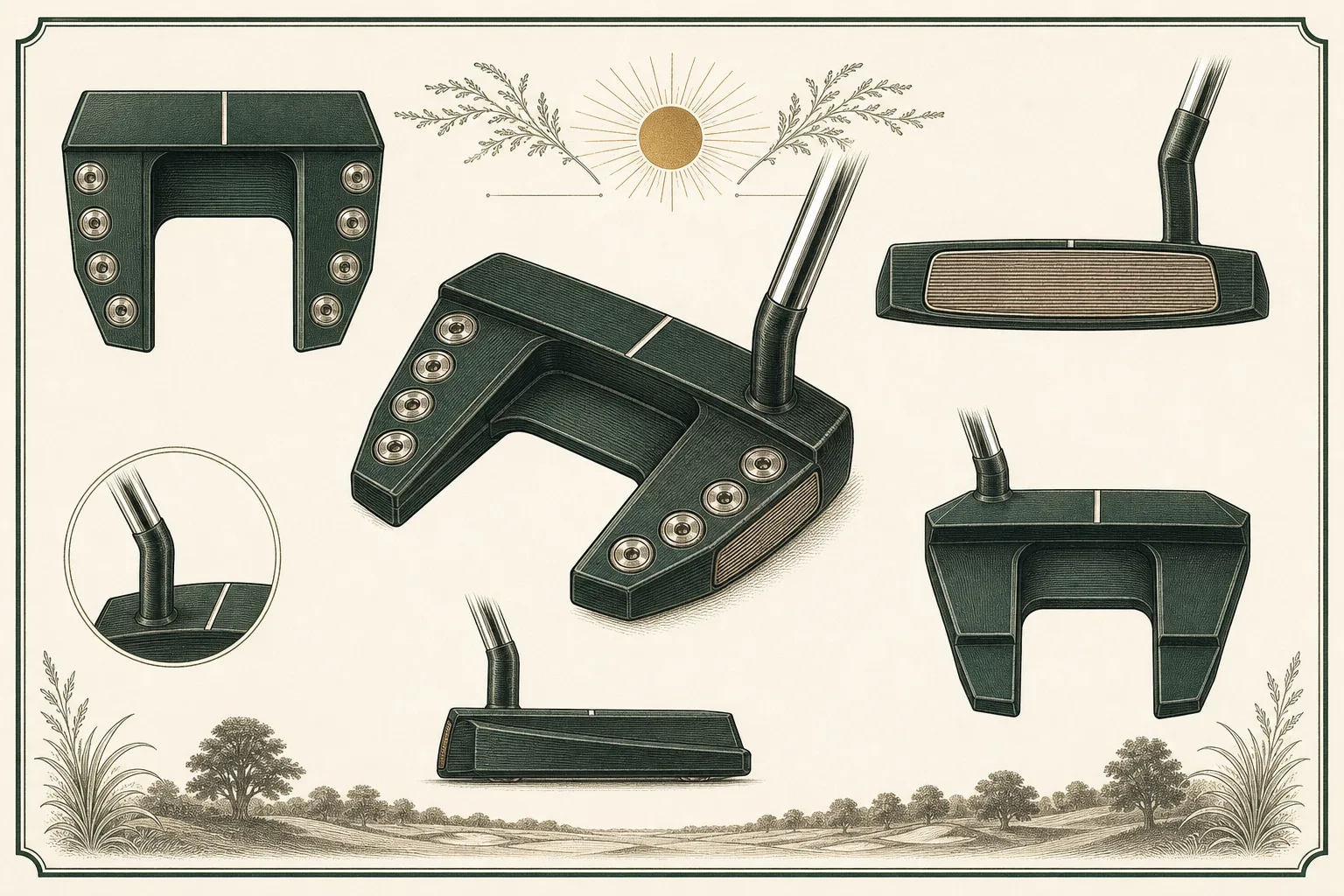
“The putter that put L.A.B. on the map, the first to bring Lie Angle Balance to market in its large branding-iron mallet shape. Torque is removed from the equation so the face stays square to the path with no manipulation; ideal for anyone who fights face control, and it works with any stroke.”
This is the putter that built L.A.B. Golf. Its DNA traces to Bill Presse, a former aerospace engineer and instructor who founded Directed Force in Reno, Nevada around 2015 and invented Lie Angle Balance, the idea that a putter can be mass-balanced so it has no tendency to twist (torque) open or closed through the stroke, staying square to the path with no hand manipulation. Presse's company was failing when scratch-golfer-turned-club-owner Sam Hahn, who had a revelatory experience with a big branding-iron-shaped Directed Force 'Reno 2.1,' partnered with him; by spring 2018 they rebranded as L.A.B. Golf (Lie Angle Balance). The Directed Force 2.1, a large 100%-CNC-milled 6061 aluminum mallet with a shaft-through-the-center, unobstructed top line and up to 36 alignment configurations, became the brand's flagship and the design that made the whole zero-torque category real.
Original retail was about $400 rising to ~$485 for later stock/custom builds. It holds value unusually well for a used putter because of the L.A.B. boom: clean used DF 2.1s commonly trade around $250-400 privately, and demand stayed strong even as the DF3 (2024) replaced it and began pushing more used 2.1s onto the market. There is no reconditioned-retail inflation game here, but be aware custom shaft/length/finish specs and the correct Press Grip materially affect value, and an odd custom lie can make a used one hard to re-fit.
L.A.B. went from a near-bankrupt Reno startup to a company valued in the hundreds of millions, a story documented by Sports Illustrated, Golf.com and local Oregon press, and the Directed Force 2.1 was the vehicle. It created and defined the zero-torque putter movement that the entire industry chased by 2024-25, and it earned genuine tour credibility, most visibly with 32-time tour winner Adam Scott, who has gamed L.A.B. putters since 2019. Multiple independent outlets treat it as a landmark design, which clears the cult classic bar comfortably. (Not 'icon': it is a modern, still-unfolding legacy, not a decades-settled Ping Eye 2-level pillar.)
Aimed squarely at golfers who fight face control and inconsistent face rotation, and it works with any stroke shape including straight-back-straight-through. The payoff (make percentages that L.A.B. cites rising into the high-90s on short putts) comes only after committing to the technique change and living with a big, polarizing head shape and a premium price. Not for a player who loves a small traditional blade, dislikes bold alignment-heavy mallets, or is unwilling to relearn grip pressure and tempo.
It launched (as the rebranded Directed Force 2.1 / 'DF 2.1') in the 2018-2019 window and spent years as a niche cult object before the broader zero-torque boom it started arrived around 2023-2025, when nearly every major brand shipped a torque-balanced answer. Within L.A.B.'s own line it sat as the flagship mallet above the Mezz.1 and the blade-shaped Link.1, and was ultimately succeeded by the DF3 (2024). Its true modern 'equivalent' is the wave of imitators it spawned rather than any predecessor.
Scored on a putter-relative scale, and this earns a high mark honestly. It is a large, deep, ~375g CNC-milled mallet built for maximum MOI, so it resists twisting on off-center strikes about as well as a putter can, and the Lie Angle Balance mass-balancing means the face does not want to rotate open or closed through impact regardless of stroke path. That is real forgiveness for the specific miss that ruins most putts: face angle at impact. It is not a 9-10 because it still demands a genuine adjustment, the recommended low-grip-pressure/'thumbs-off' technique and its heavy, unfamiliar feel carry a real learning curve, and short putts can suffer until the stroke change sticks.
Calibrated across the whole catalog — a tour blade scores low here on purpose; it means control, not ease.
Reading is one thing — hitting is another. Book a bay and see the numbers for yourself before you buy anywhere.