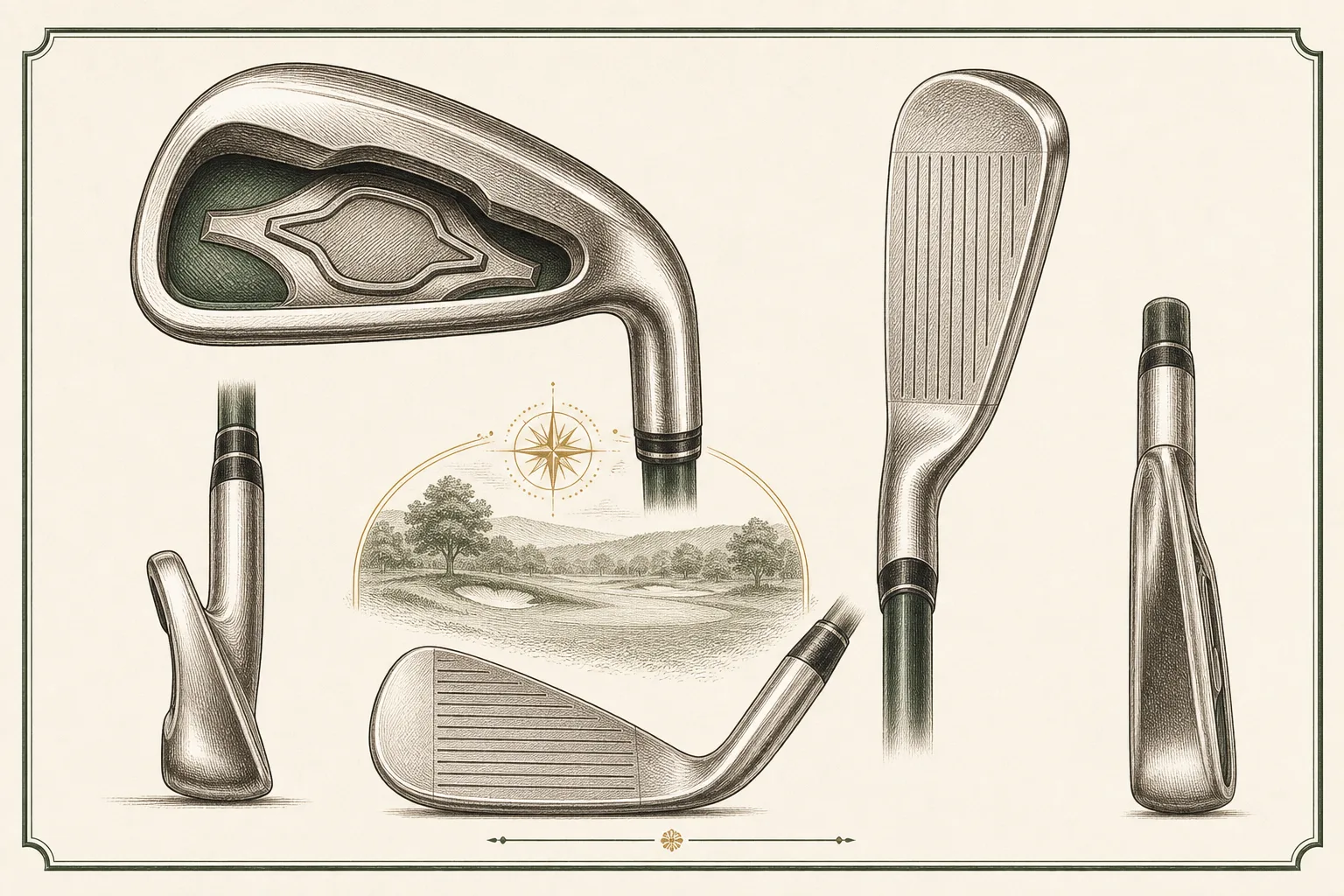
“Pro Series shrinks the head, thins the topline and trims offset for better ball-strikers who still want cavity forgiveness. A nice step down from the standard X-16 for lower handicaps.”
The X-16 Pro Series succeeded the X-14 Pro Series as Callaway's better-player cavity-back in 2002, shrinking the head further with less offset, a slightly shorter blade and a thicker topline than the X-14 generation while keeping VFT and a notch-weighting system that moved more mass to the perimeter than the X-14's version had. The base X-16's weak-by-design lofts (a 42-degree 9-iron per contemporary testing) kept launch easy despite the more compact profile, and reviewers noted the set still performed credibly - straight ball flight even on toe and heel misses - two decades after release. It filled the same market slot as the X-14 Pro Series before it: a step down in bulk and offset from the mainstream X-16 for golfers who had outgrown maximum forgiveness but still wanted a cast, cavity-backed forgiveness cushion.
Solidly regarded rather than cult-followed: golfreview.com shows a 4/5 average across 77 user reviews for the Pro Series, and enthusiast write-ups note it still performs well 'twenty years later,' but there's no scarcity narrative, no tour legend, and no dedicated forum mythology comparable to a true cult classic. It's a well-liked, unremarkable iron in retrospect - a good used buy, not a hunted one.
Better ball-strikers and low-to-mid handicaps who wanted the X-16 family's easy launch and forgiveness in a less bulky, more workable head than the standard X-16. A high handicapper should default to the standard X-16 for its extra offset and stability; a genuine low-handicap player chasing maximum shot control today has faster, cleaner modern players-distance options.
Released in 2002 as the direct successor to the X-14 Pro Series, competing with Titleist's 735/755CM, Ping's i3/G2, and TaylorMade's RAC OS in the players-distance category. It was succeeded within Callaway's line by later X-series and Big Bertha iron generations through the mid-2000s, part of the company's routine roughly two-year iron refresh cycle.
Less forgiving than the standard X-16 by design - reduced offset and a shorter blade trade some stability for a cleaner look and more workability - but the shared notch-weighting cavity and VFT tuning still deliver real perimeter forgiveness compared to a true players' cavity or blade of the same era. It sits squarely in the players-distance middle ground.
Calibrated across the whole catalog — a tour blade scores low here on purpose; it means control, not ease.
Complete sets are affordable and plentiful on the used market in 2026, typically $100-$200 depending on shaft and condition on eBay and Golfbidder, with well-worn sets going for less. It is a solid budget players-distance option rather than an appreciating or scarce set.
Reading is one thing — hitting is another. Book a bay and see the numbers for yourself before you buy anywhere.
“Pro Series shrinks the head, thins the topline and trims offset for better ball-strikers who still want cavity forgiveness. A nice step down from the standard X-16 for lower handicaps.”
The X-16 Pro Series succeeded the X-14 Pro Series as Callaway's better-player cavity-back in 2002, shrinking the head further with less offset, a slightly shorter blade and a thicker topline than the X-14 generation while keeping VFT and a notch-weighting system that moved more mass to the perimeter than the X-14's version had. The base X-16's weak-by-design lofts (a 42-degree 9-iron per contemporary testing) kept launch easy despite the more compact profile, and reviewers noted the set still performed credibly - straight ball flight even on toe and heel misses - two decades after release. It filled the same market slot as the X-14 Pro Series before it: a step down in bulk and offset from the mainstream X-16 for golfers who had outgrown maximum forgiveness but still wanted a cast, cavity-backed forgiveness cushion.
Solidly regarded rather than cult-followed: golfreview.com shows a 4/5 average across 77 user reviews for the Pro Series, and enthusiast write-ups note it still performs well 'twenty years later,' but there's no scarcity narrative, no tour legend, and no dedicated forum mythology comparable to a true cult classic. It's a well-liked, unremarkable iron in retrospect - a good used buy, not a hunted one.
Better ball-strikers and low-to-mid handicaps who wanted the X-16 family's easy launch and forgiveness in a less bulky, more workable head than the standard X-16. A high handicapper should default to the standard X-16 for its extra offset and stability; a genuine low-handicap player chasing maximum shot control today has faster, cleaner modern players-distance options.
Released in 2002 as the direct successor to the X-14 Pro Series, competing with Titleist's 735/755CM, Ping's i3/G2, and TaylorMade's RAC OS in the players-distance category. It was succeeded within Callaway's line by later X-series and Big Bertha iron generations through the mid-2000s, part of the company's routine roughly two-year iron refresh cycle.
Less forgiving than the standard X-16 by design - reduced offset and a shorter blade trade some stability for a cleaner look and more workability - but the shared notch-weighting cavity and VFT tuning still deliver real perimeter forgiveness compared to a true players' cavity or blade of the same era. It sits squarely in the players-distance middle ground.
Calibrated across the whole catalog — a tour blade scores low here on purpose; it means control, not ease.
Complete sets are affordable and plentiful on the used market in 2026, typically $100-$200 depending on shaft and condition on eBay and Golfbidder, with well-worn sets going for less. It is a solid budget players-distance option rather than an appreciating or scarce set.
Reading is one thing — hitting is another. Book a bay and see the numbers for yourself before you buy anywhere.