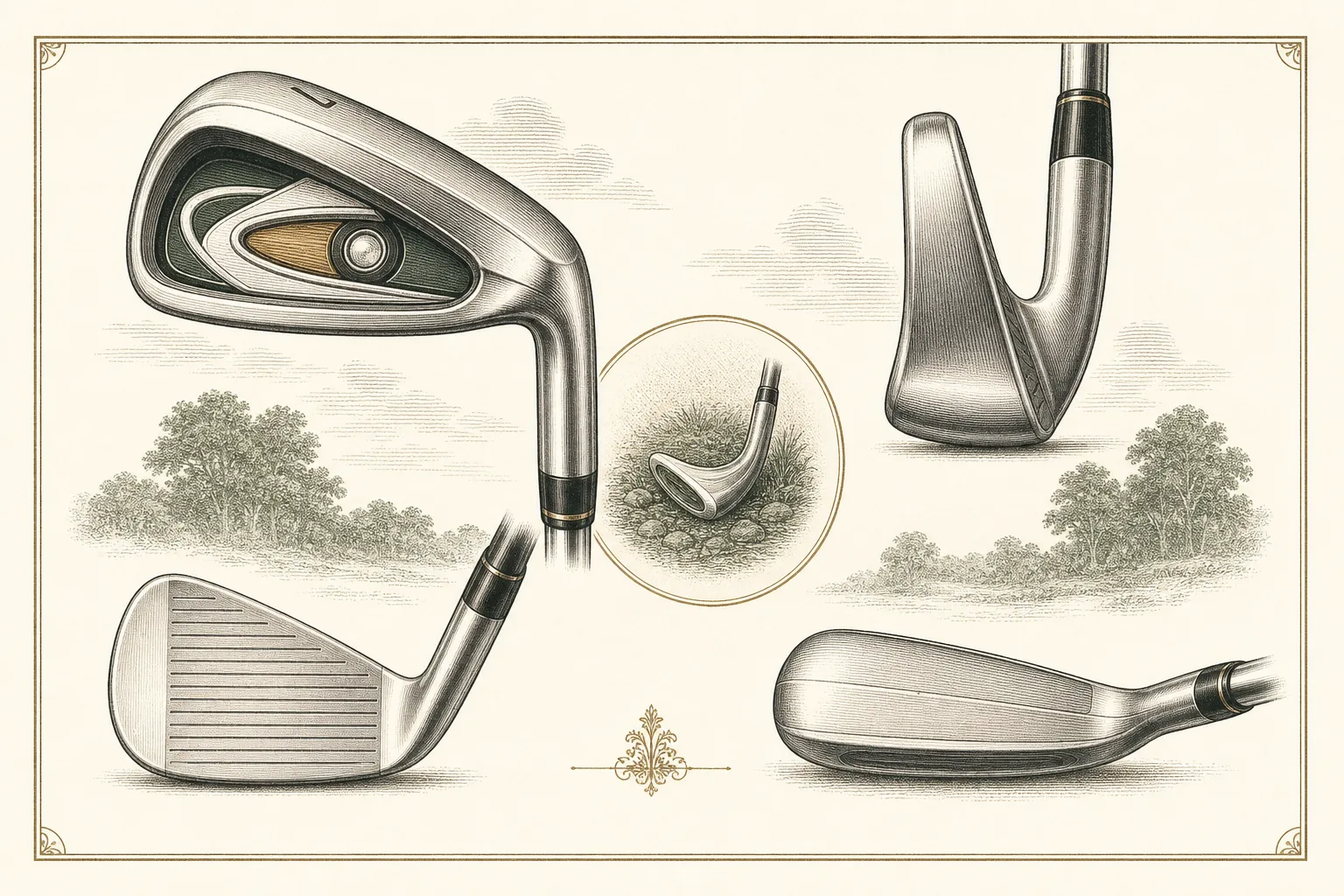
“The Pro variant of the a1 shrinks the head and thins the topline for better ball-strikers. A players-cavity rung that still leans on Adams' hybrid long clubs.”
The Idea a1 Pro (2004) was the better-player sibling to Adams' original Idea a1 — the set that put Adams' 'combo' philosophy into a shape serious golfers would actually put in the bag. It replaced the notoriously hard-to-hit 2-iron with a 2 i-Wood hybrid and gave the 3- and 4-irons a hollow-back construction with minimal offset so a skilled player could still work the ball, while the mid/short irons stayed more traditional. Individual clubs retailed around $99.99. It arrived at the front end of Adams' mid-2000s Idea era, before Adams became a public company in 2005, and helped establish combo-set thinking (hybrid long clubs, iron short clubs) as a legitimate concept for accomplished players, not just high-handicap buyers.
User ratings are unusually strong for a nearly 20-year-old set (4.8/5 across 21 reviews on golfreview.com, versus 4.5/5 for the standard a1), and it is cited as an early proof point for hybrid-iron combo sets among better players — but there is no forum-driven 'hunt it down' scarcity or tour legend attached to it, so it falls short of cult-classic status.
Better players of the mid-2000s who wanted workability but were tired of fighting long irons; today it suits a nostalgic buyer or a low-handicapper assembling a period-correct bag rather than anyone shopping for genuine forgiveness or modern distance, both of which current GI irons deliver far more of.
Sat alongside the standard Idea a1 (game-improvement version) in Adams' 2004 lineup and predated the more fully developed Idea Pro Forged combo set of 2006; the concept of swapping long irons for hybrids within a single branded set became standard practice across the industry by the following decade. A modern equivalent is any players'-combo set pairing a low iron count with matching hybrids.
More forgiving than a pure players'-cavity because the hardest club to hit (the 2-iron) is removed entirely and the 3/4-iron hollow-back construction lowers CG versus a solid forging; still, the minimal offset and better-player shaping mean off-center strikes in the mid/short irons cost distance and accuracy more than in a true game-improvement set.
Calibrated across the whole catalog — a tour blade scores low here on purpose; it means control, not ease.
Individual clubs and partial sets circulate cheaply today, generally $10-$30 per club or roughly $100-$200 for a fuller used set on eBay, reflecting both its age (over 20 years) and its status as a mainstream mid-2000s offering rather than a sought-after collectible.
Reading is one thing — hitting is another. Book a bay and see the numbers for yourself before you buy anywhere.
“The Pro variant of the a1 shrinks the head and thins the topline for better ball-strikers. A players-cavity rung that still leans on Adams' hybrid long clubs.”
The Idea a1 Pro (2004) was the better-player sibling to Adams' original Idea a1 — the set that put Adams' 'combo' philosophy into a shape serious golfers would actually put in the bag. It replaced the notoriously hard-to-hit 2-iron with a 2 i-Wood hybrid and gave the 3- and 4-irons a hollow-back construction with minimal offset so a skilled player could still work the ball, while the mid/short irons stayed more traditional. Individual clubs retailed around $99.99. It arrived at the front end of Adams' mid-2000s Idea era, before Adams became a public company in 2005, and helped establish combo-set thinking (hybrid long clubs, iron short clubs) as a legitimate concept for accomplished players, not just high-handicap buyers.
User ratings are unusually strong for a nearly 20-year-old set (4.8/5 across 21 reviews on golfreview.com, versus 4.5/5 for the standard a1), and it is cited as an early proof point for hybrid-iron combo sets among better players — but there is no forum-driven 'hunt it down' scarcity or tour legend attached to it, so it falls short of cult-classic status.
Better players of the mid-2000s who wanted workability but were tired of fighting long irons; today it suits a nostalgic buyer or a low-handicapper assembling a period-correct bag rather than anyone shopping for genuine forgiveness or modern distance, both of which current GI irons deliver far more of.
Sat alongside the standard Idea a1 (game-improvement version) in Adams' 2004 lineup and predated the more fully developed Idea Pro Forged combo set of 2006; the concept of swapping long irons for hybrids within a single branded set became standard practice across the industry by the following decade. A modern equivalent is any players'-combo set pairing a low iron count with matching hybrids.
More forgiving than a pure players'-cavity because the hardest club to hit (the 2-iron) is removed entirely and the 3/4-iron hollow-back construction lowers CG versus a solid forging; still, the minimal offset and better-player shaping mean off-center strikes in the mid/short irons cost distance and accuracy more than in a true game-improvement set.
Calibrated across the whole catalog — a tour blade scores low here on purpose; it means control, not ease.
Individual clubs and partial sets circulate cheaply today, generally $10-$30 per club or roughly $100-$200 for a fuller used set on eBay, reflecting both its age (over 20 years) and its status as a mainstream mid-2000s offering rather than a sought-after collectible.
Reading is one thing — hitting is another. Book a bay and see the numbers for yourself before you buy anywhere.