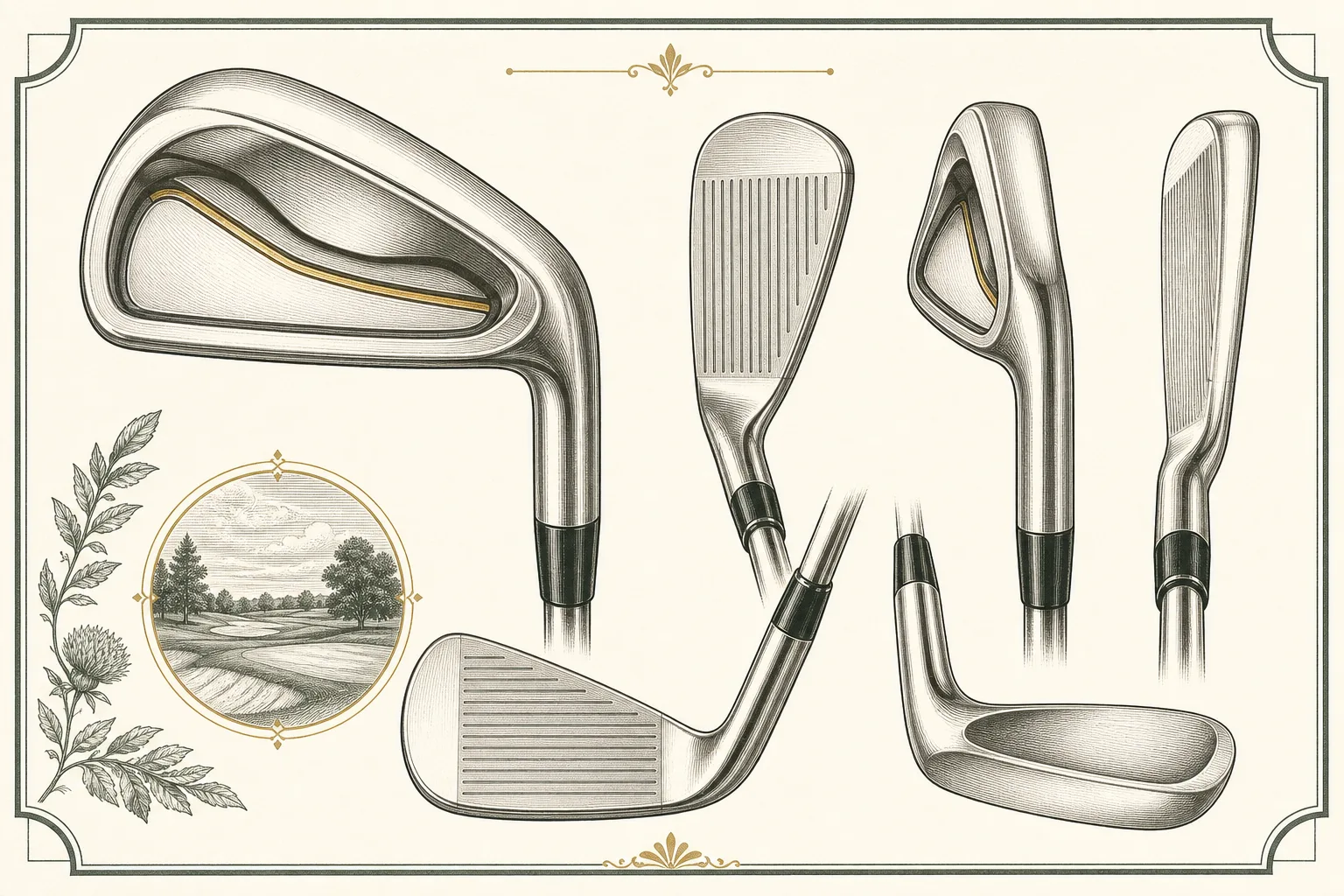
“Late-2000s forged cavity in the MP mid-tier. A dependable rung-2 iron, unremarkable but well-built.”
The MP-62 grew directly out of Mizuno's tour workshop rather than a research lab: its sole is a direct copy of Luke Donald's personal grind, with a rolling leading edge and rolled trailing edge and an aggressive heel-to-toe camber built to let both diggers and pickers find clean turf interaction. Forged from 1025E pure select mild carbon steel with forged U-grooves, it added 'Dual Muscle' technology - a bar behind the center of the face, developed from vibration and frequency analysis research - to quiet miss-hit feel without changing the compact, minimal-offset shape better players wanted. Donald and other Mizuno staff played it almost immediately, and at a $900 street price it was Mizuno's tour-facing cavity for a player who wants to work the ball, not be protected from a bad one.
Genuine tour pedigree - built from a real Tour player's personal grind and adopted by Mizuno staffers on release - and a strong 4.6/5 across 20 user reviews on golfreview.com. That is a real, sourced quality signal, but the MP-62 never generated the sustained GolfWRX 'why are they so good' hunt threads or forum reverence that mark a true cult classic; it reads as a well-respected, dependable Tour-adjacent iron rather than one collectors actively chase two decades on.
Better ball-strikers (roughly 0-8 handicap) who want to shape shots both ways and don't need help finding the fairway or the green. A mid-to-high handicapper wanting forgiveness or extra carry distance gains nothing here that a modern game-improvement iron wouldn't do far better.
Launched in the same window as Titleist's 690.CB/MB and TaylorMade's Tour Preferred forged irons, and inherited the deeper-CG 'Cut Muscle' sole geometry Mizuno had proven on the MP-32/MP-60 generation, adapted here into a Tour-driven grind rather than a factory shape. It sat as Mizuno's better-player forged cavity between the MP-52 (more forgiving) and the MP-67/blade-style options of the period.
A standard players' cavity forgiveness level for its class - the Dual Muscle bar exists to remove unwanted vibration and improve feel on a miss-hit, not to expand the effective sweet spot the way a game-improvement iron does. Minimal offset and a centrally located CG mean thin or toe strikes still cost real distance and accuracy; it demands a repeatable strike just as much as any Tour-grind players iron.
Calibrated across the whole catalog — a tour blade scores low here on purpose; it means control, not ease.
Complete sets commonly sell for roughly $150-300 private-party in 2026 depending on shaft and condition; premium Tour shafts (Project X) push toward the top of that range. It does not command collector premiums - value tracks ordinary used-forged-iron depreciation for a well-built but non-iconic set.
Reading is one thing — hitting is another. Book a bay and see the numbers for yourself before you buy anywhere.