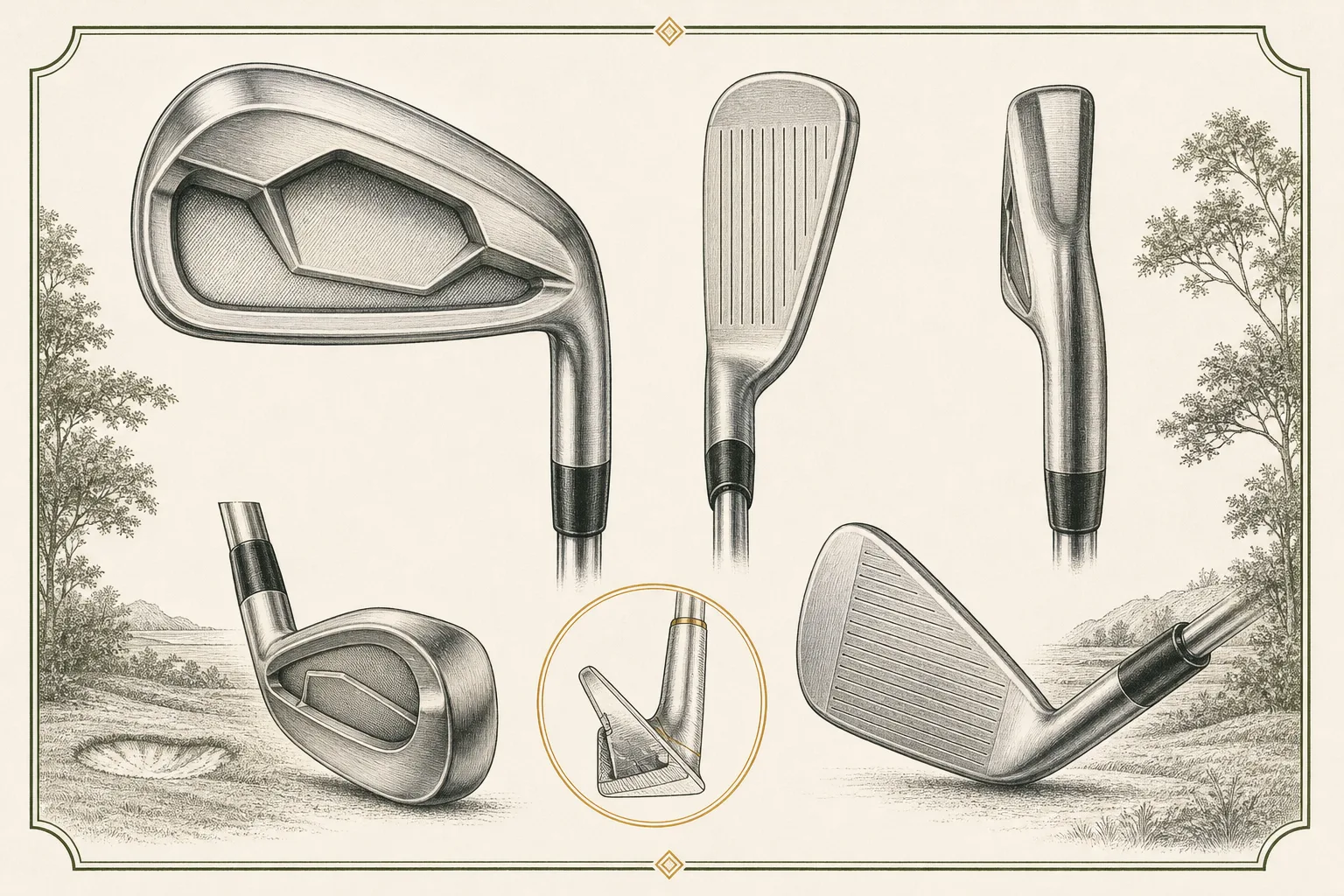
“Avoda Origin (same length) - 1020 forged muscle-cavity, ultra-minimal 0.5mm offset, all built to one length. A 2026 Hot List single-length pick. Rung-2 identity club.”
The pure single-length expression of Avoda's Origin line, the format that put the brand on the map when Bryson DeChambeau, golf's most famous one-length devotee, used Avoda's 3D-printed same-length prototypes at the 2024 Masters and won that year's U.S. Open with the concept. The retail Same Length set builds every iron to one length (37.5 inches in the tested configuration) so setup, posture, and swing plane stay identical from wedge to long iron, with premium carbon-steel forgings and a small muscle cavity tuned for feel and consistent weighting across a set where head weights must be matched with unusual precision. Reviewers describe an 'exceptionally,' even 'fabulously' soft impact and excellent turf interaction from the narrow soles. It's a feel-first players' iron for golfers drawn to the repeatability of one length.
Notable, not cult: its profile is entirely the product of a very recent, very high-profile tour endorsement (DeChambeau) plus strong early press (Golf Monthly, Today's Golfer, Golf Digest Hot List). Single-length itself has a small, passionate following, but Avoda specifically is a two-year-old boutique with no legacy yet. The single-length niche and the marquee win make it more than a commodity, but any 'classic' framing would be premature and unsupported.
For better players (roughly 0-8) who want forged feel and are genuinely committed to the single-length concept and its identical-setup consistency. At 37.5 inches every iron, the long irons feel shorter/easier and the short irons feel longer, an acquired adjustment reviewers flag. Not for high-handicappers seeking forgiveness, nor for anyone unsure about one-length, who should try the Combo Length or a conventional set first.
Arrived 2023-2024 and rode DeChambeau's 2024 Masters/U.S. Open exposure into visibility, within a modest single-length revival whose highest-profile prior chapter was Bryson's Cobra ONE Length irons. As a premium forged one-length set it has almost no direct retail competition, its rivals are conventional variable-length players' irons from Titleist, Mizuno, and Srixon rather than other single-length sets. The 3D-printed tour version hints at a manufacturing frontier.
Below-average by absolute standards, appropriate for a precision-oriented single-length players' iron. Golf Monthly explicitly notes it is 'designed for precision rather than maximum forgiveness,' with minimal 0.5mm offset, a small muscle cavity, and narrow soles that appeal to skilled golfers, not high-handicappers. Single length does aid consistency by standardizing the swing, which is why it earns a 5 rather than a blade-like 3-4, but the compact players' head offers little perimeter help and punishes mis-hits.
Calibrated across the whole catalog — a tour blade scores low here on purpose; it means control, not ease.
No meaningful secondhand market: new, low-volume, premium, and single-length (a hard resell because fit is idiosyncratic), so clean used sets are scarce and hold value well. If one surfaces, expect roughly $900-1,500 against $1,379+ retail. Buy-new is the realistic path; there's no reconditioned-retail inflation to warn about, just genuine scarcity.
Reading is one thing — hitting is another. Book a bay and see the numbers for yourself before you buy anywhere.
“Avoda Origin (same length) - 1020 forged muscle-cavity, ultra-minimal 0.5mm offset, all built to one length. A 2026 Hot List single-length pick. Rung-2 identity club.”
The pure single-length expression of Avoda's Origin line, the format that put the brand on the map when Bryson DeChambeau, golf's most famous one-length devotee, used Avoda's 3D-printed same-length prototypes at the 2024 Masters and won that year's U.S. Open with the concept. The retail Same Length set builds every iron to one length (37.5 inches in the tested configuration) so setup, posture, and swing plane stay identical from wedge to long iron, with premium carbon-steel forgings and a small muscle cavity tuned for feel and consistent weighting across a set where head weights must be matched with unusual precision. Reviewers describe an 'exceptionally,' even 'fabulously' soft impact and excellent turf interaction from the narrow soles. It's a feel-first players' iron for golfers drawn to the repeatability of one length.
Notable, not cult: its profile is entirely the product of a very recent, very high-profile tour endorsement (DeChambeau) plus strong early press (Golf Monthly, Today's Golfer, Golf Digest Hot List). Single-length itself has a small, passionate following, but Avoda specifically is a two-year-old boutique with no legacy yet. The single-length niche and the marquee win make it more than a commodity, but any 'classic' framing would be premature and unsupported.
For better players (roughly 0-8) who want forged feel and are genuinely committed to the single-length concept and its identical-setup consistency. At 37.5 inches every iron, the long irons feel shorter/easier and the short irons feel longer, an acquired adjustment reviewers flag. Not for high-handicappers seeking forgiveness, nor for anyone unsure about one-length, who should try the Combo Length or a conventional set first.
Arrived 2023-2024 and rode DeChambeau's 2024 Masters/U.S. Open exposure into visibility, within a modest single-length revival whose highest-profile prior chapter was Bryson's Cobra ONE Length irons. As a premium forged one-length set it has almost no direct retail competition, its rivals are conventional variable-length players' irons from Titleist, Mizuno, and Srixon rather than other single-length sets. The 3D-printed tour version hints at a manufacturing frontier.
Below-average by absolute standards, appropriate for a precision-oriented single-length players' iron. Golf Monthly explicitly notes it is 'designed for precision rather than maximum forgiveness,' with minimal 0.5mm offset, a small muscle cavity, and narrow soles that appeal to skilled golfers, not high-handicappers. Single length does aid consistency by standardizing the swing, which is why it earns a 5 rather than a blade-like 3-4, but the compact players' head offers little perimeter help and punishes mis-hits.
Calibrated across the whole catalog — a tour blade scores low here on purpose; it means control, not ease.
No meaningful secondhand market: new, low-volume, premium, and single-length (a hard resell because fit is idiosyncratic), so clean used sets are scarce and hold value well. If one surfaces, expect roughly $900-1,500 against $1,379+ retail. Buy-new is the realistic path; there's no reconditioned-retail inflation to warn about, just genuine scarcity.
Reading is one thing — hitting is another. Book a bay and see the numbers for yourself before you buy anywhere.