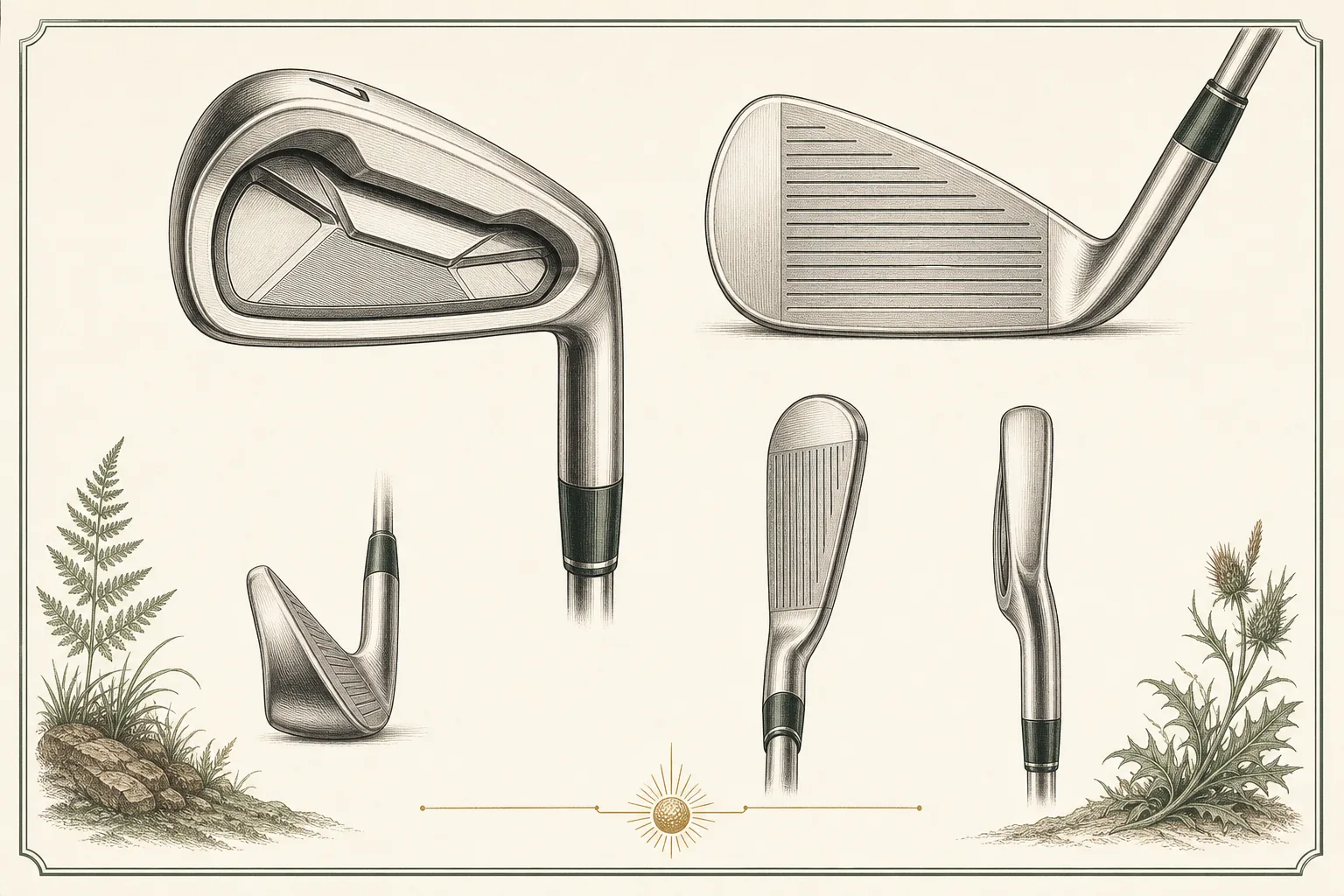
“A rung-2 classic forged cavity with a slightly wider sole and Bridgestone's Sure Contact sole for cleaner turf interaction. Understated looks and soft feel. Good used value for a skilled player who wants a no-nonsense CB.”
Bridgestone unveiled the J15 forged iron family at the 2015 PGA Merchandise Show as a three-way split by player ability -- the J15CB, J15DF, and J15DPF -- with the CB sitting as the most traditional, least forgiving of the trio: a classic cavity-back silhouette for players who wanted a compact forged head rather than the more perimeter-weighted DF and DPF. It carried Bridgestone's Sure Contact Sole, a heel-shape variation built into the forging itself rather than ground on afterward, meant to improve turf interaction, and was forged from premium carbon steel for the soft feel Bridgestone's Japan-built irons are known for. Tour players including Matt Kuchar and Brandt Snedeker were seen playing or testing prototype CB cavity-backs around the 2015 launch, with Snedeker spotted gaming a version alongside a J715 driver prototype at the 2014 WGC-Bridgestone Invitational.
Golfalot's review found the CB competent but said it 'did not stand out as much' next to its own DF sibling in feel and liveliness, and a GolfWRX thread titled 'The Bridgestone J15 CBs have to be one of the best, don't they?' shows real curiosity from forum members rather than a runaway consensus -- this reads as a tour-vetted, well-engineered iron rather than a forum-worshipped cult object.
Fits low- to mid-single-digit handicaps who want a compact, forged, tour-proven cavity back and are willing to trade the DF's or DPF's extra forgiveness for a more traditional look and firmer feedback at impact.
It launched into a 2015 forged players-iron market crowded with Mizuno's JPX-850 Forged and Titleist's AP2, competing on Bridgestone's Japanese forging pedigree and tour validation from Kuchar and Snedeker rather than a marketing budget anywhere near those larger brands.
Bridgestone explicitly built the CB as the most traditional, least forgiving model of the three-iron J15 forged lineup, positioned below the more perimeter-weighted DF and well below the game-improvement DPF, so its forgiveness should be read as 'good for a players' cavity back' rather than forgiving in an absolute sense.
Calibrated across the whole catalog — a tour blade scores low here on purpose; it means control, not ease.
2nd Swing lists a J15 Cavity Back set (5-PW, Project X Rifle steel, stiff, +1/4 inch) against an original price of $899.99, discounted to about $338 in average condition; that $899.99 retailer-listed original runs somewhat higher than catalog MSRPs of roughly $789 quoted elsewhere, a gap likely reflecting the premium steel shaft bundled into that particular retail set. Realistic private-party pricing on eBay and forum classifieds for played sets typically runs lower, in the $200-$300 range for a clean 4-PW or 5-PW set.
Reading is one thing — hitting is another. Book a bay and see the numbers for yourself before you buy anywhere.
“A rung-2 classic forged cavity with a slightly wider sole and Bridgestone's Sure Contact sole for cleaner turf interaction. Understated looks and soft feel. Good used value for a skilled player who wants a no-nonsense CB.”
Bridgestone unveiled the J15 forged iron family at the 2015 PGA Merchandise Show as a three-way split by player ability -- the J15CB, J15DF, and J15DPF -- with the CB sitting as the most traditional, least forgiving of the trio: a classic cavity-back silhouette for players who wanted a compact forged head rather than the more perimeter-weighted DF and DPF. It carried Bridgestone's Sure Contact Sole, a heel-shape variation built into the forging itself rather than ground on afterward, meant to improve turf interaction, and was forged from premium carbon steel for the soft feel Bridgestone's Japan-built irons are known for. Tour players including Matt Kuchar and Brandt Snedeker were seen playing or testing prototype CB cavity-backs around the 2015 launch, with Snedeker spotted gaming a version alongside a J715 driver prototype at the 2014 WGC-Bridgestone Invitational.
Golfalot's review found the CB competent but said it 'did not stand out as much' next to its own DF sibling in feel and liveliness, and a GolfWRX thread titled 'The Bridgestone J15 CBs have to be one of the best, don't they?' shows real curiosity from forum members rather than a runaway consensus -- this reads as a tour-vetted, well-engineered iron rather than a forum-worshipped cult object.
Fits low- to mid-single-digit handicaps who want a compact, forged, tour-proven cavity back and are willing to trade the DF's or DPF's extra forgiveness for a more traditional look and firmer feedback at impact.
It launched into a 2015 forged players-iron market crowded with Mizuno's JPX-850 Forged and Titleist's AP2, competing on Bridgestone's Japanese forging pedigree and tour validation from Kuchar and Snedeker rather than a marketing budget anywhere near those larger brands.
Bridgestone explicitly built the CB as the most traditional, least forgiving model of the three-iron J15 forged lineup, positioned below the more perimeter-weighted DF and well below the game-improvement DPF, so its forgiveness should be read as 'good for a players' cavity back' rather than forgiving in an absolute sense.
Calibrated across the whole catalog — a tour blade scores low here on purpose; it means control, not ease.
2nd Swing lists a J15 Cavity Back set (5-PW, Project X Rifle steel, stiff, +1/4 inch) against an original price of $899.99, discounted to about $338 in average condition; that $899.99 retailer-listed original runs somewhat higher than catalog MSRPs of roughly $789 quoted elsewhere, a gap likely reflecting the premium steel shaft bundled into that particular retail set. Realistic private-party pricing on eBay and forum classifieds for played sets typically runs lower, in the $200-$300 range for a clean 4-PW or 5-PW set.
Reading is one thing — hitting is another. Book a bay and see the numbers for yourself before you buy anywhere.