“Compact, workable Apex Pro with tungsten weighting. A rung-2 set for the accomplished ballstriker; solid used value.”
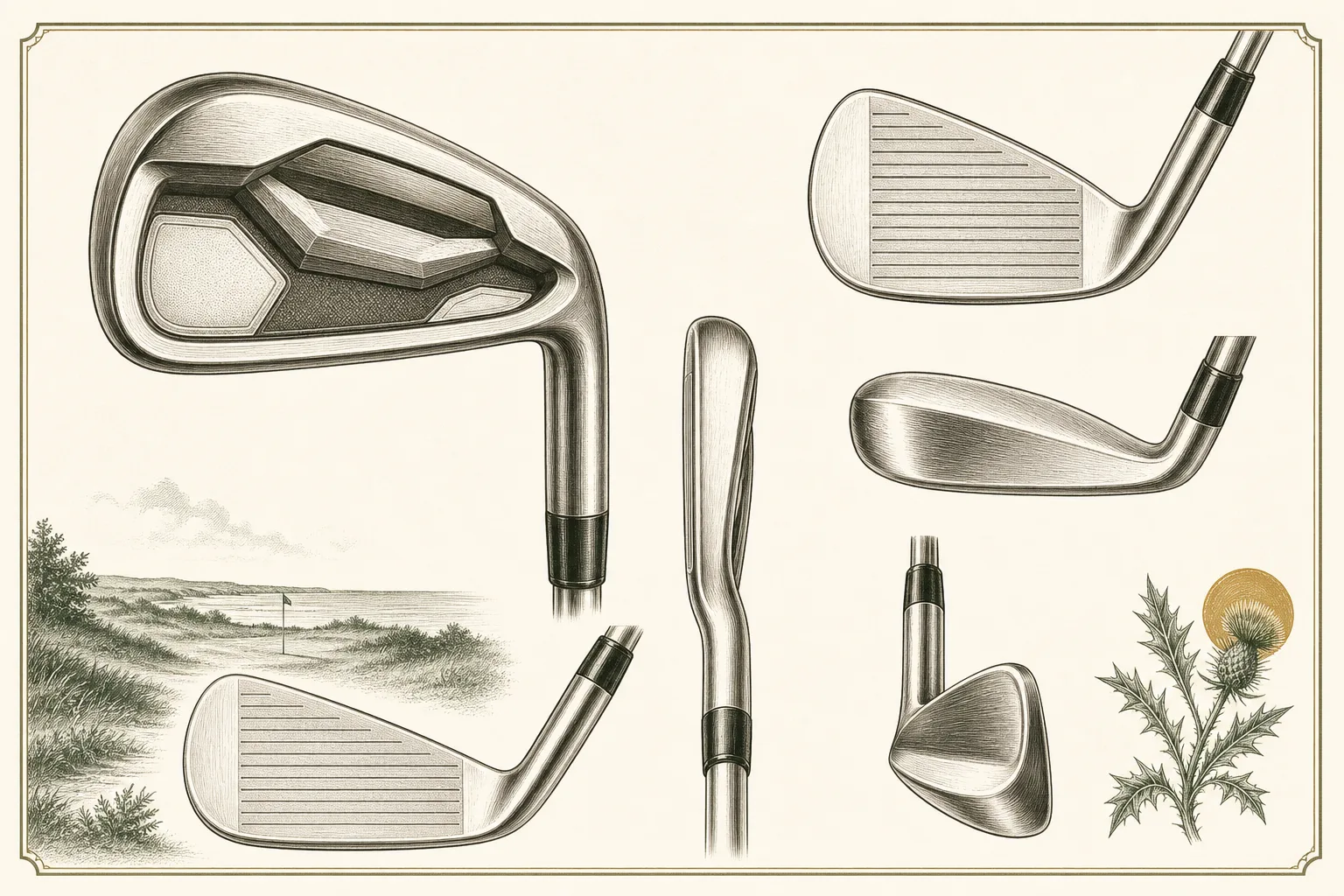
The Apex Pro 16 rebuilt Callaway's compact players' iron around a fully forged 1025 mild carbon steel head, 'Quadruple Net Forged' through four separate processes to refine its final shape before finishing in gloss chrome. Behind its forged back panel, Callaway varied the internal fill by iron: tungsten weights in the 3-5 irons to lower the CG and boost launch, steel in the 6-8 irons for a mid CG, and an empty pocket in the 9-iron and wedges to keep weight low in the sole and the CG higher for a more penetrating short-iron flight. That progressive weighting was the point -- reviewers noted it packed real forgiveness into a shape that looks 'Tour only.' It launched paired with the more distance-oriented Apex CF16, forming Callaway's 2016 two-tier Apex family.
Well-reviewed at launch and respected as one of the better compact players' cavity-backs of its generation, but with no lasting cult narrative -- it doesn't turn up in 'greatest irons ever' discussions or command scarcity pricing. It was a strong, workmanlike tour-adjacent iron that Callaway superseded on schedule with the Apex Pro 19.
Elite amateurs and better ball-strikers who want tour-level looks with enough internal engineering to be playable rather than punishing. Reviews are explicit that this is 'really for elite amateurs and tour players' -- a mid-or-higher handicapper chasing forgiveness should look at the Apex CF16 or a true game-improvement iron instead.
Released alongside the Apex CF16 as Callaway's 2016 two-way forged split, going up against Titleist's AP2, Mizuno's JPX-900 Tour, and TaylorMade's PSi Tour in the compact players'-cavity category. It was replaced by the Apex Pro 19, which added Callaway's 360 Face Cup technology to the same compact-cavity concept.
A genuine players' cavity: the progressive tungsten/steel weighting gives it more forgiveness than a true muscleback blade, particularly in the long irons where the tungsten pulls the CG low and back. But the compact head, thin sole and smaller cavity than a game-improvement iron mean it still demands a fairly centered strike -- squarely mid-pack on the forgiveness scale for its class, well below the Apex CF16 sold alongside it.
Calibrated across the whole catalog — a tour blade scores low here on purpose; it means control, not ease.
Retailed at $1,299 in 2016. As a ten-year-old players' iron, realistic 2026 private-party value for a clean steel 3-PW set runs roughly $180-$300; reconditioned-retail sellers typically list comparable sets $100-$200 higher.
Reading is one thing — hitting is another. Book a bay and see the numbers for yourself before you buy anywhere.
“Compact, workable Apex Pro with tungsten weighting. A rung-2 set for the accomplished ballstriker; solid used value.”
The Apex Pro 16 rebuilt Callaway's compact players' iron around a fully forged 1025 mild carbon steel head, 'Quadruple Net Forged' through four separate processes to refine its final shape before finishing in gloss chrome. Behind its forged back panel, Callaway varied the internal fill by iron: tungsten weights in the 3-5 irons to lower the CG and boost launch, steel in the 6-8 irons for a mid CG, and an empty pocket in the 9-iron and wedges to keep weight low in the sole and the CG higher for a more penetrating short-iron flight. That progressive weighting was the point -- reviewers noted it packed real forgiveness into a shape that looks 'Tour only.' It launched paired with the more distance-oriented Apex CF16, forming Callaway's 2016 two-tier Apex family.
Well-reviewed at launch and respected as one of the better compact players' cavity-backs of its generation, but with no lasting cult narrative -- it doesn't turn up in 'greatest irons ever' discussions or command scarcity pricing. It was a strong, workmanlike tour-adjacent iron that Callaway superseded on schedule with the Apex Pro 19.
Elite amateurs and better ball-strikers who want tour-level looks with enough internal engineering to be playable rather than punishing. Reviews are explicit that this is 'really for elite amateurs and tour players' -- a mid-or-higher handicapper chasing forgiveness should look at the Apex CF16 or a true game-improvement iron instead.
Released alongside the Apex CF16 as Callaway's 2016 two-way forged split, going up against Titleist's AP2, Mizuno's JPX-900 Tour, and TaylorMade's PSi Tour in the compact players'-cavity category. It was replaced by the Apex Pro 19, which added Callaway's 360 Face Cup technology to the same compact-cavity concept.
A genuine players' cavity: the progressive tungsten/steel weighting gives it more forgiveness than a true muscleback blade, particularly in the long irons where the tungsten pulls the CG low and back. But the compact head, thin sole and smaller cavity than a game-improvement iron mean it still demands a fairly centered strike -- squarely mid-pack on the forgiveness scale for its class, well below the Apex CF16 sold alongside it.
Calibrated across the whole catalog — a tour blade scores low here on purpose; it means control, not ease.
Retailed at $1,299 in 2016. As a ten-year-old players' iron, realistic 2026 private-party value for a clean steel 3-PW set runs roughly $180-$300; reconditioned-retail sellers typically list comparable sets $100-$200 higher.
Reading is one thing — hitting is another. Book a bay and see the numbers for yourself before you buy anywhere.