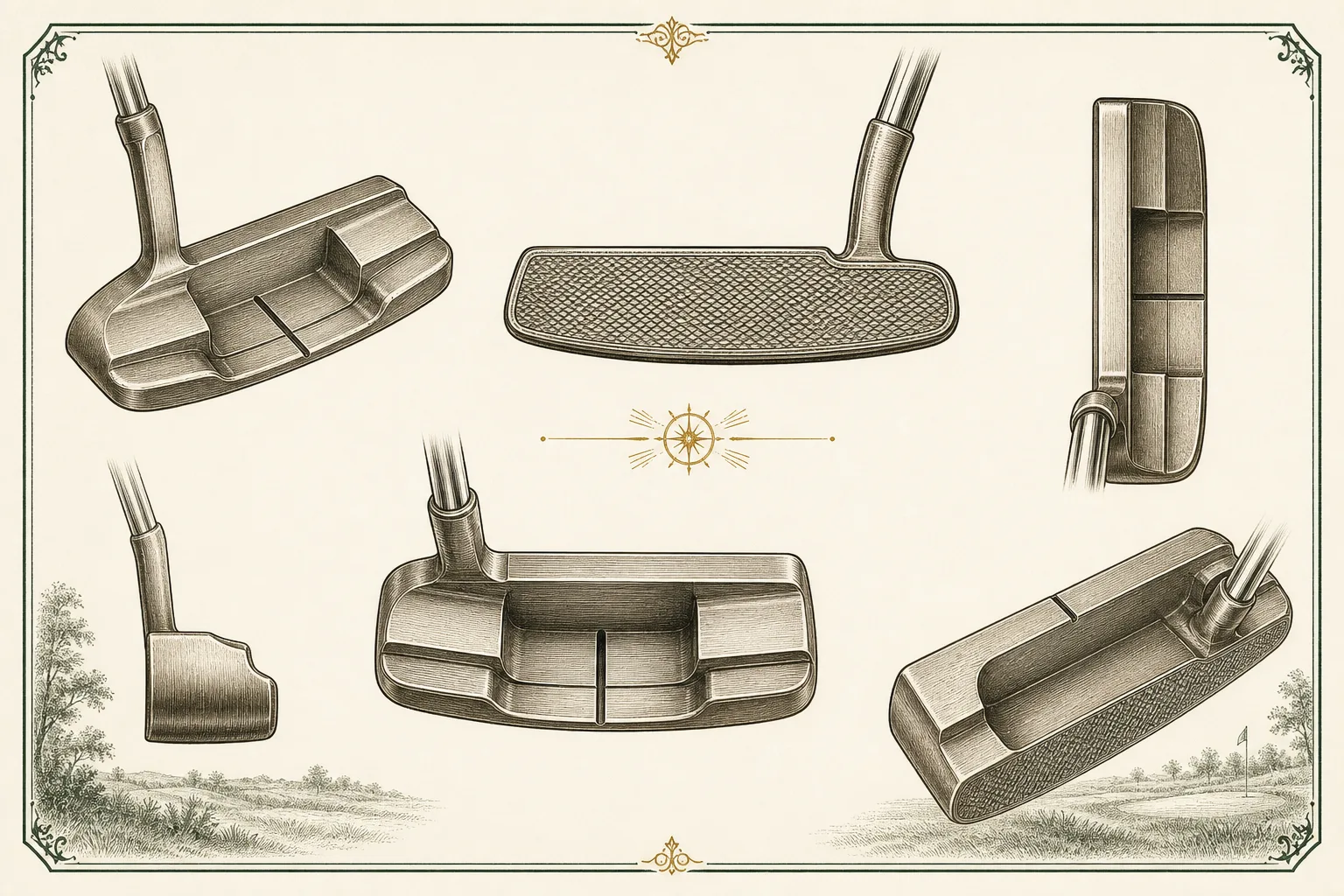
“A stable, compact mallet with a shorter heel-to-toe face that makes centering strikes easier, offered in a counterbalanced build. Near face-balanced, so it favors a straight-back-straight-through stroke.”
The BB32 is a stable, compact mallet built with a shortened heel-to-toe face relative to a blade, making the sweet spot easier to find, and it was offered from the mid-2010s in a Counterbalance (CB) build that added shaft length and grip weight to shift the balance point toward the middle of the club. Bettinardi's counterbalance versions across the BB line (BB1 CB, BB32 CB) retailed at a $50 premium over the standard $299 BB models in 2014, and the BB32 CB specifically ran a heel-shafted plumber's neck with about 1/4 toe hang at roughly 395 grams. Reviewers flagged toe and heel mis-hits as unusually well controlled for the shape, keeping distance loss and dispersion low compared to blades of the same era.
It earned specific, repeated praise in independent reviews for its off-center-strike consistency ('an extremely accurate putter on all accounts,' one reviewer kept it in the bag after testing) rather than generic marketing copy, which is a real signal of quality — but it never generated the collector chase or tour mythology that would push it past 'well-reviewed mallet' into cult territory.
Straight-back-straight-through or very-slight-arc putters who want more stability than a blade without a bulky alignment-aid mallet, and who like the extra swing weight and stroke damping a counterbalanced shaft/grip combination provides. Strong-arc players should look to a toe-hang blade instead.
It launched into the mid-2010s counterbalance-putter wave that also produced the Odyssey Metal-X #7 CH and SeeMore's counterbalanced FGP, as manufacturers chased the stability gains popularized by long/belly putters after the 2016 anchoring ban pushed golfers toward counterbalanced standard-length designs instead.
The shortened face-length mallet shape and near-face-balanced feel meaningfully widen the effective sweet spot versus a blade, and the counterbalanced build's added head/grip weight further steadies the stroke against small strike errors — solid mid-pack forgiveness for a mallet that still reads compact at address, short of the max-MOI BB55/BB56.
Calibrated across the whole catalog — a tour blade scores low here on purpose; it means control, not ease.
Realistic private-party prices for a clean BB32 (standard or CB) run roughly $130-$220 given it has been out of production since 2020 and was a mid-tier BB model at original MSRP of $299-$349; graded-retail listings occasionally price it higher but the everyday resale market sits in that lower band.
Reading is one thing — hitting is another. Book a bay and see the numbers for yourself before you buy anywhere.
“A stable, compact mallet with a shorter heel-to-toe face that makes centering strikes easier, offered in a counterbalanced build. Near face-balanced, so it favors a straight-back-straight-through stroke.”
The BB32 is a stable, compact mallet built with a shortened heel-to-toe face relative to a blade, making the sweet spot easier to find, and it was offered from the mid-2010s in a Counterbalance (CB) build that added shaft length and grip weight to shift the balance point toward the middle of the club. Bettinardi's counterbalance versions across the BB line (BB1 CB, BB32 CB) retailed at a $50 premium over the standard $299 BB models in 2014, and the BB32 CB specifically ran a heel-shafted plumber's neck with about 1/4 toe hang at roughly 395 grams. Reviewers flagged toe and heel mis-hits as unusually well controlled for the shape, keeping distance loss and dispersion low compared to blades of the same era.
It earned specific, repeated praise in independent reviews for its off-center-strike consistency ('an extremely accurate putter on all accounts,' one reviewer kept it in the bag after testing) rather than generic marketing copy, which is a real signal of quality — but it never generated the collector chase or tour mythology that would push it past 'well-reviewed mallet' into cult territory.
Straight-back-straight-through or very-slight-arc putters who want more stability than a blade without a bulky alignment-aid mallet, and who like the extra swing weight and stroke damping a counterbalanced shaft/grip combination provides. Strong-arc players should look to a toe-hang blade instead.
It launched into the mid-2010s counterbalance-putter wave that also produced the Odyssey Metal-X #7 CH and SeeMore's counterbalanced FGP, as manufacturers chased the stability gains popularized by long/belly putters after the 2016 anchoring ban pushed golfers toward counterbalanced standard-length designs instead.
The shortened face-length mallet shape and near-face-balanced feel meaningfully widen the effective sweet spot versus a blade, and the counterbalanced build's added head/grip weight further steadies the stroke against small strike errors — solid mid-pack forgiveness for a mallet that still reads compact at address, short of the max-MOI BB55/BB56.
Calibrated across the whole catalog — a tour blade scores low here on purpose; it means control, not ease.
Realistic private-party prices for a clean BB32 (standard or CB) run roughly $130-$220 given it has been out of production since 2020 and was a mid-tier BB model at original MSRP of $299-$349; graded-retail listings occasionally price it higher but the everyday resale market sits in that lower band.
Reading is one thing — hitting is another. Book a bay and see the numbers for yourself before you buy anywhere.