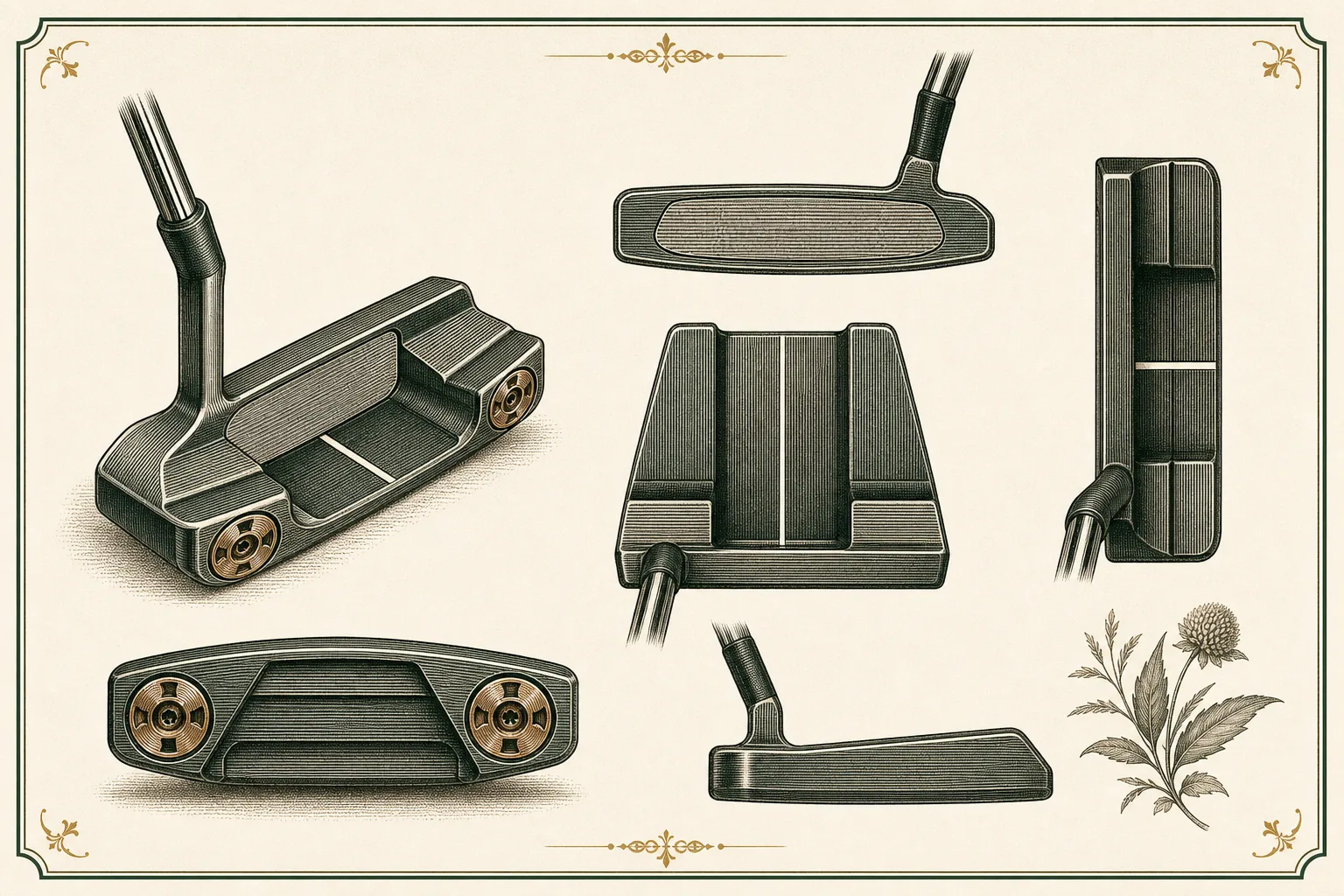
“Edel's Torque Balanced mallet strategically removes toe weight for a toe-up balance point, reducing twisting so the face returns square. Add the fully adjustable alignment and weighting and you get Edel's most technical putter. Great for a player who fights face rotation.”
The EAS 3.0 is the mallet-shaped step-up in Edel's Torque Balanced EAS family, moving further from the blade-derived EAS 1.0/2.0 shapes toward a rounder, higher-MOI head while keeping the line's core idea: strip weight from the toe to create a toe-up balance point that resists face rotation, then let a fitter tune head weight and alignment for the individual player. Golf.com's ClubTest 2022 panel covering the EAS range (1.0, 2.0, and the larger 4.0/5.0 mallets) consistently praised the interchangeable alignment-plate system across the whole family, and the mallet-shaped models were specifically credited with delivering more consistent roll and distance control on off-center strikes than the blade-derived heads.
Same standing as the rest of the EAS line: strong, repeated coverage in specialty equipment press (Golf.com ClubTest, MyGolfSpy, GolfWRX forums) as a well-regarded fitting-first mallet, without ever becoming a tour-pro or mainstream retail phenomenon the way L.A.B. Golf's mallets did.
Good for a player who wants Edel's fitting-first, torque-managed approach but prefers a mallet's larger footprint and higher forgiveness ceiling over the EAS 1.0/2.0 blade-derived shapes. Not for a traditionalist who wants a blade look or is unwilling to go through a fitting.
Released a year after the EAS 1.0/2.0 as Edel extended the same technology into a mallet profile, part of the broader early-2020s trend (alongside L.A.B. Golf and mainstream mallets like Spider/Ten) of putter makers pushing torque-management or MOI as the primary marketing story instead of pure aesthetics.
The mallet shape plus Edel's toe-up Torque Balanced weighting gives it the most built-in stability of the three EAS models — reviewers specifically credited the EAS mallet shapes with more consistent roll and distance control on mis-hits than the blade-derived EAS 1.0/2.0 heads — though it still sits below purpose-built max-MOI mallets like Cure's RX5 or Odyssey's largest Ten shapes.
Calibrated across the whole catalog — a tour blade scores low here on purpose; it means control, not ease.
Roughly $200-300 in 2026; being the newest and highest-MSRP EAS model, it holds slightly more value than the 1.0/2.0, but remains a thin resale market as a discontinued, custom-fit product.
Reading is one thing — hitting is another. Book a bay and see the numbers for yourself before you buy anywhere.
“Edel's Torque Balanced mallet strategically removes toe weight for a toe-up balance point, reducing twisting so the face returns square. Add the fully adjustable alignment and weighting and you get Edel's most technical putter. Great for a player who fights face rotation.”
The EAS 3.0 is the mallet-shaped step-up in Edel's Torque Balanced EAS family, moving further from the blade-derived EAS 1.0/2.0 shapes toward a rounder, higher-MOI head while keeping the line's core idea: strip weight from the toe to create a toe-up balance point that resists face rotation, then let a fitter tune head weight and alignment for the individual player. Golf.com's ClubTest 2022 panel covering the EAS range (1.0, 2.0, and the larger 4.0/5.0 mallets) consistently praised the interchangeable alignment-plate system across the whole family, and the mallet-shaped models were specifically credited with delivering more consistent roll and distance control on off-center strikes than the blade-derived heads.
Same standing as the rest of the EAS line: strong, repeated coverage in specialty equipment press (Golf.com ClubTest, MyGolfSpy, GolfWRX forums) as a well-regarded fitting-first mallet, without ever becoming a tour-pro or mainstream retail phenomenon the way L.A.B. Golf's mallets did.
Good for a player who wants Edel's fitting-first, torque-managed approach but prefers a mallet's larger footprint and higher forgiveness ceiling over the EAS 1.0/2.0 blade-derived shapes. Not for a traditionalist who wants a blade look or is unwilling to go through a fitting.
Released a year after the EAS 1.0/2.0 as Edel extended the same technology into a mallet profile, part of the broader early-2020s trend (alongside L.A.B. Golf and mainstream mallets like Spider/Ten) of putter makers pushing torque-management or MOI as the primary marketing story instead of pure aesthetics.
The mallet shape plus Edel's toe-up Torque Balanced weighting gives it the most built-in stability of the three EAS models — reviewers specifically credited the EAS mallet shapes with more consistent roll and distance control on mis-hits than the blade-derived EAS 1.0/2.0 heads — though it still sits below purpose-built max-MOI mallets like Cure's RX5 or Odyssey's largest Ten shapes.
Calibrated across the whole catalog — a tour blade scores low here on purpose; it means control, not ease.
Roughly $200-300 in 2026; being the newest and highest-MSRP EAS model, it holds slightly more value than the 1.0/2.0, but remains a thin resale market as a discontinued, custom-fit product.
Reading is one thing — hitting is another. Book a bay and see the numbers for yourself before you buy anywhere.