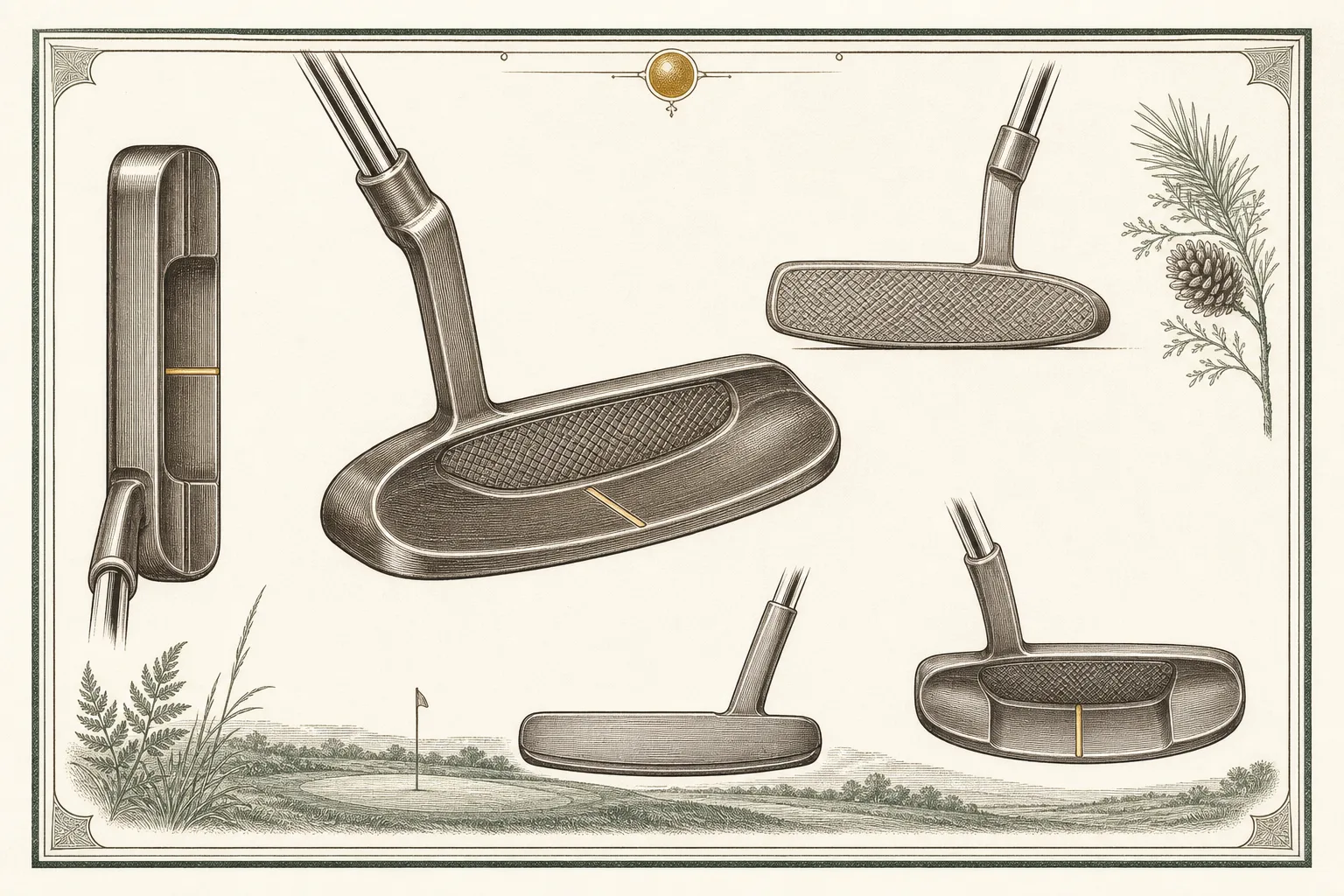
“The Classic series brings Cure's adjustable weight and lie technology into more conventional, less oversized head shapes. Still high MOI and face-balanced, it suits a straight stroke with a more traditional look.”
Cure's Classic Series took the brand's signature high-MOI, adjustable-weight engineering -- the same idea behind its RX-series mallets -- and put it inside a traditional blade shape instead of an oversized mallet. Launched in fall 2015 as the CX1 (square-back) and CX2 (round-back), both are 100% CNC-milled from aluminum with a 5-inch blade length and tungsten weight inserts in the heel and toe, roughly a half-inch longer and a quarter-inch deeper in the face than a typical modern blade. Six removable weight screws let a fitter swing total head weight from 334g to 376g (CX1) or 342g to 384g (CX2), pushing MOI to roughly 6,400-7,350 g/cm-squared -- figures that rival dedicated high-MOI mallets despite the classic blade silhouette. The Classic Series earned a spot on Golf Digest's March 2016 Hot List in the Blade category, scoring 4.5/5 for Innovation and 4/5 for Performance.
Independent, juried recognition (Golf Digest Hot List, Blade category, March 2016) plus a distinct engineering claim -- high-MOI numbers rivaling oversized mallets inside a blade shape -- gives this real standing beyond marketing copy. It has not built the enduring forum-hunt cult of a true classic, but the Hot List placement is a genuine third-party signal most putters lack.
Golfers who want the visual and feel preferences of a traditional blade putter but do not want to give up the stability and mis-hit forgiveness of a modern high-MOI mallet -- essentially a bridge product for blade-loyalists who are stats-curious about MOI technology. A golfer who wants maximum forgiveness above all else should still look at Cure's own RX-series oversize mallets instead.
Cure's own company history and contemporaneous coverage place the CX1/CX2 launch in fall 2015, with a 2017 refresh adding subtle head-shape and alignment updates. The Classic Series is explicitly a blade-shaped putter (Cure's own marketing contrasts it with the RX-series mallets), not a mallet. It launched alongside a broader mid-2010s wave of MOI-focused putters (Odyssey O-Works, TaylorMade Spider) but distinguished itself by putting the technology in a blade rather than a mallet shape.
Unusually forgiving for a blade-shaped putter: the deep, long face and heel/toe tungsten weighting push MOI into territory that rivals purpose-built high-MOI mallets (roughly 6,400-7,350 g/cm-squared depending on weight configuration), well above a traditional blade's typical range. Scored below Cure's own RX-series mallets because the more compact blade profile still cannot match an oversized mallet's raw polar moment, but well above a conventional blade like a Scotty Cameron Newport.
Calibrated across the whole catalog — a tour blade scores low here on purpose; it means control, not ease.
Used CX1/CX2 examples commonly sell for $120-$200 in 2026 depending on condition and included weights, down from the $299.95 original retail -- a typical mid-tier putter depreciation curve. Complete weight kits (all six screws present) command a premium over incomplete sets, since replacement weights are a specialty order.
Reading is one thing — hitting is another. Book a bay and see the numbers for yourself before you buy anywhere.
“The Classic series brings Cure's adjustable weight and lie technology into more conventional, less oversized head shapes. Still high MOI and face-balanced, it suits a straight stroke with a more traditional look.”
Cure's Classic Series took the brand's signature high-MOI, adjustable-weight engineering -- the same idea behind its RX-series mallets -- and put it inside a traditional blade shape instead of an oversized mallet. Launched in fall 2015 as the CX1 (square-back) and CX2 (round-back), both are 100% CNC-milled from aluminum with a 5-inch blade length and tungsten weight inserts in the heel and toe, roughly a half-inch longer and a quarter-inch deeper in the face than a typical modern blade. Six removable weight screws let a fitter swing total head weight from 334g to 376g (CX1) or 342g to 384g (CX2), pushing MOI to roughly 6,400-7,350 g/cm-squared -- figures that rival dedicated high-MOI mallets despite the classic blade silhouette. The Classic Series earned a spot on Golf Digest's March 2016 Hot List in the Blade category, scoring 4.5/5 for Innovation and 4/5 for Performance.
Independent, juried recognition (Golf Digest Hot List, Blade category, March 2016) plus a distinct engineering claim -- high-MOI numbers rivaling oversized mallets inside a blade shape -- gives this real standing beyond marketing copy. It has not built the enduring forum-hunt cult of a true classic, but the Hot List placement is a genuine third-party signal most putters lack.
Golfers who want the visual and feel preferences of a traditional blade putter but do not want to give up the stability and mis-hit forgiveness of a modern high-MOI mallet -- essentially a bridge product for blade-loyalists who are stats-curious about MOI technology. A golfer who wants maximum forgiveness above all else should still look at Cure's own RX-series oversize mallets instead.
Cure's own company history and contemporaneous coverage place the CX1/CX2 launch in fall 2015, with a 2017 refresh adding subtle head-shape and alignment updates. The Classic Series is explicitly a blade-shaped putter (Cure's own marketing contrasts it with the RX-series mallets), not a mallet. It launched alongside a broader mid-2010s wave of MOI-focused putters (Odyssey O-Works, TaylorMade Spider) but distinguished itself by putting the technology in a blade rather than a mallet shape.
Unusually forgiving for a blade-shaped putter: the deep, long face and heel/toe tungsten weighting push MOI into territory that rivals purpose-built high-MOI mallets (roughly 6,400-7,350 g/cm-squared depending on weight configuration), well above a traditional blade's typical range. Scored below Cure's own RX-series mallets because the more compact blade profile still cannot match an oversized mallet's raw polar moment, but well above a conventional blade like a Scotty Cameron Newport.
Calibrated across the whole catalog — a tour blade scores low here on purpose; it means control, not ease.
Used CX1/CX2 examples commonly sell for $120-$200 in 2026 depending on condition and included weights, down from the $299.95 original retail -- a typical mid-tier putter depreciation curve. Complete weight kits (all six screws present) command a premium over incomplete sets, since replacement weights are a specialty order.
Reading is one thing — hitting is another. Book a bay and see the numbers for yourself before you buy anywhere.