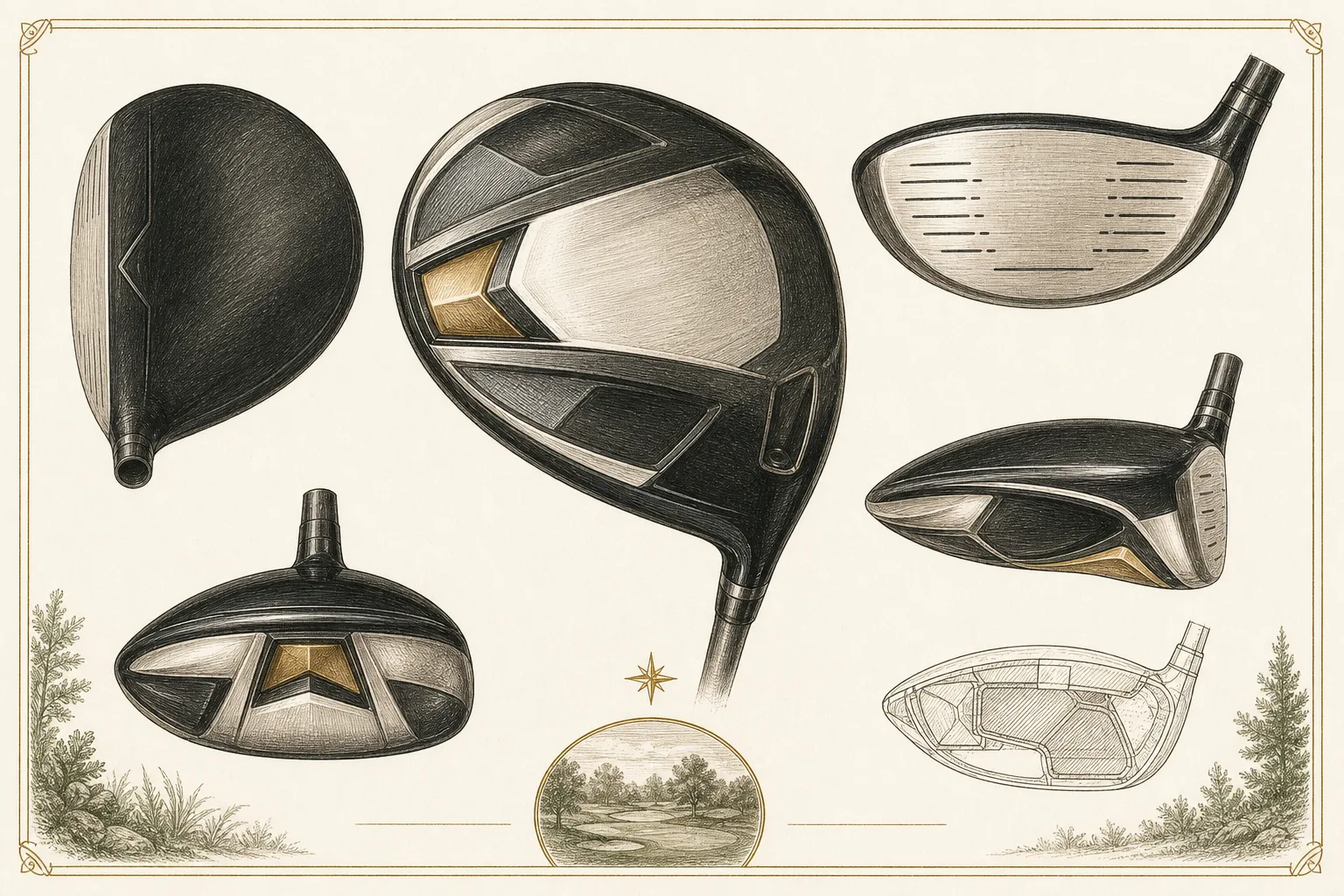
“Aero-tuned Forged Composite head, also in a low-spin Tour version. A capable standard driver; treat as a value buy today.”
The RAZR Hawk driver headlined Callaway's 2011 line with Forged Composite, a lightweight crown/body material co-developed with Lamborghini that let engineers precisely tune wall thickness — thinner where weight needed to come out, thicker where structure mattered — rather than accept the uniform properties of cast titanium. Paired with Callaway's Hyperbolic Face Technology (a thicker center tapering to a thinner perimeter) at a 460cc head size and a 46-inch shaft, it was aimed squarely at aerodynamic drag reduction to help players swing faster. A companion RAZR Hawk Tour version offered lower stock lofts (8.5°/9.5°/10.5°) for better players. Contemporary club testing found some testers hitting it as much as 20 yards farther than their gamer driver, with consistent results even on mis-hits.
A strongly reviewed flagship in its year — PGA.com's ClubTest rated it among the top drivers tested for 2011, and the Lamborghini materials-science story was widely covered — but not a cult classic: it was a mainstream annual release superseded within a year by the RAZR Fit's OptiFit adjustability, with no lasting scarcity or forum-hunted reputation today.
Golfers wanting an easy-swinging, fast-feeling 460cc driver with no adjustability to fuss over — a simple, well-reviewed gamer for its era. A player specifically wanting fitting flexibility (face angle, draw bias) should note this predates OptiFit and look instead at the following year's RAZR Fit, which added that adjustability on the same design lineage.
Released in 2011 as Callaway's flagship driver, the same year it introduced the Forged Composite/Lamborghini partnership across its driver and fairway wood lines, competing with TaylorMade's Burner SuperFast 2.0 and Titleist's 910D2/D3. It was replaced the following year by the RAZR Fit, which added the OptiFit adjustable hosel Callaway had not yet built into the Hawk.
Good forgiveness for a 2011 460cc driver: Hyperbolic Face Technology was specifically built to hold ball speed away from center, and period testers reported consistent distance gains even on mis-hits. It predates the true adjustable-weighting, ultra-high-MOI drivers that followed within a few years, so by modern standards it is a solidly-but-not-exceptionally forgiving head.
Calibrated across the whole catalog — a tour blade scores low here on purpose; it means control, not ease.
Realistic private-party price in 2026 is roughly $30-$55 for a clean head-and-shaft combo (original MSRP $399); the Lamborghini-materials story adds no measurable collector premium today, and value tracks condition and shaft like any other 15-year-old mainstream driver.
Reading is one thing — hitting is another. Book a bay and see the numbers for yourself before you buy anywhere.