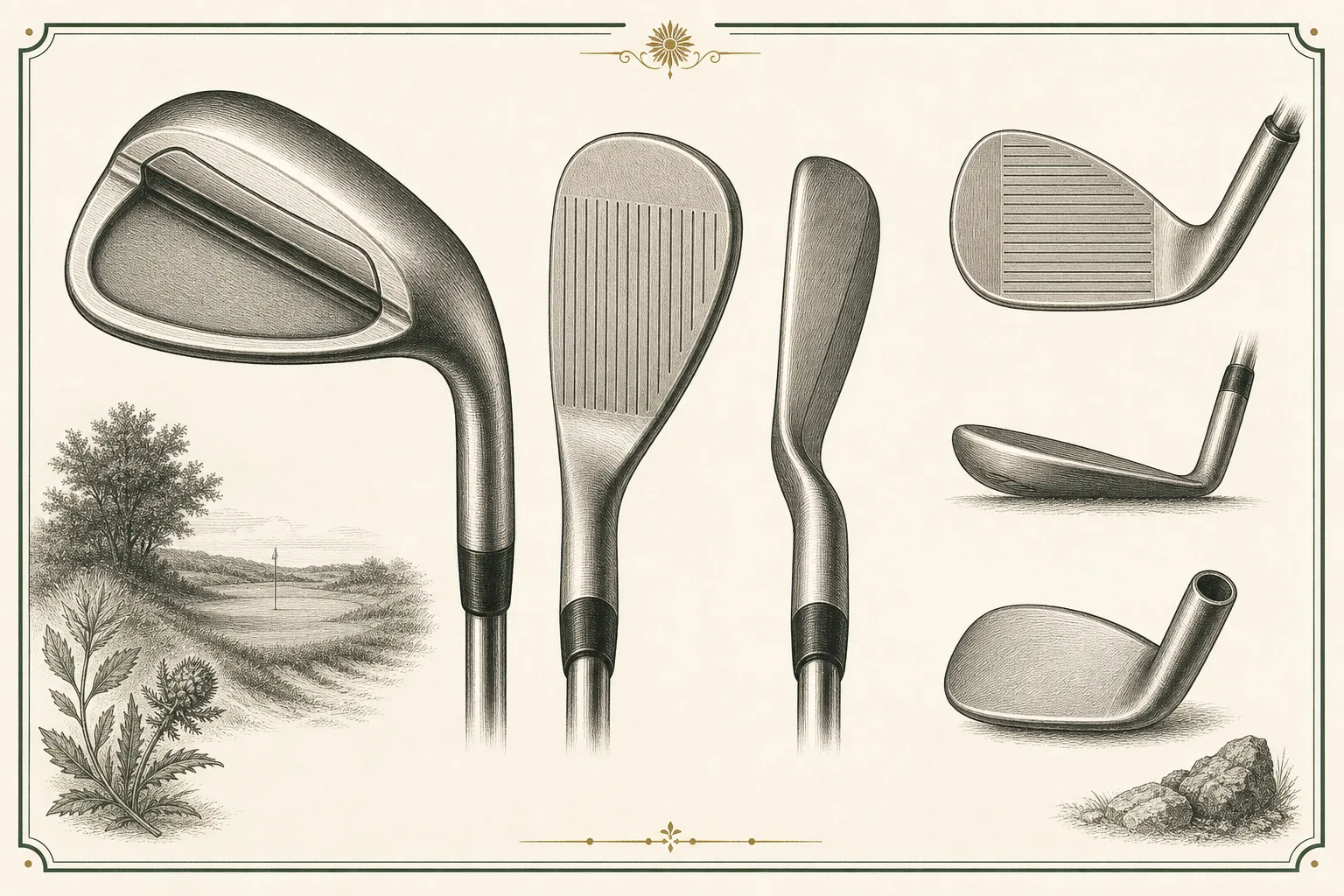
“Ping's tour wedge before the Glide line, with W (wide) and S (thin) sole options. Steel players' wedge; identity club.”
Ping's Tour wedge line covered two closely related tools sold side by side: the Tour-W (softer stainless, teardrop head, a tungsten toe weight and a small Custom Tuning Port to raise MOI) and the Tour-S (a brushed-chrome, tour-legal-groove update aimed at players wanting a cleaner look and firmer feel). For 2012 Ping widened the fitting matrix to three sole widths per loft — Thin Sole for tight lies, Standard for everyday turf, and Wide for soft ground — with the rear third of the sole aggressively relieved to open the face for flop shots. It sat in Ping's line as the tour-oriented wedge below the fully custom Tour-S/W grind work its staff used, before being folded into the Glide family in 2015.
Well-regarded in enthusiast reviews (Golf Monthly, Today's Golfer, Golfalot all gave it strong marks for feel and sole versatility) and it anchored Ping's wedge business for several years, but it never became a legend the way the Eye 2 or the Vokey line did — it was superseded cleanly by Glide in 2015 and isn't chased on the secondary market beyond ordinary demand for a decent used wedge.
Golfers who want a tour-style, workable wedge and are willing to be fit into the right sole grind for their turf and attack angle — mid-to-low handicaps who spin/flight wedges intentionally. A high-handicapper who just needs to get the ball out reliably would do better with a wider, more forgiving modern GI wedge.
Launched into a wedge market dominated by Titleist Vokey Spin Milled/SM4-5 and Cleveland CG line; Ping's answer was fitting depth (sole widths) rather than groove marketing. It was replaced by Ping Glide (2015), then Glide 2.0/3.0/4.0/Forged — the sole-width fitting concept carried forward into those lines.
A tungsten toe weight and CTP nudge the CG toward more stability than a pure blade wedge, and the three-sole-width fitting system is specifically there to rescue strikes from bad lies, but wedges as a class are compact, thin-soled, and unforgiving of anything but a clean strike — this sits mid-pack for its category, not high in absolute terms.
Calibrated across the whole catalog — a tour blade scores low here on purpose; it means control, not ease.
Realistic 2026 private-party prices are low, as with most 10+ year old wedges: single wedges commonly sell for roughly $25-70 on eBay depending on condition and grind, with well-worn examples at the bottom of that range. This is a using-tool price, not a collector one.
Reading is one thing — hitting is another. Book a bay and see the numbers for yourself before you buy anywhere.
“Ping's tour wedge before the Glide line, with W (wide) and S (thin) sole options. Steel players' wedge; identity club.”
Ping's Tour wedge line covered two closely related tools sold side by side: the Tour-W (softer stainless, teardrop head, a tungsten toe weight and a small Custom Tuning Port to raise MOI) and the Tour-S (a brushed-chrome, tour-legal-groove update aimed at players wanting a cleaner look and firmer feel). For 2012 Ping widened the fitting matrix to three sole widths per loft — Thin Sole for tight lies, Standard for everyday turf, and Wide for soft ground — with the rear third of the sole aggressively relieved to open the face for flop shots. It sat in Ping's line as the tour-oriented wedge below the fully custom Tour-S/W grind work its staff used, before being folded into the Glide family in 2015.
Well-regarded in enthusiast reviews (Golf Monthly, Today's Golfer, Golfalot all gave it strong marks for feel and sole versatility) and it anchored Ping's wedge business for several years, but it never became a legend the way the Eye 2 or the Vokey line did — it was superseded cleanly by Glide in 2015 and isn't chased on the secondary market beyond ordinary demand for a decent used wedge.
Golfers who want a tour-style, workable wedge and are willing to be fit into the right sole grind for their turf and attack angle — mid-to-low handicaps who spin/flight wedges intentionally. A high-handicapper who just needs to get the ball out reliably would do better with a wider, more forgiving modern GI wedge.
Launched into a wedge market dominated by Titleist Vokey Spin Milled/SM4-5 and Cleveland CG line; Ping's answer was fitting depth (sole widths) rather than groove marketing. It was replaced by Ping Glide (2015), then Glide 2.0/3.0/4.0/Forged — the sole-width fitting concept carried forward into those lines.
A tungsten toe weight and CTP nudge the CG toward more stability than a pure blade wedge, and the three-sole-width fitting system is specifically there to rescue strikes from bad lies, but wedges as a class are compact, thin-soled, and unforgiving of anything but a clean strike — this sits mid-pack for its category, not high in absolute terms.
Calibrated across the whole catalog — a tour blade scores low here on purpose; it means control, not ease.
Realistic 2026 private-party prices are low, as with most 10+ year old wedges: single wedges commonly sell for roughly $25-70 on eBay depending on condition and grind, with well-worn examples at the bottom of that range. This is a using-tool price, not a collector one.
Reading is one thing — hitting is another. Book a bay and see the numbers for yourself before you buy anywhere.